
In their Memories of the first premieres of my operasdictated already in old age, Richard Strauss humorously evokes Marie Wittich’s protests during rehearsals for the Dresden premiere of Salomein December 1905. The Wagnerian soprano – and wife of a prominent Saxon official – reproached him for having written her an impossible role: playing a 16-year-old princess with the vocal density of an Isolde. “That is not done, Mr. Strauss”: a biblical teenager cannot subdue an orchestra of 100 teachers, nor can an oriental virgin sing like a Wagnerian heroine.
Strauss admitted that Wittich was absolutely right and that his complexion prevented him from embodying that impossible. And yet, several sopranos have touched it on stage: from Ljuba Welitsch to Asmik Grigorian, including Anja Silja and Catherine Malfitano. A Viennese critic invoked precisely these last two when writing about Vida Miknevičiūtė in 2023. The Lithuanian soprano, in full vocal maturity at 46 years old, debuted as Salome shortly before the pandemic, in Melbourne, and since then she has triumphed with the role in Vienna, Helsinki, Munich, Milan and Berlin, in productions signed by Christof Loy, Krzysztof Warlikowski, Claus Guth and Damiano Michieletto.
His Valencian Salome, premiered on April 25 in the excellent season at the Palau de Les Arts, confirms this trail. He dominates the character from his first appearance on stage, when he leaves Herod’s banquet to take to the night air to the sound of a decadent Viennese waltz. He avoids the predominant hysterical archetype and replaces it with an awakened, ironic and perverse look, sustained by economic movements and not at all imposed. Added to this is a bright and compact timbre, with frank emission and exquisitely nuanced high notes, enhanced by a very expressive slight vibrato.
But it was her vocal stamina in the demanding final scene that captivated the audience. The Lithuanian held with astonishing firmness and musical authority that impressive symphonic poem with voice, where Strauss recapitulates most of the opera’s motifs. And she turned the ending, when she repeats, filled with pleasure: “I have kissed your mouth, Jochanaan,” while crossing the brilliant orchestral wall in C-sharp major with sharp sharp edges like knives, into something difficult to forget.
The rest of the cast was not far behind. Nicholas Brownlee shared ovations with Miknevičiūtė as excellent Jochanaan. This 37-year-old American bass-baritone had already triumphed last season at Les Arts with The Flying Dutchmanby Wagner. He effortlessly imposed his singing offstage, with a corporeal center and metallic shine, and composed a prophet that was more energetic than hieratic, with a very attractive bass, although less cavernous than usual.
Tenor John Daszak is a reference Herod, in which he combines a powerful acting portrait—without histrionics and notable psychological complexity—of the decadent and libidinous tetrarch of Judea with an unusual vocal quality. The mezzo-soprano Michaela Schuster embodies an ideally mean and haughty Herodias, and intelligently manages the limitations at the ends of her instrument. And her colleague, somewhat more veteran, Lioba Braun was a luxury as Herodias’s Page, although in this production she becomes a nurse constantly present on stage.
Special mention deserves the young Wagnerian tenor Christopher Sokolowski, who made his debut as Narraboth, and opened the opera with ideal lyrical brilliance, although the production mistakenly turns him into a pushover. Among the numerous supporting roles, in addition to the Asturian tenor Jorge Rodríguez-Norton as the First Jew and several names from the Center de Perfectionament, the young Czech baritone Jiří Rajniš stood out as the First Nazarene.
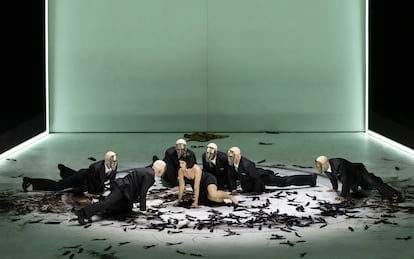
The other architect of the success of this Salomein addition to Miknevičiūtė, was James Gaffigan. The American director, former musical director of Les Arts, returned to the pit of the Valencian theater in full operatic progression: current musical director of the Komische Oper in Berlin and appointed to the Houston Opera. Gaffigan went through Strauss’ score with structural clarity, plane transparency and rhythmic precision, attentive to its most expressionist details, although without neglecting the timbral opulence in front of an orchestra and a pit that he knows well. His direction especially shone in a sharp and sensual Dance of the seven veilswhich contrasted with the stylized sexual violence seen on stage.
The contrast was not accidental: the weakest point of the production is the stage direction of the Italian Damiano Michieletto, where his insistence on inserting a current topic once again becomes a liability. After denouncing sexual tourism in Madama Butterfly (Teatro Real, 2024) and sexist violence in Carmen (2025), now moves to Salome the consequences of child abuse.
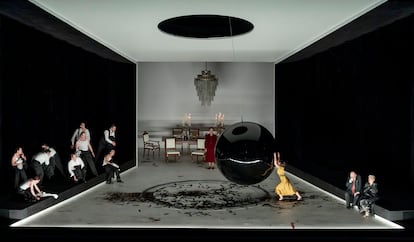
The production, premiered at La Scala in 2021 without an audience and revived there in 2023, proposes a psychoanalytic and ritualistic reading that rewrites the drama of Oscar Wilde and Richard Strauss as a family tragedy of Shakespearean inspiration, close to Hamlet. The focus shifts to the fratricide of Herod Philip at the hands of his usurping brother, with Herodias as Gertrude and a Jochanaan transformed into a paternal ghost: an underground voice that emerges from a cistern converted into the father’s tomb with a mound/altar with his name to unearth the repressed truth of the clan.
Paolo Fantin’s set design configures a white box with black walls presided over by a moon converted into a giant pendulum, articulating a chromatic progression from black to white to blood red. Carla Teti’s costumes introduce suggestions of the Viennese Secession in the female characters, while Alessandro Carletti’s lighting reinforces the ritual substratum. Five black-winged angels officiate at the sacrifice of the Agnus Dei and they project Salome as a martyr close to Saint Agnes, taking advantage of the Agnes/Agnus analogy.
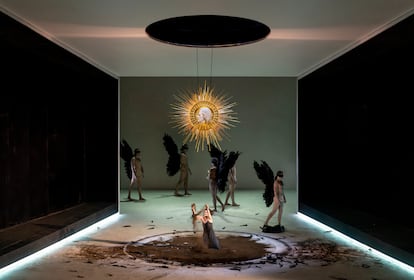
The most personal—and problematic—gesture is the inclusion of a child double of Salome, which makes the trauma explicit and turns the Dance of the seven veils in a flashback of the abuse he suffered. In the final scene, the protagonist takes off her wig and reveals a shaved head as a sign of her martyrdom. The premiere audience responded with enthusiasm, but the price of this symbolic overload is very high.
In the hands of Michieletto, Salome It becomes a traumatic reading that nullifies its blasphemous eroticism and its turn-of-the-century scandal. The redefinition of the rest of the characters erases their dramatic profiles—Narraboth reduced to a faint-hearted accountant, the Page turned into a wet nurse—and empties the supporting characters: the five Jews lose their theological dispute in favor of an irrelevant pantomime, while soldiers and Nazarenes remain as troupes in smoking. Added to this is the absence of true direction of actors: the scene, converted into a succession of living paintingsends up devouring the drama. A Salome visually brilliant, but theatrically muted.
There is one detail of this production that Richard Strauss himself would undoubtedly have applauded: the conversion of Jochanaan’s head into a stone altar. A way to conjure precisely that fashion that the composer came to regret in writing in his Memories: “What those exotic variety show stars indulged in in later performances, with their serpentine movements and brandishing Jochanaan’s head in the air, often exceeded all measures of decorum and good taste!”
‘Salome’
Music by Richard Strauss. Libretto by Richard Strauss, based on Hedwig Lachmann’s German translation of the French drama Salome (1891) the Oscar Wilde.
Vida Miknevičiūtė, soprano (Salome); John Daszak, tenor (Herod); Michaela Schuster, mezzo-soprano (Herodias); Nicholas Brownlee, bass-baritone (Jochanan); Christopher Sokolowski, tenor (Narraboth); Lioba Brown, mezzo-soprano (Witch of Herodias); Jorge Rodriguez-Norton, Daniel Norman, Filipp Modestov, Mathias Frey, tenors & Horst Lamnek, baritone (Cinco judíos); Jiří Rajniš, baritone & Agshin Khudaverdiyev, tenor (Two Nazarenes); Take Bibiloni, baritone & Alexander Milev, low (Two soldiers); Agustín Albornoz, low (A Cappadocian) and Pablo Rubín-Jurado, tenor (A slave).
Orchestra of the Valencian Community.
musical direction: James Gaffigan.
stage direction: Damiano Michieletto.
Palau de les Arts, April 25. Until May 9.