
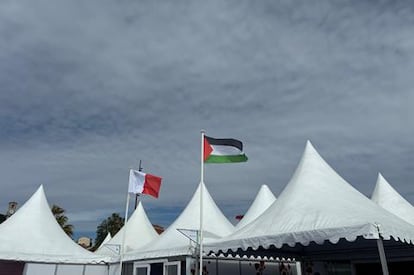
Outside the Festival Palace, about a hundred meters from its main entrance, is the Villa Internacional del Pantiero, a set of pavilions – actually, stands halfway between a booth and a pergola – that houses national film institutions. And there, on 206, is the Palestine Film Institute, struggling to find its own echo with meetings, project samples and requests for solidarity.
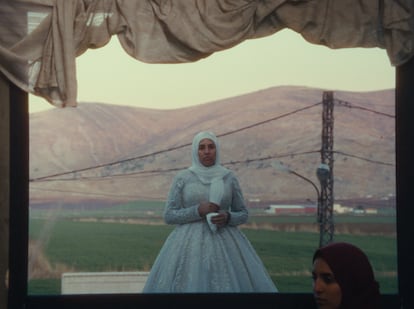
That Palestine has its voice in the Cannes market is due to the international contribution of funds (from Scotland to the Visions du Réel festival), and its workers and panelists are volunteers from different countries. It is the fourth time that Palestine has had an industrial presence in Cannes. And yes, they have aroused some interest, as Angel Cheng, the person in charge of relations with the media, points out: “It can be seen in the presence of listeners at the talks. There are attractive documentaries and many projects.” At the festival, in the Un Certain Regard section, the Palestinian co-production is screened Yesterday The Eye Didn’t Sleep, by Rakan Mayasis (a Palestinian born in Germany who currently lives in Lebanon), a story of two Bedouin sisters in the Bekaa Valley, between Lebanon and Syria. In addition, the Palestinian delegation is made up of about forty filmmakers, including directors and producers, and they have concentrated their events from May 15 to 20.
And although there is obvious political activism, there is also an effort to understand its industrial commitment. As a message, from the Palestine Film Institute they assure: “We maintain our commitment to supporting Palestinian filmmakers, building networks of global solidarity and guaranteeing that Palestinian cinema continues to challenge silence and complicity. Cinema is memory, cinema is resistance.”
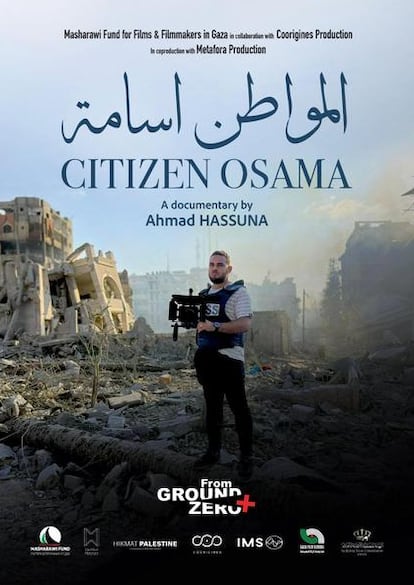
But on a Monday morning in the Palestinian pavilion, cinema is also a lesson. The organizers show their film school on a screen, all online. About twenty people attend, who will later see some movie previews, such as Citizen Osama, by Ahmed Hassouna, which portrays the life of a photojournalist and family man in Gaza, and which can be seen in screenings at the Cannes market.
The Institute was founded in 2019, and is currently led by an eclectic trio: Palestinian-American engineer and activist Abu Ayyash; the co-founder of the organization Mohanad Yaqubi, a filmmaker who lives in Brussels; and the Serbian-Palestinian producer Rashid Abderhamid.
For the Institute, they assure EL PAÍS, “the presence in Cannes is as important as finding financial mechanisms” that guarantee its annual presence in the market. “We seek stability while showing our artistic possibilities.” And they struggle so that this presence does not serve only as a mere accompaniment when they have films selected in the contest.
Complex trips
Nothing is easy for Palestinians. For example, for Dima Yousef Hasan Yasin, born in Jerusalem, with a Jordanian passport and a valid visa to enter France. She was invited by the Institute to Cannes. And then, at the end of May, he will travel to Saintes for four weeks to finish the post-production of his film It Must Be Home. When he landed last Friday at the Paris Roissy Charles-de-Gaulle airport from Tel-Aviv, a double impression on his passport (actually a moved stamp) caused him to spend the night in a detention center, until a Green MEP called attention to the error, France3 reported. At mid-afternoon on Saturday he finally arrived at the contest.
It is not an isolated case. Earlier this week, several directors, including Costa-Gavras and Claire Simon, signed an article in the newspaper Liberation to warn about the situation of Mohamed Alshareef. The filmmaker lives in Gaza, where he struggles to leave. Also invited by the Institute, he should have presented his film at the pavilion They are super. He has not yet managed to leave the Strip.
They do not forget the industrial aspect. On Sunday, Yakubi, in a meeting with the press, pointed out: “If we do not have filmmakers who care about machinery and the industrial process, we will not be able to control the story.”
The documentary meeting ends. Cheng appreciates Spain’s “firm support against the genocide in Gaza.” The mere mention of Javier Bardem makes the volunteers smile from ear to ear.