
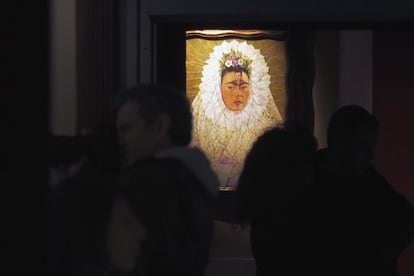
The fate of a few released, riveras y orozcos It has Mexico on edge, to the point of almost becoming a state issue. Since the announcement at the beginning of the year of the transfer of the Gelman collection to Banco Santander, a formidable dust storm has arisen that has forced the intervention of the president, Claudia Sheinbaum, to try to clear up the mess. Part of the Mexican art sector accuses the Government of favored treatment, opacity and lack of protection of a collection whose heart is protected by a strict heritage law, which limits the departure of emblematic works from the country in a delicate balance with private businesses. EL PAÍS has followed in the footsteps of the latest movements of the group, valued at 356 million dollars. This is the story of how a million-dollar and common movement in the art market has ended up becoming a phenomenal mess with three protagonists: the Mexican owner, the Spanish bank and the Government, in charge of supervising the protected works. Including a loan for 150 million dollars granted by Santander to the Mexican collector, for which the collection (156 works) appears as collateral for the credit.
The Zambranos are a powerful family of the industrial bourgeoisie of northern Mexico. They are owners of the largest cement company in the country, Cemex, and they also have, like almost all great fortunes, a tradition in art collecting. Following in this wake, Marcelo Zambrano, third generation of the saga and director of Cemex, decides to embark on a high-flying operation: to acquire one of the most important collections of modern Mexican art, the Gelman collection, which for decades had a long history of intrigues and mysteries. At the end of 2020, the entrepreneur acquires at least a first part of it. The transaction was recorded in the annual tax return of the Vergel Foundation, owned by the American executor who controlled the collection after the death of the original owners.
Since then, Zambrano begins to discreetly move the collection, seeking financing to face a million-dollar operation. On October 11, 2023, he obtained a first loan from the financial arm of the Sotheby’s auction house, as the specialized media reported. Arteinformado and has been able to verify this diary with public documents from the Property Registry of the District of Columbia. The loan is granted in favor of Arte Mexicano por el Mundo, LLC and Comercializadora de Arte del Noreste, the companies established by the businessman in the United States and Mexico, respectively, to exploit the collection, which had been in limbo for years without being exhibited or appearing in the public eye.
Years go by and the works remain in reserve. Until at the end of 2024, when the Zambranos already owned the Gelman, the collection made headlines at an auction held by Sotheby’s in New York.. Then, the Government paralyzes the sale of a left maryone of the authors protected by the heritage law and who did not have permission to be in the United States. In addition, Mexican authorities force the sale in Mexico – instead of New York – of a siqueirosanother of the armored authors. The rest of the works, around thirty, were sold in what was the first contact with the art market since the Zambranos entered the scene.
The next public movement is from January 21 of this year. Banco Santander announces an agreement with the Zambranos for the management of part of the collection – 160 of some 300 works – and its exhibition as the main course of the new cultural center, Faro Santander, which the bank will inaugurate in June of this year in the capital of Cantabria. That announcement lit the fuse of criticism, which demanded more clarity about the terms of the agreement and, above all, the role of the National Institute of Fine Arts (INBAL), which must authorize and supervise any departure of the heart of the collection outside of Mexico.
The statements that day by Daniel Vega Pérez, director of the new Faro Santander, did not help, pointing out that “it is flexible legislation.” Nor the contradictory figures that Mexican authorities gave while criticism grew. First they said five years, which is actually the term of the management agreement in favor of Santander, not the export agreements for the works. Then, two years, the usual period in these cases, which had to be confirmed by Sheinbaum herself, who assured that they would return to Mexico in 2028.
Santander’s credit
A crucial and unknown fact until now is that just a week before that press conference in Spain, on January 8, Santander granted a new loan to Marcelo Zambrano for 150 million dollars, which refinanced the previous one granted by Sotheby’s Financial Services. According to the contract registered with the Mexican Ministry of Economy, consulted by this newspaper, the collection – 156 works, valued at 356 million dollars – serves as collateral for the loan that has a term of 12 and a half years.
The agreement, also registered in the database of the District of Columbia in the United States, in this case without figures, details the operation of this type of operations, similar, for example, to that of credit to buy a house, which remains as a guarantee in case of non-payment. This opens a theoretical door for Santander to become the owner of the collection, although sources close to the negotiations point out that “there are formulas to refinance the credits and not reach that scenario.” In the environment of the family of collectors they add that the entire legal framework “is strictly attached to compliance with Mexican laws.”
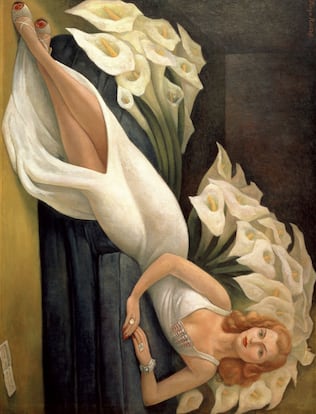
The jewel that supports the credit, it was already known, is for the artist Frida Kahlo. She is also the banner of the protests of the Mexican artistic sector, which, in addition to demanding more transparency from INBAL, observes with regret how the country’s modern heritage is fragmented abroad, despite the express wishes of the Gelman couple that it remain united and within Mexico. Diego in my thoughts: 67.5 million dollars. Self-portrait with monkeys: 45 million. Another 45 million guaranteed by The embrace of love from the Universe… Gold, silver and bronze for the pop icon, who presides over a large inventory where Diego Rivera, José Clemente Orozco, David Alfaro Siqueiros and María Izquierdo also rub shoulders. Only fifteen of the works by Frida and Diego represent 97% of the price of the set, such is the value of the impressive marriage of artists. The list is long and confirms what sources in the sector have told the newspaper: that bank loans, common in the artistic world, usually cover approximately half of the value of the collections.
Most of the artists that appear in the inventory have been declared National Artistic Monuments, and this is the most sensitive point and the one that raises the most dust, since the financial movements carried out in this operation are common practice in the market. The regulations limit the departure of works covered under that umbrella and, in the case of Frida Kahlo, which has the most severe declaration, prohibits their definitive export and orders the authorities to do everything possible to make their repatriation effective. When consulted by this newspaper, INBAL has not made any comments.
From Banco Santander they emphasize that they do not make specific comments about their clients, reports Manuel Morales. And they add that “in any case, the relationship that Santander may have with the Zambrano family is accessory to the management and preservation of the Gelman collection. Under no circumstances will the collection leave Mexico outside of the agreement in force, that is, always within the framework of a temporary export authorized by INBAL and in accordance with Mexican legislation.”
The export of the works
The most critical Mexican collectors and curators point out that, despite it being already clarified that the permission to export the works is the usual two years, and not the five originally announced, the INBAL has been more lax in this case than in others. “INBAL had been very strict with permits until now,” says a professional who participated in the sector’s public letter that asked for greater transparency from the Government in the agreements reached.
That same source points out that four Frida Kahlo oil paintings have been for sale in Mexico for years, but they are not sold because they have been priced on the international market and no one is willing to pay for works that cannot leave the country. “This Santander thing has set a precedent, now collectors are going to start asking for the same thing,” he adds.
The plan to make the most of the collection does not end in its fragmented sale or in its international tour, as planned, with stops every two years in Mexico to reassess the state of the works. Between December of last year and January of this year, applications have been submitted to register the trademark Gelman Collection in the European Union (EU), Mexico and the United States. In the EU it has been definitively published this Friday, April 24. This registration, carried out by Zambrano’s company, protects the brand from any commercial use, from the printing of plates or books to the downloading of files authenticated through tokensthrough cultural events or educational services.
While the owners advance their collection management plan, controversy grows within the country. The biennial returns to Mexico do not satisfy the most critical, who also fear that the works cannot withstand the transfers, nor do they solve the underlying problem: a precarious public policy when it comes to protecting the country’s modern heritage.
This fall, the Gelman collection will be the highlight at the inauguration of the Faro Santander center, the financial institution’s new cultural space in the capital of Cantabria. Its opening was scheduled for this summer, but the image of all the released Leaving Mexico in the midst of World Cup euphoria was a scenario that the Mexican Government could not afford. The current exhibition of part of the collection at the Museum of Modern Art in the Mexican capital will finally be extended until after the soccer competition, and then they will fly to Spain to return in 2028. Thus will end the penultimate chapter of a collection surrounded by controversy.