
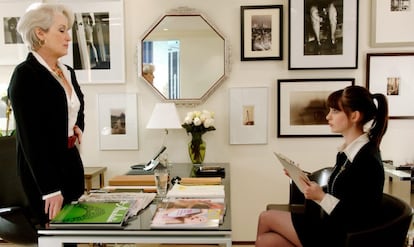
20 years ago, an aspiring journalist decided to accept a job as an assistant editor at the most important fashion magazine, that is, the most influential and powerful in the world. Andy Sacks, played by Anne Hathaway, landed in Runway almost like a Martian on Earth and forcibly deciphered all the codes of an industry she did not know, under the implacable gaze and verb of her boss Miranda Priestly (Meryl Streep). It happened in the movie The devil wears Prada, inspired by a book of the same title by Lauren Weisberger, who had worked as Anna Wintour’s assistant. The film became an instant classic because it was able to X-ray the aspirational capitalism of the 2000s with very expensive styling. The second installment will premiere in Spain on April 30. The scenario is the same, but in these two decades a few things have changed: extreme performance is called burnoutjournalism is experiencing its umpteenth crisis and the classic hierarchies of power have collapsed.
The first film brought a generation to the theaters. “It became something like the women’s weapons of the millennials because he was able to create that bond by connecting with what was happening at that moment, the zeitgeist, what the pedants would say,” says Paloma Rando, screenwriter and columnist for EL PAÍS. “She appealed a lot to the place that an intern occupied, and the power she could have, that’s why she was almost visionary in the way in which many of us later lived, and this universe of the first works was built,” adds Paloma Abad, from the Debate label where she is preparing the launch of Annathe unauthorized biography, but not discredited either, the editor clarifies, of Anna Wintour signed by journalist Amy Odell. In 2006 Abad was a journalism student with the aspiration of working in fashion magazines. “That environment of Runway “I was much more privileged, but you could still get into the shoes of a woman who had no idea about fashion and entered the powerful industry of these magazines,” she says, after having held all kinds of positions, including positions of responsibility, in the Spanish editions of Harper’s Bazaar y Vogue.
The devil wears Prada was released in the summer of 2006 under the film label chick flicka chick flick that dealt with the plots of a story of Vogue and how its all-powerful editor Anna Wintour exercised control. This premise complicated its success at the box office, which a priori was also predestined by the launch, in the same week of June, of Superman Returns. The bad omens did not come true, the collection exceeded 320 million dollars worldwide, ahead of what the superhero achieved. “There was an effect similar to that of Barbenheimer almost before the internet,” says Paloma Rando, in reference to the cultural phenomenon that occurred in 2023 when they were released at the same time. Barbie y Oppenheimer.
Not only was the film’s large budget compensated, which in costumes alone amounted to more than a million euros, but also the cachet of the cast. Streep rejected a first offer, probably because of the place that playing a tyrant and perhaps frivolous magazine editor would occupy in her filmography, but she finally accepted when the number multiplied. “She is a villain with nuances because she pays a personal price for being one. That helps not so much to justify her, but to understand her,” says Rando. The character achieved a life of its own outside of the film.
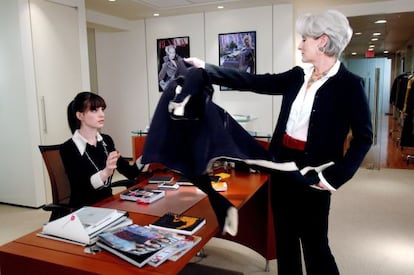
With this fashion background, the screenwriter, Aline Brosh McKenna, and the director, David Frankel—both repeat in the second installment—constructed a generational story about work, ambition and power. The character of Andy Sacks went from an attitude of almost indifference towards a job that was a mere procedure to reaching a serious publication (he doesn’t say it, but he probably aspired to The New Yorker o Vanity Fair) to another vital condition of pure dedication, infinite hours and servitude to her boss’s every whim. Phrases such as: “Let me know when your life is destroyed. It will be time for a promotion” and “a million girls would kill to have your position” remain to be remembered.
“Many of us were able to experience this work dynamic, we may have even defended it at some point, but everything has changed, as well as what we are willing to sacrifice,” says Rando. “There are many young people who no longer do it or at least are not able to say it with pride like then, there is the great resignation after the pandemic, for example.”
The world in a magazine
After four reworkings of the script, a measured construction of the characters so that they would not remain in the first layer of trifle, The devil wears Prada encapsulated a time in a magazine editorial office. “Not so long ago everything was so elitist, or rather stratified, as the film shows, perhaps not reaching that caricature,” says Abad, who assures that he has never witnessed a director throwing away a million-dollar fashion production. “I have seen how a job was discarded, but I have not had to get out of an elevator because the editor got on,” adds Carmen Melgar, journalist and fashion professor.
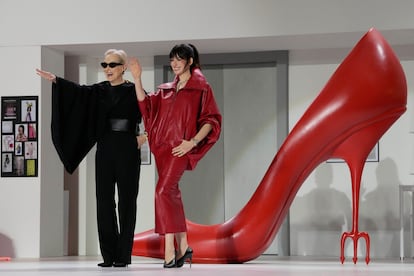
The fictional magazine Runway 20 years ago also exemplified a sector that printed hundreds of thousands of copies per month, with great influence among its readers, with relevant signatures and the ability to change a designer’s collection a few days after its premiere at a fashion week. Melgar started in this industry in 2004, since then he has experienced changes such as digitalization, economic crises and also the way of leading. “Now they are part of an industry that is not only dedicated to selling copies, but rather they are editorial products and then decline in the sale of many other actions,” explains the journalist. “There are also other prescribers on the internet, whereas before everything came essentially from these magazines or television.”
The second film (The Devil Wears Prada 2) addresses all these vicissitudes through a reputational crisis of Priestly’s character to which Andy Sacks will come to the rescue and will meet again with Emily (Emily Blunt) and Nigel (Stanley Tucci), among other characters. The obsession with internet visits, traffic measurement tools and all those aspects that have changed forever in the publishing sector become part of the cast. Brand image no longer only depends on the respect earned through fear, social networks set the pace for a woman who seems to have to adapt to these new dynamics.
The same timeline has seen the accumulation of fame for a film that would now be considered memetic, but that was able to fix many of its script lines in the popular imagination, before the internet took charge of extracting aphorisms from cultural products to make them viral. It is difficult not to feel a millennial emotional call when hearing the phrase “cerulean blue;” or the implacable irony of “flowers?” For spring? How original”; the disappointment of saying goodbye “that’s all”; and the forcefulness of “everyone wants to be us.”
The devil’s view of Prada 2 remember many of these phrases in a new exercise in nostalgia that has catalyzed most of the consequences of the last five years. “It is a capital element in these times of uncertainty,” says Abad. “There is something very human about it: you have to remember the time in which you were young. Furthermore, in a time in which cultural content is so fragmented and in which everyone seems to design their own tailor-made cultural menu, remembering a time in which there were films that challenged us and brought us all together, and that talked about so many things that were important to us, I think it is unavoidable, given the circumstances in which that now seems to be much more difficult to achieve.”
When Streep played the role, Anna Wintour was at the peak of her popularity and prestige in the industry, and over time she has become a pop culture character. But then, the editor of Vogue Not only had he criticized Lauren Weisberger’s books on which the film was based, but he had not participated in the promotion. Two decades later, Wintour and Condé Nast, the magazine’s publishing company, have been involved in the entire campaign orchestrated by Disney, owner of the film. The former director of the magazine has starred with Streep on the publication’s May cover, she has made videos with the actress that have accumulated millions of views on different social networks, and she has presented an Oscar award with Hathaway. Meanwhile, the two protagonists travel the world from premiere to premiere wearing all those brands that in 2006 did not want to participate in the film, while at the same time they are the visible face of the Coca-Cola, Starbucks and Old Navy campaigns, among other brands.
“They have known very well how to read the opportunity of what is now called synergies, the enrichment that they are going to achieve because the magazine is going to have much greater reach,” explains Melgar. “An extraordinary film can become a great phenomenon without a campaign behind it, but it has a much more difficult time. And when expectations are so high, when success is assumed to be so great, of course all brands want to jump on the bandwagon. The crux of the matter is to see how they connect and that this polyamory is natural and not forced,” adds Rando. Abad will release Wintour’s biography on the same day as the film’s premiere, and in those pages unknown aspects of an opaque editor that today does embrace the exposure provided by social networks will be revealed. The sign of the times.