
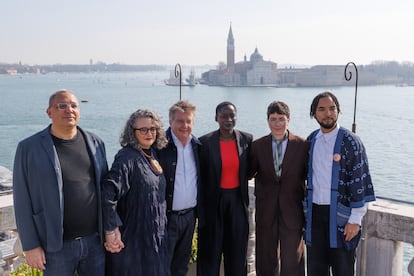
The international jury of the 61st Venice Art Biennale, which will begin on May 9, has announced that it will exclude Russia and Israel from the competition for the awards because they are countries whose leaders “are currently accused of crimes against humanity by the International Criminal Court.”
In the case of Russia, the Hague Court issued an arrest warrant against Russian President Vladimir Putin in 2023 for war crimes in Ukraine. In 2024 he did the same with the Israeli Prime Minister, Benjamin Netanyahu, accused of war crimes and crimes against humanity committed in Gaza.
The members of the jury, chaired by the Brazilian Solange Farkas, accompanied by Zoe Butt, from Australia; Elvira Dyangani Ose, from Spain; Marta Kuzma, from the United States; and Giovanna Zapperi, from Italy, have announced that they will not consider Russian and Israeli works when awarding the awards.
In practice, it is not an expulsion: countries will be able to participate and maintain their pavilion in the Art Biennale, but they will be left out of the official competition. The jury does not have the power to decide on the participation of the countries, since that is the responsibility of the Biennial Foundation, but it awards the main official awards, including the Golden Lion for the best national participation – which is awarded to the best national pavilion -, the Golden Lion for the best artist and the Silver Lion for the best emerging artist.
The Venice Biennale Foundation – which organizes the artistic event and other events such as the Biennale of Architecture, Cinema, Theater or Music –, chaired by Pietrangelo Buttafuoco, has responded by clarifying that the jury acts with “full autonomy and independence of judgment.” The institution has pointed out that the composition of the jury is a “natural expression of the freedom” that the Biennale itself defends and guarantees, and has defended that any country recognized by Italy can participate. He has also insisted that he “rejects any form of censorship of art and culture.”
The presence of Russia and Israel in this edition, driven by Buttafuoco’s expressed desire to open participation to all States that are interested, has generated tension in the Italian cultural environment in recent weeks. Numerous artists and intellectuals have been asking for some time to be excluded from this important event, one of the largest showcases of world contemporary art.
Russia has not participated since 2022, when, after the invasion of Ukraine, the curator and the artists selected for the Russian pavilion canceled their participation. In 2024, Moscow gave its exhibition space, located in the Biennale gardens, to Bolivia.
This year, however, it will reopen its pavilion, despite the fact that 22 countries have signed a letter of protest and that the European Commission has initiated the procedure to withdraw funding for the Biennale. On the other hand, the historic representation of Israel in the Biennale Gardens is under construction, although the country will participate with a new space in the Arsenale, another of the exhibition venues.
Russia’s involvement remains a source of tension. In recent weeks, the European Commission had threatened to freeze or withdraw the two million euros of subsidy it had granted to the biennial for the 2025-2028 triennium if the reopening of the Russian pavilion was not clarified or reviewed. This Thursday, Brussels announced that it gave the Venice Biennale a period of 30 days to explain its reasons for allowing Russia’s participation and has warned that, if the response is not “satisfactory”, it will suspend the funding it had allocated.
An “anticultural drift”
This ultimatum has also been supported by the statements of the High Representative for Foreign Policy of the European Union, Kaja Kallas, who has stated that, while Moscow “bombs museums, destroys churches and tries to erase Ukrainian culture”, its participation is “morally wrong.” Russian Foreign Ministry spokesperson Maria Zajárova responded by accusing the EU of falling into an “anti-cultural drift.”
The European Commission has also reported that it has received a response from the Italian Government and that it now awaits a direct response from the Biennial within the indicated period. The explanations that the Italian Executive has given to Brussels are unknown, but last month the Ministry of Culture of the transalpine country distanced itself from the initiative to readmit Russia and stated that it was “an autonomous decision” of the Biennial Foundation. In addition, Minister Alessandro Giuli asked Buttafuoco to provide him with “utmost urgency” the documentation relating to Russia’s participation – including communications with authorities in Moscow and details of how the participation is being organized and financed – to evaluate its “compatibility” with the current European sanctions regime.
Ukraine has asked its European partners to enforce sanctions and urged Italy not to issue visas to Russian participants.
An unusual decision
With this unusual decision, the jury of this edition has considered that it is not possible to completely separate art from the political context, especially in a system in which artists represent countries. This means that the political dimension is almost always present, since these are not just individual works, but “national art”, with pavilions that in many cases are financed by the governments themselves and in which the international context – wars, crises or clashes between different visions of the world – ends up weighing on the reading of the works.
In the long history of the Venice Art Biennale, founded in 1893, geopolitical tensions have sometimes conditioned the artistic debate and have come to be placed above the works themselves, while at other times art has been used for political purposes, marked by the international context.
For example, in the Cold War years, it became a strategic “battlefield” where the United States and the Soviet Union used art as a form of cultural diplomacy or soft power (soft power), that is, a tool to project influence without resorting to military force. Through their pavilions and artists, both blocks sought to show the superiority of their political and social models to the international public.