
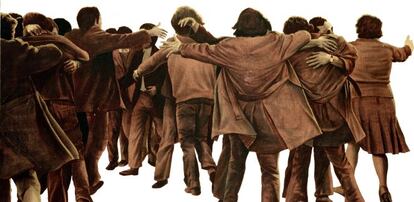
Last Tuesday, June 2, Pedro Caba (Madrid, 1934) died at the age of 92. Pedro Caba was a doctor, the Communist Party doctor to whom the opposition went throughout the difficult years of Franco’s rule, and not always for a prescription or a check-up. Dolores Ibárruri, Santiago Carrillo, Antonio Buero Vallejo, Cristina Almeida, officials from the Cuban Embassy, the Russian Embassy, but, above all, political activists, trade unionists, people committed to democracy and freedom who knew Carabanchel or the General Directorate of Security well passed through there. Pedro helped everyone in any way. As he himself said, his office was a political center where the police also went.
Pedro was a lot and many things. There are infinite ways to tell who Pedro Caba was that always end in the same way, that is, pointing to a good, dedicated, progressive and truly unique man. Because we can talk about Pedro Caba vice president of the WHO, a position for which he was elected in 1988; the young Pedro Caba, already a doctor, instigator/inspirator of the bizarre escape from the Vado prison; One could talk about Pedro Caba, Cuban ambassador in the mid-seventies: “Doctor Caba, there is no one here, they have all escaped,” the cleaning lady tells him one day. “Well, look, boy, you take the key and take charge of the Embassy until the new one arrives,” they ask him from Cuba. “I am the ambassador, although it is true that I have lost my accent a little,” Pedro explained to the doorman. Pedro Caba, the friend, confidant and doctor for forty years of the nuns of the Fausta Elorz convent, who as a sign of gratitude hid one of the dangerous multicopiers for him.
We find Pedro Caba in the emblematic work of Genovés, The hug, icon of the anti-Franco movement, that hug that serves to tell our recent history. “Genovés came to my office when that was a focus… One day he told me: ‘I have a project that I want to tell you.’ It consisted of everyone going to the prison to greet those who came out with a hug.”
And Pedro Caba, the protagonist of the novel Garden of Villa Valeria, by his great friend Manuel Vicent, an excellent chronicle of the progressive, committed and activist bourgeoisie, in the last years of the dictatorship and during the transition. A group of people who, finally, had weight in the arrival of democracy in this country.
Pedro Caba was born in Madrid, but soon moved to Extremadura, where his father was imprisoned during the war. He slept in a park with his mother. He began his medical degree in Valencia, but finished it in Madrid because he was expelled for demonstrating on May 1. He joined the Communist Party in 1954. And since then, it was also non-stop before, always with Ana Mari by his side.
Pedro devastated, dragged. I have talked before about Villa Valeria. That house in which things happened that left their mark. The meals, the after-dinner conversations, the discussions, sometimes really tense. There was a lot of talk and unrepeatable people like Juan Trías, Gonzalo Marín, Manuel Vicent, Pablo del Amo, Joaquín Cervera, Jesús Chamorro and so many and so many too. There was also a group of children, then teenagers, then young people, who attended and participated in all that, first listening, learning, then intervening and participating. That group that was created around Pedro Caba forever transformed us, those of my generation, into people committed to democracy, freedom, rights and social justice. In an interview I did with Pedro two years ago, he said: “I dreamed, I worked for something that didn’t turn out well.” No, Peter, no. There are your children, Pedro, Eva, Sonia and Pablo, your grandchildren and the whole gang that you and your group turned into forever responsible people with the present and the future that you dreamed of.