
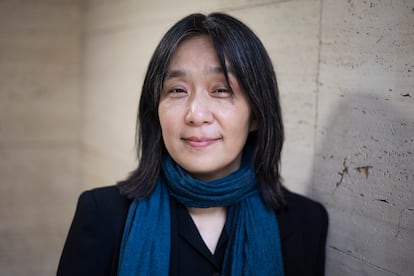
Han Kang continues to be that small, educated, kind woman, with a shy appearance and with the same humble tone and very quiet voice that characterized her, but the radiant luminosity that this South Korean writer gives off today is evident. The writer, born in Gwangju (South Korea) 55 years ago, received EL PAÍS in Barcelona this Wednesday, where she responded to the call of Sant Jordi, the great book festival that is celebrated in the Catalan capital at a time when the refuge of reading is growing in Spain. As a bookseller who has been until two years ago, she is moved by the enthusiasm that exists in the city around literature.
There are authors from a single universe; others capable of combining many registers. And then there’s Han Kang. The writer demonstrates it again in ink and blooda 2010 novel now recovered in Spanish by Random House with a translation by Sunme Yoon, in which she embraces criminal intrigue while extending the roots of the themes that made her powerful in The vegetarian, Greek class, Impossible to say goodbye or Human acts: fear, the body, the collision between life and death, visible and invisible violence, the most pressing intimacy and the explosive sensitivity that it transmits from all its approaches, be it dreams, the sensations of a child, slippery shoes or the coffee filter. The sublime writer that Han Kang is offers here—again—the complete palette of colors that has earned her the highest award.
Ask. In an interview in Madrid in 2023, before the Nobel, you said: “Language makes me suffer.” Is it still like this?
Answer. Not as much as then. At that time the language was more difficult for me to understand, but at the end of the day it is something that we all have. I live with it, it is the means to communicate, to meet people and transmit everything I think. Today I feel it as something more precious, I value it a little more. It doesn’t mean it’s easier, but I put a little more value on it and that’s why I feel that what I write today seems less difficult. Not all novels turn out well, but when they turn out well the language becomes less heavy and I can begin to understand it more.
ink and blood It is his fourth novel, the first after the great success that was The vegetarian, Booker Prize in 2016, and in it he takes readers by the hand through a world without a map, sometimes incomprehensible, dark, where there is no ease or simplicity, but the truth about a death that someone wants to turn into suicide. There is intrigue and mystery seen as clashes in search of that truth.
P. A character tells us that life is a succession of violent acts. Is that unbearable violence of every day what you want to reflect?
“What makes us live in this world full of violence and suffering, in these dark times, is love.”
R. When this novel was going to be published in Spain, I reread it and what surprised me is that it is full of love. It is true that there is a lot of suffering and violence, but the love is also so powerful and so warm that even the comfort they give each other, what they try to protect, the food they share and the way they hug each other hurts the heart. All of this makes love reflect more grandly. And ultimately what makes us live in this world full of violence and suffering, in these dark times, is love. In The vegetarian love is not seen so directly, but here I focused a lot on the question they ask themselves: do we have to live, is it worth it? Yes, you have to live. We must live with all our strength and the force that makes us live is love. The next book was Greek class that the same question is asked and that I represented with the five senses, especially with touch. But this book, Ink and blood, He is the intermediary, a bridge that could unite The vegetarian con Greek class.
P. In the 2023 interview you said that in this book, in Ink and blood, It was precisely blocked in chapter 7 and was blocked for a long time. Why and how did it manage to be unlocked?
R. He has a very good memory! (laughs) In those days I had personal problems, I was going through difficult situations, I had read a lot of fiction and that universe of the imaginary and the fictitious was difficult for me to see and digest. I wasn’t even able to watch movies, fiction didn’t allow me to advance. And I was resting for a year. Afterwards I began to remember what was written in a more beautiful way, as if it were a friend that I had not seen in a long time and that you began to miss, so I read it from beginning to end, which at that time was chapter 7. It was like meeting that friend that I had not seen for a long time and I was able to have that strength and energy to write again.
P. In this book the hidden side of the Moon is important. Is it a metaphor for our wounds?
R. We know that we cannot see the far side of the Moon, but when it rotates around the Earth, we can see a little more or a little less. I found that very interesting literaryally because when we get to know people it is the same: sometimes we can see a little more or a little less of their hidden side. I read a lot about astrophysics and I tried very hard to be able to express that language in this novel. In high school I was very excited to learn Kepler’s theory about how stars move in their orbits and I was very surprised to know that the universe was creating this melody, this very mathematical music. I was the typical student who asked the teacher very strange questions: “Why are there no storms when it snows?” And I wanted there to be that connection between the questions of astrophysics and those of literature. In literature we ask ourselves: what is the human being? What is its nature? Why does it exist? Why do you have to live or die? And in astrophysics they also ask: Why does the universe exist? How did it exist? Is it eternal or unlimited? Is it finite or infinite? And these things that seem so different were very related and I wanted to represent through that novel that common point that the universe and humans share.
The universe is so immense and so infinite that in the face of that wonder our pains can be perceived as small.”
P. Did you also want to show the smallness of our problems compared to the infinity of space?
R. I always wrote this novel with that comparison in mind. The universe is so immense and so infinite that in the face of that wonder our pains can be perceived as small. And I felt something quite new and curious: before the wonderful and immense universe, pain seemed smaller, but love seemed bigger. It was something very interesting to me and I wanted readers to be able to feel it.
P. You make a literature of the body. Is the body a territory of combat, of collision?
R. We have a body and I don’t know if it’s because I’m Asian, but I see the physical and the spiritual as the same thing, not separated or divided, but as a whole. I wanted to talk about this very sentimental body by touching points that were one. We use it as a tool and I wanted to talk about these electrical currents that we can feel with this element called the body.
P. She usually uses two friends or two sisters as very strong protagonists in her novels. Is it an expression of the importance of friendship?
R. I do not like to repeat the literary or structural form in my works, I like each one to be different from different perspectives. But I do realize that I always end up talking about two women who are friends or sisters or so close that they seem like blood sisters. I think I have a lot of interest in that deep relationship between two women.
“I write because I have things I want to write.”
P. Why do you write?
R. I write because I have things I want to write. Normally I usually start from a blank sheet of paper, I start from nothing and I tell myself: you don’t need to make an effort, don’t force yourself to write. But I close my eyes and think about what’s on my mind, what makes me desperate to write, what stories I want to tell and there is always something I want to express. I have always had something I have wanted to write, if one day I ran out of things I want to write I would stop doing it, but they never stop. It’s like a curse, because every time I’m finishing a work there are three other things I want to write, always three. And when I finish one, there should be two left, although one more always appears and it ends up being three again. The ideas I want to express never cease.
P. He says he only knows the title and the ending when it starts. Is that all you have?
R. Yes, I always have the title and the ending. Sometimes I see interviews from other authors who don’t know how it will end. I find it interesting and I want to try it, but usually when I start I already have it in mind. Sometimes I change, but what changes are the routes or paths in which the novel develops towards the conclusion. The important thing is that image that I visualize of the final scene.
P. How would you define your literature, your literary project?
R. It is difficult to define it because I consider that I am constantly changing. I feel that in my literature I am advancing, I am walking, and from time to time I look back and say: I was a writer like that, in that way, and although I describe it in one way or another, perhaps in ten years or two it may be totally different because I am going to continue writing. I keep changing and I want to keep changing.
P. And has your view of violence and death also changed, like your literature? The holes of death never heal, he says in Ink and blood.
R. That speaks of longing and love for a person who has died because a person, even if he or she has died, always stays with us. Its place never disappears. ink and blood It is a work full of love because that impossibility of healing speaks of a deceased person whom we will never forget.
P. You say that the Nobel Prize has not changed you, but doesn’t it make you more dizzy to write after receiving it?
R. Everyone asks me this and I say to myself: should I feel that pressure? But surprisingly I don’t feel it. When it comes to writing I am so immersed in it that I don’t think and I say to myself: am I the strange one for not feeling that pressure and that vertigo that everyone asks me about and that I don’t feel? No, I’m not sorry.