
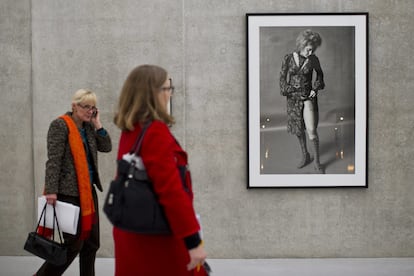
The artist of performance, Filmmaker and feminist Valie Export, one of the best-known Austrian creators, died this Thursday in Vienna, just three days before her 86th birthday. “We mourn the loss of an exceptional artist, an extraordinary personality and a special human being,” the foundation that bears the artist’s name said in a statement.
With the death of Valie Export, in some way, a generation of great women artists, some of the pioneers, who worked from her body, always in full body, comes to an end, looking for a way of telling that would give history a twist; using unexplored media at the time—performance, expanded cinema, video—to tell things differently, because one cannot talk about the new heroes—the new heroines—with the old points of view.
In fact, in the 1970s the body became the undisputed protagonist of the art world and not only through the work of so many creators, who used it as a flag of subversion—no, rather of insubordination. The Cuban resident in New York Ana Mendieta, Niki de Saint Phalle, Yoko Ono, Carolee Schneemann, Charlotte Moormarn, Esther Ferrer, Orlane…. among others, they gave a twist to the proposals of Kaprow, Klein or Shigeko Kubota, who had opted to incorporate theatricality into art and, based on the theatrical review, the implications with corporeality: being in the work in full body.
Their radical, performative proposals counted on the public to complete the work, sometimes even through horror at the actions of the Viennese shareholders in the 1960s—Hermann Nitsch or Arnulf Rainer—who carried out bloody rituals where what was historically erased and uncomfortable about the body was implied: blood and violence.
In that Viennese cultural environment, one of the most radical episodes in the history of art in the 20th century and sometimes something borderline appeared on the Austrian art scene Waltraud Höllinger, a girl from Linz, the country’s feminist focus until the 1980s and beyond.
He had received training in the Applied Arts, but his future had little to do with the continuation of the great Austrian Nouveau tradition. He was not going to dedicate himself to textile design, he said in an interview. The first thing was to change my name, put aside that of the father and husband. This is how VALIE EXPORT was born—all capital letters, imitating industrial design—a popular tobacco brand in Austria in the late 1960s, which the artist smoked. Then he took to the street in a performance that sought to scandalize like the artist’s kiss on the slot machine at the FIAC in Orlan or The gentleman with his hand on his chest (1967/1968) by the ZAJ, made by Esther Ferrer together with Juan Hidalgo, and one of the most iconic actions.
Valie Export’s proposal was even more drastic: sheltered behind a type of screen covered by a cloth, she offered her breasts behind the cloth itself for whoever wanted to touch them. Tap and touch cinema (cinema to feel and touch), from 1968, was a way of making clear how uncomfortable the relationship with the body is, touching a body in public, groping for those bodies.
A year later would come his Genitalpanik Pants Actions (Genital Panic), from 1969, which had little to do with Freud, or at least beyond pure superficiality. EXPORT was more interested in theorists such as Luce Irigaray or Roland Barthes and pioneers—Virginia Woolf and Gertrude Stein, about whom he wrote some articles in those years. Be that as it may, when looking at the pants that revealed the most intimate parts of the artist, it was clear that the Freudian allusion to the fear of symbolic castration—or here not so much—was obvious.
However, the great contribution—almost visionary—to the theory and practice of gender of this artist is not related—or not only—to the use of the body; not even with his expanded cinema works or his games with the fragmentations of the body in films like Phrases, from the early eighties. Seen in perspective, its great contribution was theoretical, when it was planned in 1970, in Women’s Art: A Manifesto, how the artists’ freedom would depend on control over new technologies, something that many later continued to reflect on. He never ignored the political problems that the body entails, even going so far as to discuss the practice of clitoral ablation in some cultures, knowing at all times that to talk about the body one must talk about the entire body.