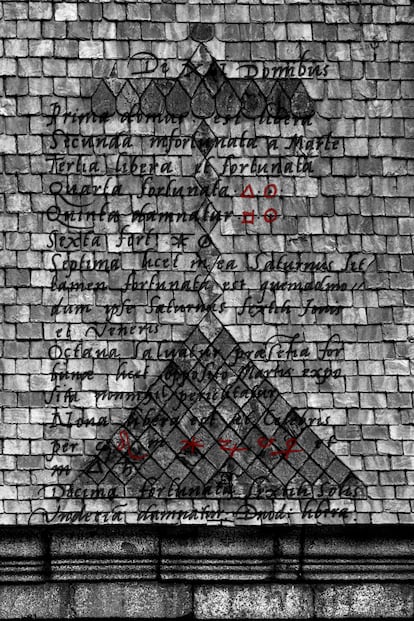
In the last three months, photographer Isabel Muñoz has felt that the Royal Monastery of San Lorenzo de El Escorial was like her second home. He has photographed its rooms, its works of art, the library and the surrounding La Herrería forest. At the same time, he has investigated the lives of the people who were responsible for the construction of this monumental complex – a UNESCO World Heritage Site since 1984 -, especially King Philip II. Muñoz has moved around the entire complex to tell it in his new work, The stones of the sky35 pieces in which she has curled her hair with the techniques and materials used to become almost an alchemist.
The result, presented last Wednesday, can be seen until September 6 on the landings of the Royal Collections Gallery, a perhaps debatable space to show an exhibition, and in the gardens of Campo del Moro. Muñoz (Barcelona, 75 years old), winner of the National Photography Prize in 2016, has jumped once again, as has happened in his work for years, from photography to another form of artistic expression, “a hybrid,” he says, “between image and engraving.”
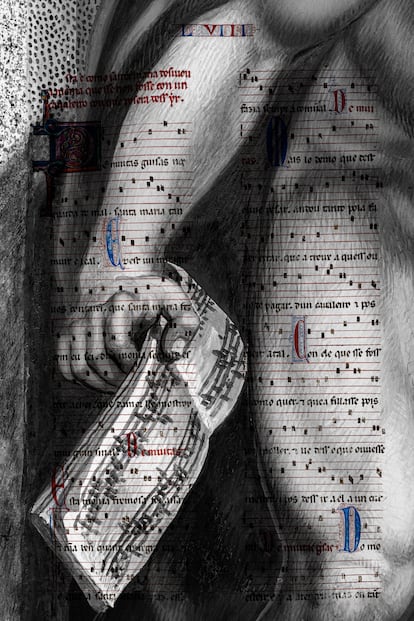
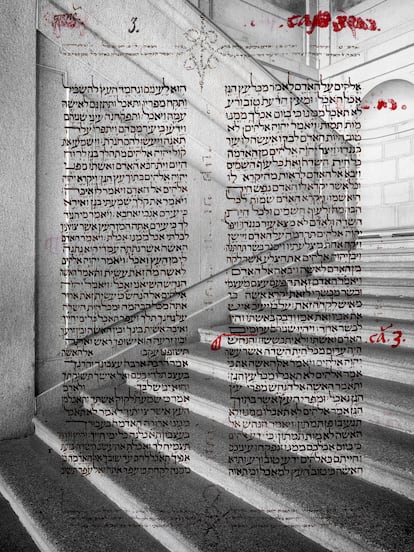
The pieces on display have the texture of engraving and metals such as gold, silver, copper and tin have been applied to them. On the photographs taken of spaces in El Escorial or of its works, he has printed, on very fine silk paper, texts in several languages from the volumes of the Escorial library, books that are related to the photographed image. “I started from an old technique from when engraving began,” he stressed. “You make a metal plate the same size as the piece you want, you put the platinum on it, for example, and with a torculo (press for stamping engravings) you seal it.” A laborious process, with many tests, which has also turned out to be “an investigation.” That’s it for the technical explanation. The theory: “Today, photography is not only the image, it is also the video, the installation, the objects…”.
Muñoz’s work, within the PHotoESPAÑA festival, is commissioned by National Heritage from its program field notebooks, which celebrates its third edition. This program “directs attention to the natural spaces of the Royal Sites managed by National Heritage” and is sponsored by the company Acciona, the organizers point out. It is an initiative that “brings renowned Spanish photographers into dialogue with environments of exceptional value, with the aim of raising public awareness about the importance of preserving an environment that represents a landscape and cultural legacy.”
The Escorial, which some have historically viewed with disdain for representing an epicenter of the absolutist monarchy, was built, as is known, to commemorate the victory in the battle of San Quentin against the French troops in 1557, which occurred on the day of Saint Lawrence. The work began in 1562, with the project of the Renaissance architect Juan Bautista de Toledo, which Juan de Herrera completed, until it was completed three decades later.
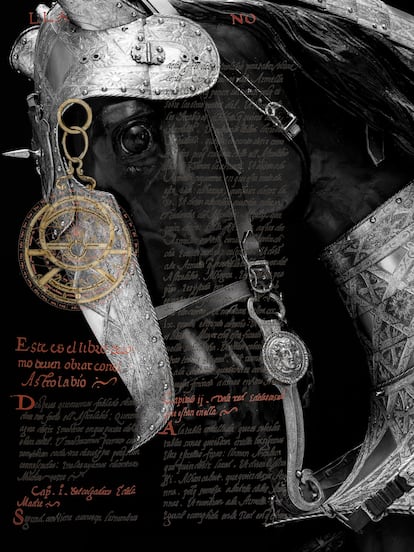
“Philip II brought together wise men of the time to raise the most advanced knowledge,” says the artist. Muñoz highlighted “the library”, which the king commissioned from the humanist Benito Arias Montano and houses 40,000 volumes; “the innovative water channeling system and the use of local granite as the main material.”
In the superimposed texts, Muñoz has included symbols, cabalistic numbers, because, remember, the so-called King Prudente conceived the monastery as an architecture destined for a symbolic order, for a cosmic harmony. In fact, he had several astrologers; At this time, Matías Haco was also a doctor.
Wrapped in the propaganda of the black legend, the artist has, however, searched for “the human Philip II, who was capable of writing beautiful letters to his daughters in which he described what the roses in the monastery garden were like.” In this sense, he “also liked to see Philip II through the women he loved” (he married four times, one of them with a first cousin and another with a full niece). “I believe that the one who loved the most was Isabel de Valois.” It was her third marriage, daughter of the kings of France, who died at only 23 years old in childbirth.
Muñoz confesses that until this work he had not been “especially interested in either the monastery or the character of Philip II.” But he has not been able to resist the fascination of having Hebrew and Muslim codices and works such as the Lapidaryby Alfonso
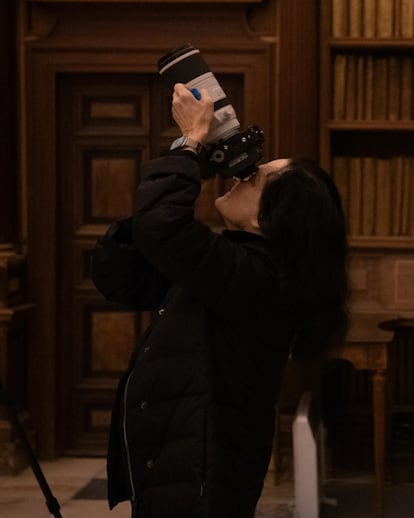
History aside, she was asked about the process of selecting what was photographed. Muñoz wanted to “convey what he felt.” This is how he spoke, for example, about the piece that shows a cantoral. “There is a fascinating collection, they were made on parchment.” So for something so refined, he decided to apply gold leaf. Furthermore, he has looked for “architectures that reflected geometry, triangles, squares.”
What has been the most difficult? “It was about creating something from scratch because you don’t know it. You have to try the different papers, the different metals; see who prints well and don’t mind repeating it as many times as necessary. It’s the part of a photographer’s work that is not usually told. There are moments of tension, but then – he smiles – when you see the result…”.