
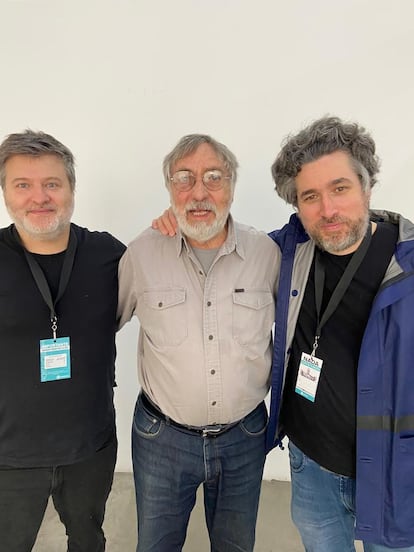
We were friends of Beto Brandoni during the last stage of his life. For us he was a hero as an artist: he had starred in what we consider to be the best Argentine films of all time. We will remember him from the work we enjoyed together, in these years in which we became good friends.
my masterpiece It was the first thing we shot with Brandoni. The end of the film was filmed in the north of Argentina, in the Hornacal mountain ranges, an extraordinary place in the province of Jujuy, on the border of Argentina and Bolivia. Those mountain ranges where we filmed are 4,700 meters above sea level! Due to the lack of oxygen it was impossible for us to string together a single sentence, in addition to suffering an unbearable headache. Under these conditions, we filmed the end of the film, and incredibly it went as planned: the scene conveyed serenity and placidity, even though we were dragging due to lack of air.
We owe this film the beginning of a deep friendship with Beto, which grew project by project. A no minor detail of this film: even my masterpieceBeto had practically not worked in the movies for 12 years. It seems incredible for an actor of his size and category, but that’s how it was. Between 2003 and 2015, 3,500 Argentine films were filmed, however, in none of them was there a relevant or leading place for him. The reason: in our opinion, an obsequence of the directors, producers and artists of Argentine audiovisuals who thinned it out so as not to irritate the Peronist Government of that time, ideologically confronted with Brandoni, someone who always maintained a fierce defense of his democratic convictions.
It was a time of artists applauding power, a calamity. So we feel proud to have cut that dark streak in his career. From then on, Brandoni’s figure did not stop growing and he himself told us a few days ago: “At 85 years old I am, by far, in the best moment of my career.”
We immediately proposed another film, 4×4. There Beto shares scenes of great acting commitment with Dady Brieva, a well-known Argentine comedian who is located at the other end of his ideological arc. We had doubts about how Beto was going to react to the proposal (the man was always known for his character), but he really liked the offer to perform with Dady as a tool to soften the polarization we are experiencing and thus relax the confrontations between artists over political issues. And so it was, they themselves had a great time working and everything went very well. Dady said: “I’m playing with Messi.”
One day having dinner at Beto’s house, the idea of doing the series arose. Nothing. We were already friends and we knew him much better. So the work was born as a game of mirrors with his own life, his view of the world, his predilection for Buenos Aires food and his unconditional love for the city of Buenos Aires. The scripts were made as if by a tailor, to suit him. We wanted to honor him. He deserved it because he was the last of a generation of great artists in Argentina.
The series set out to pay tribute to that entire universe. In such a way that we even summoned Robert de Niro, with whom he maintained an old friendship due to a visit he had made to Buenos Aires several decades ago. Despite all the odds, De Niro accepted (he had never decided to make a television series until now) and moved to our capital.
The first scene between De Niro and Brandoni had the entire team quite nervous (we were too). But Beto was very calm: the presence of whom many consider the greatest icon of world cinema did not move him a hair. The scene was done and turned out great despite being performed in four languages (Spanish, Guaraní, Italian and English). At the end of the take, when the directors announce that it is finished, Beto comes to the monitors and tells us, as if accepting something new, half secretly: “Bobby is good, huh?” As if to say: “This boy has a future.” We thought it was great.
De Niro admired Brandoni’s political history: he had been threatened with death by the Peronist government prior to the dictatorship, he went into exile with his family and returned during the military regime to help future president Raúl Alfonsín in his plan to return to democracy.
Then we put forward other proposals. When we were writing the series Nothing y The managerwe spoke with Guillermo Francella and Brandoni about making crossover participations in the series that both would star in. Each one was going to play a role in the other and that’s how it happened.
Beto always liked the idea of playing a lineman, playing a homeless man. We wrote a fun role together: El Polaco, a needy man (Beto said) who lives in the Plaza de Barrancas de Belgrano with a dog called Le Pera (tango composer, in homage to his fanaticism for that musical genre). He made a special appearance in the first season and another in the latter, the fourth, which is about to premiere on May 1. This last one is one of the funniest scenes of all The manager. It’s going to be very remembered, you’ll see why.
But there was more. In September of last year we filmed with Beto the second part of Nothing. will be called All and will also have him as the protagonist alongside Majo Cabrera. Beto is an actor who always thought about the public and this is no exception, he left us this last filmed gift that transcends him and makes him even greater.
There is no doubt that Brandoni was a great actor, very loved and with a great connection with the public. But, in addition, we know that he was a very brave, honest and committed man. We have not met another like this. There were no differences between what he said and what he did. His coherence was exemplary. Our friend was a man in one piece. We are going to miss them a lot.