
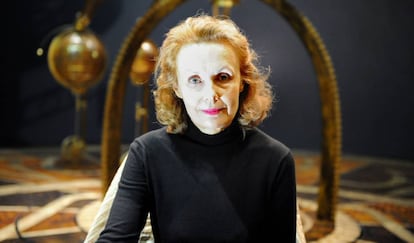
When Innocence premiered in 2021 at the Festival d’Aix-en-Provence, EL PAÍS critic Luis Gago wrote: “If there are still those who think that opera is an outdated or anachronistic genre, with no possible fit in today’s world, as soon as you see and hear Innocence will immediately change his mind.”
There is no place where what Finnish Kaija Saariaho’s opera tells of, the aftermath of the massacre at a high school, is more relevant than in the United States. The Metropolitan premiered it on April 4 and this week it still has three performances left. In New York, the applause has once again been unanimous for a work (“Call to make history,” Gago considered) that remained, after Saariaho’s death two years after its premiere in France – in which she came out to greet in a wheelchair, already very ill -, as the swan song of a great lady of European composition.
Last Saturday’s matinee performance was followed by a standing ovation lasting several minutes for the performers and for Susanna Mälkki, who leads the orchestra with determination. Also, the chill of the public, warned by the program of the harshness of the subject, after attending the representation of a story that is all too familiar in the country of mass shootings.
There is, of course, the intimacy of this society with the epidemic of armed violence, whose most brutal expression regularly manifests itself in tragedies in educational centers in towns and cities in which children soon learn through drills what they should do in the event that a gunman breaks into their schools. But there is also the depth with which the libretto addresses the subject in all its complexity.
Work by the award-winning Finnish novelist Sofi Oksanen (author of Purge), with the adaptation of the playwright Aleksi Barrière, son of Saariaho, Innocence mixes in several languages (from French to English and from Spanish to Romanian) the day of the tragedy with its wounds, still open 10 years later. It is then that the perpetrator of the massacre, hiding behind a new name, is released from the prison he entered as a minor.
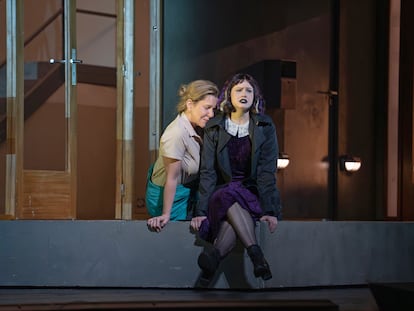
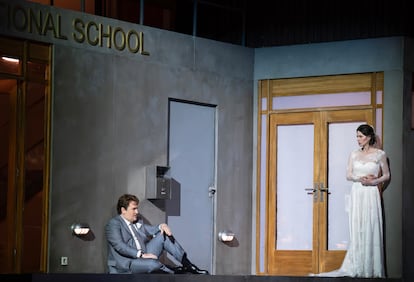
The plot takes place in five short acts without intermission within an elegant scenographic device, which, conceived in several planes by Simon Stone, slowly rotates while imperceptibly mutating. The story focuses on the traumas of the survivors and also on the responsibility of the victims; in the fault of those who dodged the shots; and, particularly, in the pain of two characters played, respectively, by the stars of the production: the American mezzo-soprano Joyce DiDonato and the young Finnish pop star Vilma Jää, a specialist in Finno-Hungarian folk songs. DiDonato is a mother who lost her daughter (Jää) and unknowingly accepts a job as a waitress at the murderer’s brother’s wedding that resurrects her worst memories.
Innocence It also dwells, driven by Saariaho’s concise and unsentimental music, on the remorse of the shooter’s family, a ghostly presence. Could his parents have done more to prevent the tragedy? Does your brother have the right to leave those terrible events behind and embark on a new life with the woman he marries, from whom he has until now hidden his past?
An urgent debate
That part is the most overwhelming and unexpected. It is not so common to see the most urgent debates about a current issue take the stage of an opera house. The responsibility of the monster’s parents is an issue that, since the premiere of the opera, has been placed at the center of the discussion about mass shootings in the United States, given that gun control seems very far from the reach of a society built on the right to own them.
Six months after the premiere in Aix-en-Provence, a 15-year-old boy named Ethan Crumbley walked into his high school north of Detroit with a 9mm pistol his father had just bought him as an early Christmas gift. He killed four students between the ages of 14 and 17, and injured seven other people.
Nothing is too exceptional in that story in a country where between 2008 and 2024, 794 mass shootings were recorded in educational centers, according to data cross-referenced from the Gun Violence Archive, Everytown and Education Week databases. Or in which, of the 10 most serious massacres in history, two occurred in primary schools, that of Sandy Hook in 2011 (26 dead), and that of Uvalde, in Texas, where in 2022 19 children and two teachers died.
The extraordinary thing about that tragedy is what came next, when a jury held the boy’s parents responsible, whose strident warning signs they did not know how to (or did not want to) see. They received 15 years in prison, however contradictory it may be that the murderer was judged as an adult responsible for his actions in order to be sentenced to life imprisonment.

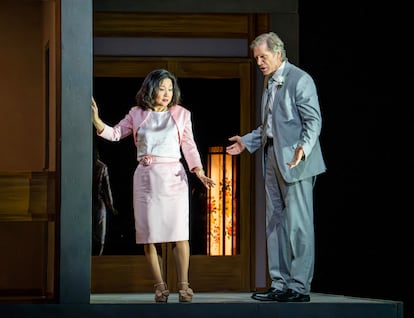
That precedent led a court to find guilty last March of Colin Gray, the father of a 14-year-old boy who killed four people (two students and two teachers) at a high school in Georgia in 2024. Gray, who also gave the gun to his son, will be sentenced in July. The father of Innocence (played at the Met by American baritone Rod Gilfry) also teaches his son to shoot, and blames himself for being too harsh with his upbringing.
At the Met there are also echoes of another famous massacre, that of Columbine, a town in Colorado where two teenagers murdered 12 students and a high school teacher before committing suicide.
That tragedy inaugurated in 1999 a new era in mass shootings in the United States, especially in high schools, and it took hold in the collective imagination thanks to two films: a documentary by Michael Moore and a chilling fictional reconstruction by Gus Van Sant.
Before we continue: if you haven’t seen the opera and are the kind of person who considers it a crime to have a story spoiled for you, perhaps you should stop reading here.
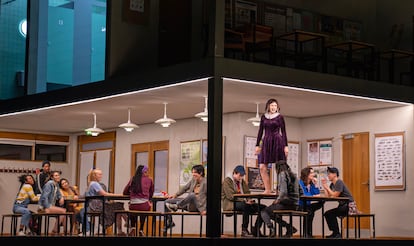
Like the perpetrators of the Columbine massacre, the murderer of Innocence He also plans his butchery meticulously for a year, together with his brother and a friend, who regret it at the last moment. This is how she tells it, she does not sing: another of the successes of the staging is that, in the present, which takes place in the wedding hall, the performers are singers, while, in the past, which takes place in an international institute in Helsinki, the story advances with dialogues in the amplified voices of the “musical actors”, according to the definition of Saariaho and Oksanen.
The end of Innocence It is not as punitive as what the judges have written in the Crumbley and Colin Gray cases. The last word on stage is reserved for the ghost of the victim Markéta (Jää). With her ancestral timbre, she asks her mother (DiDonato) to forgive the killer’s family and move on.
After Saturday’s performance, the audience left the Metropolitan with the echo of that song of forgiveness. And less than 24 hours later, a new tragedy brutally murdered the lyric. It was not in a high school, but in a house in Shreveport (Louisiana). A man killed eight children, including seven of his eight children, before police shot him dead.
It was another day of violence in the United States, a country with more weapons (393 million) than inhabitants (343). A society that an opera is putting in front of the mirror of its brutality these days.