
For Alfredo Kraus, Werther was an inner being. The Canarian tenor explained his doctrine about the protagonist of Jules Massenet’s opera, premiered in 1892, in a short text published in the magazine The Opéra Avant-Scène: a character who does things that are simple in appearance, but felt from within, without great gestures or demonstrations; a voice that should never sound completely healthy, crossed by a shadow even in happy moments. It was his way of warding off the greatest danger of the most legendary role of his career: singing it well without inhabiting it.
His name floated last Monday the 4th among those attending the premiere of Werther at the Gran Teatre del Liceu, with the incentive of the debut in the role of tenor Xabier Anduaga. Some remembered his last high school incarnation of the character, in June 1992; others dated back to 1978 or 1987. And the memory of Piotr Beczała’s stage debut in 2017 still weighs heavily, when he performed the famous Why wake me up?. The San Sebastian native received a standing ovation from the audience and sang very well. But of the suicidal poet, of that inner being, hardly anything emerged.
Anduaga has partly overcome the Italian tone of his singing in French, so evident four years ago in the Lakmé by Delibes of the Teatro Real. He has not yet achieved, however, the prosodic ductility, the flexibility of phrasing or the palette of dynamic nuances that Massenet requires to become a reference Werther. All in all, the quality of the Donostiarra’s voice was evident from the initial greeting to nature, O Nature, full of gracewhere an attractive vocal virility and a high register of explosive projection emerged.
There were some flashes in the handling of the half voices during the statement to Charlotte under the moonlight and, already in the second act, in the confrontation with Albert. They were not enough, however, to portray the psychological complexity of the character. For the rest of the performance, the tenor clung to his excellent vocal virtues, with which he dazzled in I would have on my chest —where he imagines what would have happened if he, and not Albert, had been Charlotte’s husband—, without managing to inoculate that shadow that presides over Werther’s every moment. His version of the famous Why wake me up?which earned him the only spontaneous applause of the night, shone for the quality of the sharp A sharp in fortissimo, but not for the contrast that Massenet prescribes below, when the breath of spring must dissolve into a murmur in pianissimo.
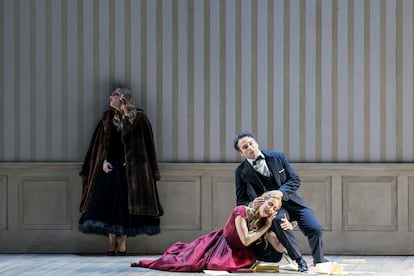
Nor does Christof Loy’s staging favor the San Sebastian tenor, who reduces Massenet’s opera to his characteristic psychological confinement in front of a wall and calls for a singer-actor of far superior dramatic depth. The production, with which manager German debuted at La Scala in 2024 and was revived last year at the Théâtre des Champs-Élysées in Paris, part of Loy’s passion for The elective affinitiesby Goethe. The novel allows him to reformulate the unfortunate Werther-Charlotte-Albert triangle as a quartet that incorporates Sophie, Charlotte’s sister and openly in love with Werther, as evidenced by the license that it is she, and not her father the mayor, who announces Albert’s return.
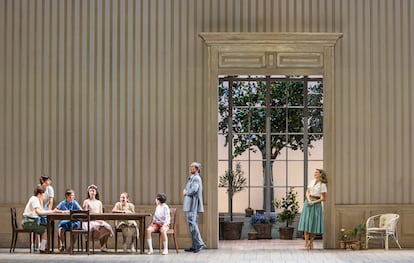
The origin of this dramaturgical concept dates back to its first Wertherpremiered in Bremen in 1996. Loy then turned Massenet’s title almost into a chamber opera that removed the entire environment from view and concentrated attention on the main quartet. The contrast is revealing today: the entire exterior apparatus is now preserved – the children, the mayor and his cronies Johann and Schmidt, the lovers Brühlmann and Käthchen along with several extras – but Johannes Leiacker’s set design is limited to a large light wall, pierced by a wide door that reveals a gallery with a tree in the background, thus reinforcing the feeling of psychological confinement. Robby Duiveman’s costumes contribute to this, placing the play in the 1950s: the result points towards a bourgeois drama a la Chekhov or Ibsen, but also towards a kind of house clos by Sartre that imprisons the four characters in the last act, instead of reserving that atmosphere for the final meeting between Charlotte and Werther.
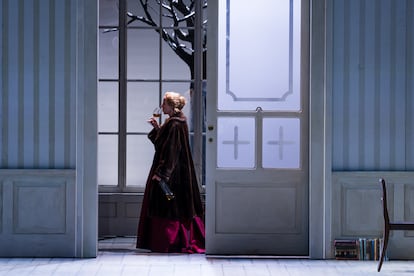
Unfortunately, the four protagonists—all debutants in their respective roles—failed to infuse true intensity into this attractive proposal by Loy, responded here by Silvia Aurea De Stefano, who greeted the end of the premiere visibly pregnant. The mezzo-soprano German Kristina Stanek drew a Charlotte with good vocal means and reasonably determined French diction, but unable to convey the inner destruction to which her moral firmness leads her—keeping her word and marrying Albert—and which Loy stages in the third act through alcohol. Strictly vocally, however, he shone with homogeneous emission and almost Wagnerian density in that same third act, and especially in the aria of tears, Go! let my tears flowin which, supported by the wonderful alto saxophone solo, she starred in one of the musical highlights of the night.
The Navarrese soprano Sofía Esparza was, within the leading quartet, the one who went the furthest in terms of drama. Her Sophie here inverts the cliché of the domestic bird and acquires her own loving consciousness, full and not at all childish; brought brilliance and sparkle, especially in the second act with The cheerful sun, full of flameresolved with good agility. The Madrid baritone David Oller, as Albert, did not quite make the possessive husband credible into which Loy transforms the usual resigned good-natured man: limited vocal means and, even so, the most solvent French pronunciation of the cast.
Among the supporting cast, the fun trio formed by bass Stefano Palatchi, baritone Enric Martínez-Castignani and tenor Josep Fadó, respectively as the mayor and his two friends Johann and Schmidt, were very convincing. Cristòfol Romaguera and Marta Esteban were also convincing, as the young couple in love Brühlmann and Käthchen, together with the vocal sextet of the Cor Vivaldi – Petits Cantors of Catalunya Escola IPSI.
In the pit, Henrik Nánási removed the thorn of his problematic and eventful Tosca 2023. His reading, with intense colors and an anti-sentimentalist vocation, led by a Gran Teatre del Liceu Symphony Orchestra in good shape – with brilliant solos on the strings and woodwind – fully connected with Loy’s dramaturgy. It was proven in the famous Moonlight of the first act, a page of ethereal sensuality, but above all in the tormented interlude of the Christmas night which precipitates the fourth act, integrated with notable success in the stage action as the threshold of the tragic outcome.
Kraus concluded his brief text about Massenet’s protagonist by confessing that his interpretation of Werther continued to constantly evolve: “Every time I sing it, I find new details to express. Like everything in life – the sea, the fire, the air – it is immersed in a continuous movement.” Anduaga will undoubtedly have the same experience, also during the next performances of this production, since no one doubts that we are facing one of the lyrical tenors called to mark the next decade.
‘Werther’
Music by Jules Massenet. Libretto by Édouard Blau, Paul Milliet and Georges Hartmann based on the work The sufferings of young Werther de Johann Wolfgang von Goethe
Xabier Anduaga, tenor (Werther); David Oller, baritone (Albert); Stefano Palatchi, low (The mayor); Josep Fadó, tenor (Schmidt); Enric Martínez-Castignani, baritone (John); Cristófol Romaguera, baritone (Brühlmann); Kristina Stanek, mezzo-soprano (Charlotte); Sofia Esparza, soprano (Sophie); Marta Esteban, soprano (Käthchen).
Cor Vivaldi – Petits Cantors de Catalunya Escola IPSI
Choir director: Pilar Paredes
Symphony Orchestra of the Gran Teatre del Liceu.
Musical direction: Henrik Nánási.
Stage direction: Christopher Loy.
Gran Teatre del Liceu, May 4. Until May 17.