
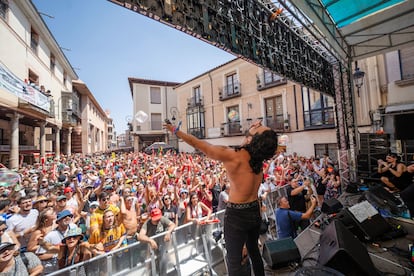
In July 2022, EL PAÍS published the following headline: The bubble is installed at music festivals in a saturated market. For yet another summer, the debate on the already popular festival bubble and whether or not there is an excessive number of music festivals in Spain. Javier Ajenjo, director of Sonorama Ribera, is forceful: “We have been talking about this for six years. It is a supply bubble in general, because not everyone can have a festival.” The cancellations of several events of various formats, led by the Reggaeton Beach Festival, which canceled its seven events due to lack of viability, and due to cut events indie like Fortaleza Sound and Oh, See! Nerja, killed in combat for not having sold enough tickets, puts on the table the lack of viability of part of the sector. The context is preceded by the suspension of Tomavistas from Madrid or by the stoppage of the concentration of punk rock Tsunami Xixón, which will not be celebrated in 2026 after several years of success due to the lack of bands of the genre on tour. “We didn’t feel like doing it wrong. It’s good to stop and look around,” explains Esteban Girón from the organization.
The reality is that after the crisis that live music suffered due to the pandemic in 2020/2021, supply and demand have not stopped growing and its benefits have reached historic highs. This sector has a turnover of 800 million euros in 2025, double that of 2022, when it began to flourish again. The organizers of the main festivals know this and agree that the potholes respond more to a self-regulatory mechanism of the market than to a definitive crisis capable of eroding this business. “In all sectors there are successes and failures, but ours is in the media and tends to be aired more. But the numbers are there: it is still a buoyant sector,” they finish from Bring The Noise, behind events that have hung the sign of “all sold”, such as the eclectic O Son do Camiño or the metalhead Resurrection Fest. A job full of comings and goings, that takes time to build and that Sonorama does not mind acknowledging: “It took us 22 years to not have losses.”
According to the latest Live Music Yearbook, Spain has established itself as a preferred destination for festival tourism at a European and even global level. In fact, the report Festivals. The new cultural engineprepared by the consulting firm LIN3S in 2025, says that it is the third country in Europe with the highest number – exceeding 1,000 in 2025 -, only behind Germany and the United Kingdom. “After the pandemic there was a boom and the industry was not prepared. It was said: ‘Not a city without a festival or concert’. Everything was flooded with meaningless offers and people who were not professionals in the sector joined the business,” explains José Piñero, director of iconic events such as Low Festival, Warm Up Estrella de Levante or Spring Festival. “Some organize festivals without having a clue and only because they have gotten the help of a city council. They finance themselves without knowing their viability,” he adds, while describing his profession as high risk. “Many said ‘hold my hat, I’ll put on a festival,’ and it’s not that simple,” he concludes. “You have to have a long-term approach. There are toxic elements, cases that harm the sector, produce imbalances and people begin to think about not buying tickets in case something happens. In the end, the righteous pay for the sinners,” he concludes. Of course, he explains that this year they have reached their best figures in WarmUP and Spring, and Low is preparing to celebrate its first edition in Torrevieja, after 15 years in Benidorm: “We have changed because in Benidorm they asked us a fortune to use the venue.”
For Javier Arnáiz, director of Mad Cool, the sector is undergoing a natural adjustment and is experiencing a moment of “maturity”, not only because of its professionalization, but also because of the public: “It has evolved a lot. Today it is more demanding, more informed and has a huge offer to choose from. It is not enough to have a good poster, you have to offer a complete experience and an identity.” About to celebrate the tenth anniversary of the Madrid event, he says that for years the offer grew very quickly and that now the market is finding its balance: “Organizing a festival is increasingly complex. Production costs, logistics and artists’ caches have increased. Projects that fail to differentiate themselves have more difficulties.” In this sense, Arnaiz would not speak of a crisis in festivals or the end of a model, but of “the importance of generating trust.”
Gonçalo Miranda, from the Dreambeach electronic festival, assures that there is an explosion, something similar to what happened in the real estate market in 2006. “It is an evil that affects many because there is currently an excess of events in Spain and many of the self-proclaimed festivals are nothing more than festivals. The majority of artists repeat themselves,” he assures. Rami Molinero, behind Ebrovisión for 26 years, agrees: “Many repeat posters because there are bands that are known to sell. In our case, more than half of the poster has never played before.” The head of Ebrovisión, which brings together 23,000 people in Miranda de Ebro (Burgos), believes that what is happening is more a matter of natural selection: “It has become the town’s festival. It seemed like you were going to become a millionaire with this, but I don’t know any promoter with a private jet or who lives like Bad Bunny. Living off a festival is very complicated.”
Carlos Montilla has been directing a small format festival in Galicia for a decade, Dezassete Grados Ribeira Sacra, and agrees that a restructuring is taking place because it has grown very quickly: “Those who do not have a consolidated image suffer. The public no longer moves only by posters, they do so by plan and experience. This is not the time for clonal events. We must be less afraid and bet on broader artistic lines.”
Tali Carreto, from Monkey Week, also talks about saturation and believes that the cancellations are from first-time projects with no track record or that compete in styles with others with more experience. “It is very important to create a community, like the fibers (spectators of the International Festival of Benicàssim) in its day,” he concludes. But there is also the factor of rising prices, as Juan Gama, from Prestoso, in Cangas del Narcea, points out: “Everything went off, it was programmed from the public and that made the groups’ caches increase. It is difficult to access certain artists and tours are planned well in advance.”
The death of the ‘indie’ poster: this is how festivals change to survive
The relaxation of once-rigorous musical labels has also affected the festival scene. “I don’t think he indie is banished. Rather, the labels have lost weight and listening habits are much more open than ten years ago,” they explain from Mad Cool. In Sonorama they agree and claim this openness: “The stigmas of indie They are disappearing. Before, they almost burned us for taking Amaral and we were surprised with Raphael. Sometimes we go too far cool: music has to be varied.” In this sense, Ajenjo celebrates that festivals are the object of desire of all generations: “Before, our parents did not go to concerts. Now older people are a fundamental part of the public.”
Electronic music has experienced notable growth and today occupies a central place within festival culture. This is what Mad Cool thinks, which in its previous edition included a single day dedicated to this genre and which is committed to it in one of its five stages. Of course, they ensure that they continue to believe in guitars, rock, pop and the artists that have historically been part of their DNA. “What has changed is the way posters are constructed. Before it was more common to work within very defined scenes; now the public consumes music in a much more transversal way,” they insist from the Madrid festival. Andreu Piqueras, founder of Medusa Sunbeach in Cullera, an electronics event that brings together 50,000 people at its venue every day, believes that seeing festivals like BBK Live or Primavera Sound betting on djs At the top it helps them: “In some way, it destigmatizes our gender.” Since Primavera, they believe that this artistic evolution is a reflection of the times: “Everything is more distributed. In our case, the poster has always had a very broad and diverse vocation that serves to capture the musical context of the moment: almost since its inception, artists from hip hopexperimental proposals, metal bands, a lot of electronics or musicians from non-Anglo-Saxon cultures.” And they consider that their diversity is what has ensured that they have sold out tickets for the last two years. “Our lineup goes beyond genres and headliners,” they conclude.