
For those days when the ground, with its misery and its vileness, seems unbearable, there is nothing like ascending to the firmament to have another perspective, wide and clean, panoramic. I have gone flying (literally) with two young and intrepid fighter pilots, US Air Force Lieutenant Robert Cassada and sergeant —non-commissioned officer— of the Luftwaffe at the end of World War II Nikolaus Wedekind. Both are fictional but with authentic characters. The first, unforgettable from its sonorous name, is the main character of Cassadaa first-time novel based on his memories as an aviator by the great James Salter, and which is news because it was unpublished in Spanish and has just been translated for the first time (by Eugenia Vázquez Nacarino, Salamandra, 2026). And the second, the German, stars Ruined Skya wonderful and highly documented comic series in French (five volumes) with a script by Philippe Pinard and drawing by Olivier Dauger (Paquet). Pinard is the author of that overwhelming album about the bombing of Hamburg, Inferno, which Norma published in 2022.
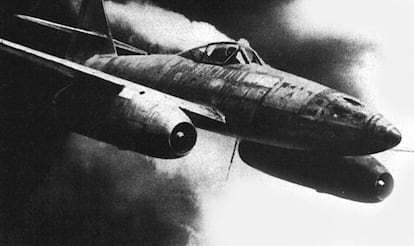
In the 1950s, Cassada flew F-86 Saber and F-100 Super Saber jets of the US 44th Fighter Squadron from several bases in Germany occupied by the Allies, such as Bitburg (Rhineland), where Salter himself was, or Giebelstadt, in Bavaria, which curiously ten years before was home to the legendary Me-262, my favorite plane, the pioneering German jets that were so surprising in the end. of the second world war and piloted by our other aviator, Wedekind. This is based at another nearby airfield, Lechfeld (about 250 kilometers from the first) and its flights, drawn with mastery and emotion, are desperate combat missions, always life or death, on the threshold of Nazi Germany losing the war.
Pinard and Dauger, the authors, solve the moral problem of putting a pilot from the Third Reich as the protagonist of their story by making Nikolaus Wedekind a very special character: he is an opponent of the Nazi regime who even boos Gauletier Giesler in his speech to the students of the University of Munich, writes leaflets for the White Rose and has a sister who is arrested and sentenced to death by the Gestapo and whose name is Sophie (like Sophie Scholl); Furthermore, his older brother, a fighter ace in the reactors, commits suicide after the failure of the attack against Hitler on July 20, in which he was an accomplice. Certainly, with this background, it is a little incredible that they put a shiny and secret Me-262 in the hands of young Nikolaus – with which he initially tries to defect to Switzerland – but it is true that at the end of the war the Luftwaffe was a total mess, a madhouse with the fighter pilots facing Goering (the famous “mutiny”) and Hitler who criticized the plump marshal and his air force.
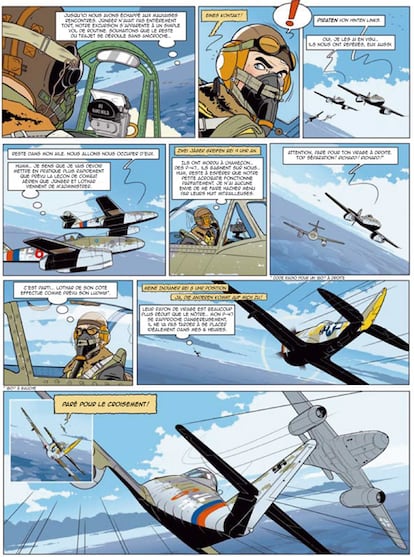
Wedekind is adopted by his brother’s comrades, all of them experienced and quite tired. Experts with the Knight’s Cross around his neck, and they recruit him for their unit, the Jagdgeschwader, fighter wing, JG 7, the most prolific operator of the Me-262, formed in the wake of the dejected ace Nowotny and who embarks on aúpa missions. The comic is so detailed that you almost believe that with what they explain to you in the panels you could pilot that jet yourself, a real sky shark. There are two sensational cameos: Johanes Steinhoff appears, the famous and former handsome fighter ace who literally left his face in a terrible accident with his Me-262 (a fate that our young aviator will share in the fifth album, Eden Hotel), and the devil himself, in the form of an omniscient, bastard mastiff eloquently named Fisto that Nikolaus inherits from his brother and that refers to Fausto (but don’t worry: the supernatural element works very well in the plot).
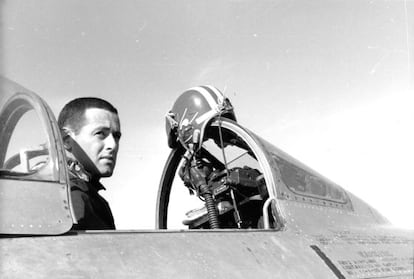
The fit of a pilot in a unit, and by extension of anyone in a group, is also the issue of Cassada, which Salter was not very happy about—it was a rewrite of his second novel The arm of fleshfrom 1961, which seemed like a failure to him and which he revised because his editor considered that it could complement his great aviation novel, the first, The hunters—. Cassada It is set in the Cold War and there is no real combat, unlike The hunters which takes place during the Korean War, in which Salter participated as a fighter pilot. However, it is a marvel, a true lesson in literary craftsmanship with passages that strangle you with emotion (“he looked to the east, there rose the pillars of the night, the deep, unfathomable blues, in the wake of the sun”). Salter’s cold, contained and sober emotion, which opens you up like the condensation trail of a reactor in a dazzling sky. When you return to Salter, as I have done now rereading Cassada in Spanish (I have the original edition of Counterpoint from 2000 dedicated by the same author with the phrase “Jacinto, here’s some bad wk!”) you wonder how you could have been without him, without his irresistible lapidary, cutting and refined prose.
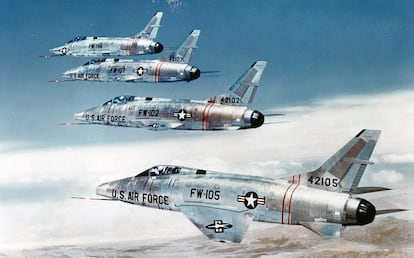
Here the life adventure of the pilot who does not quite fit into the squadron and achieve his ideals and dreams is revealed to be more essential and heartbreaking than in The hunters because there is no war in the background but rather everyday life—never free of danger, this is military aviation—built around the apparent operational routine. The characters and their feelings stand out more in that existential void in which the enemy is not the Migs but the elements, mechanics, rivalry or indifference. The drama, wrapped in the paradoxical sensation of immortality and plenitude of flight that Salter describes so well (“I felt the ethereal body, the purified mind”), is found especially on land, where Cassada, that strange blond Puerto Rican with navy blue eyes, with some features of Lord Jim and Billy Budd, fails to integrate among those who should be his peers, nor to stand out and earn acceptance and even a reputation—an issue that always obsessed Salter, both the aviator and to the writer. The most painful thing is that there is no objective cause for it. How many of us have felt that we don’t fit in, in a football team, in an editorial office, in a romantic relationship, inexorably, inexplicably, without being able to do anything to remedy it, lacking in aura.
As the pilots are at the bases with their families, Salter can also better mix his two favorite topics, aviation and relationships, which he dissects like no one else. In Cassada There is even a commander’s wife who seduces the young pilots like a copy of Mrs. Robinson from The graduateand a girl, Karen, with whom the protagonist falls in love and who turns out – look, there are girls in Germany – to be the lover of his captain (a situation that reflects one that Salter experienced, see his essential memoirs Burn the days, Salamander, 2010). The temperature of some of these scenes, such as when Cassada tries to clean up the champagne she has accidentally spilled on the dripping Mrs. Dunning (“you wipe it off”), exceeds that of the reactor turbines. Curiously, Cassada It seems like a more adult novel The huntersconstrained to a straight trajectory that leads to Cleve’s final confrontation with the scratchy Russian ace Casey Jones, the Keyser Söze of the Migs.
In Cassadadespite the low regard he had for him, Salter manages to magnificently describe the polarization between the forces that drag the pilots on the ground (competitiveness, adulterous sex or with the “mermaids” of the Munich bars, “goddesses with skin like milk”, frustration) and the exultant experience of flight, which he describes with elegiac tones (“they flew serenely, pure as angels”). Flying, a metamorphosis, an epiphany: “Cassada’s plane went from black to steel gray, then to silver as it swayed back and forth in the radiant light.”
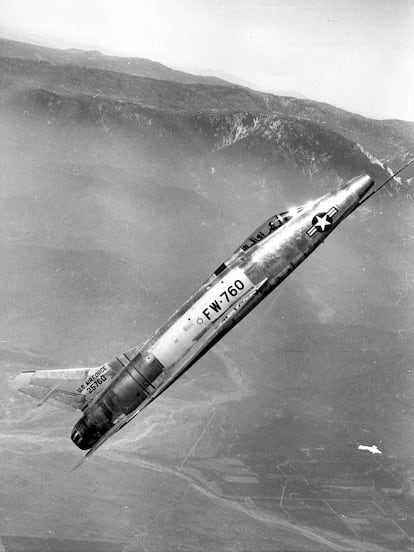
In the novel, in which two unexpected things appear, the matches Marienbad and the Roman city of Trier and its Porta Nigra, there is a lot of adventure: the deployment to North Africa of the Red Tails squadron for air combat exercises, the central episode of the two jets trying to reach the base in bad weather, short of fuel and with communications failures (something that Salter himself experienced). But what remains is above all the sensation of an ungraspable beauty, that escapes, unattainable like the confines of the sky of a deep and immaculate blue; and the realization of how random, evanescent and ultimately useless everything is.