
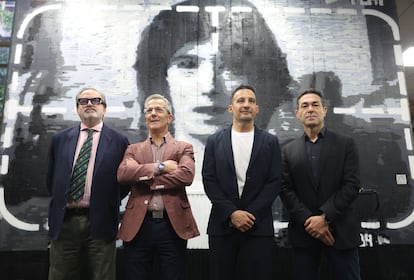
“My name is Angela. They are going to kill me.” On April 12, 1996, this phrase, spoken in front of a camera by a student from the Madrid Faculty of Information Sciences played by Ana Torrent, was heard for the first time in Spanish commercial rooms. That Friday it premiered Thesis, and from that day on, its director and co-writer, Alejandro Amenábar (Santiago de Chile, 54 years old), who was making his debut directing feature films, became a star. Three decades later, this Tuesday, the Faculty—where Amenábar studied and which hosted the filming of thriller— has projected Thesis as a birthday celebration. In the subsequent discussion, the filmmaker recalled what the beginning of his career was like and announced that he has just started a remastering that will correct some technical errors in the film.
In a packed auditorium, with room for 400 people, who just before had attended the screening of Thesis (many confessed when asking their questions that they had seen it for the first time, and looked idolized at the filmmaker), Amenábar told for an hour, in an event with many revelations, what that filming was like and the memories that stepping into the hallways of the Faculty again caused him. He had not returned for a decade, when in 2016 he inaugurated a mural tribute to his debut film on the 20th anniversary of its premiere, and which reproduces the film’s poster with Angela announcing her murder. “In the cafeteria we discussed a lot of classics, because each of us liked different films: for me the teacher is, first of all, Spielberg; then, Hitchcock… And I feel that the film portrays me in my filmic emotions is Cinema paradise”.
Amenábar was a bad student, according to his own confession. “At that Faculty I didn’t find what I expected. At that time Image and Sound was very theoretical; I wanted to make films. When I got here I became a bad student. It wasn’t the move I expected. And I also missed the subject of Filmmaking,” said the person who never finished his degree. The filmmaker has explained well why one of the characters in Thesis, The professor played by Xabier Elorriaga is named Castro, like the film critic and professor of Amenábar Filmmaking Antonio Castro. “I failed, but because I didn’t take his exam. I didn’t like the subject, which was very dry, nor him. While writing the script, Mateo Gil (co-writer and Amenábar’s fellow student) and I found the joke funny… although we removed it. Just before starting to film, I changed my mind and announced to Xabier: ‘Your character’s last name is Castro.’ After the premiere I apologized to Castro, because he has little “grace.”
In that colloquium he explained that a remastering of Thesis to correct a technical mismatch that was made during filming. Once the event was over, he explained the process to EL PAÍS: “Before, they filmed at 24 frames per second, while televisions broadcast at 25 frames. Therefore, when films were shot where monitors appeared, to synchronize the processes and images, one of the two elements was faked. Someone, I won’t say their name, decided that Thesis filmed at 25 frames per second, even though it was projected at 24. That’s why the film is about five minutes longer than it really should be.” When the filmmaker saw an Australian 4K version of Thesis, decided to face the task and correctly adjust the speed of the thriller. “I also want it to have 5.1 sound, which will help improve and clean up the dynamics between the characters, and I will remove an extra shot.”
However, he will not be able to add an image that he did not film at the time and that is missing today to place the context of the drama and show off even more the brutalist architecture of the building that houses the crimes. “I didn’t film an exterior shot of the Faculty, which would simply portray him, because he was a bad student and I didn’t take that into account (laughs). At least I do know that the chemistry between the actors and their characters remains fresh,” he explains.
When the students present at the event asked him for advice, he defined filming as “races against the clock.” And he continued: “So you have to know how to optimize. Thesis We shot it in the summer of 1995 in five and a half weeks, mainly in this building, in the Pharmacy hallways and in a chalet. The first thing I did was cross out three pages of the script, because in filming and in life you have to prioritize.” And in several answers he stressed that films “are compendiums of life.”
An example: “The role of Fele Martínez is a transcript of Sergio Rozas, the geekiest friend I had and still have. On screen you can see how they influenced me Dressed to kill, by Brian De Palma, the dialogues of Coma, by Michael Crichton, The Silence of the Lambs, Basic Instinct… I wrote the script with Mateo in the summer of fourth to fifth grade and we found it funny that the script was a whodunit (a novel or movie in which the identity of the murderer is only revealed at the end), with teachers and students involved and that took place in the bowels of this place. ” By the way, of those months he said that he studied in the mornings and wrote the thriller in the afternoons, when Gil returned to his native Canary Islands. “I failed, but I had a great time.”
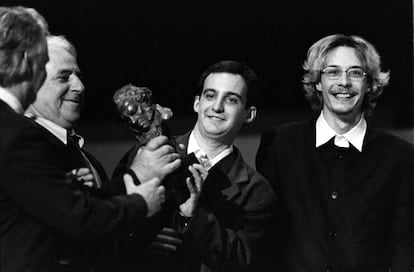
For several moments he has longingly mentioned José Luis Cuerda, the filmmaker who took his first steps. “He was a great and very modern guy. He lived filming like a nightmare, unlike me. He turned on quickly, but he also turned off. He was my second father, and he gave me life and film lessons. I still remember the day I came home and my mother told me that José Luis had called me.” He had seen a short film of his, and offered to help him. “It was fundamental in my career. ThesisFor example, Ana Torrent was a commitment of José Luis, because I thought that at 26 or 27 years old Ana would not be credible as a student. What a mistake. She sat me down and told me she wouldn’t get up until I accepted her. I’m so glad he did it. José Luis surrounded me with a team of veteran technicians. The other two protagonists? Eduardo Noriega was a very good friend of mine, and had already worked with me. Carlos Montero (the creator of the series Elite)who was also a friend of mine, found Fele in the Resad. Carlos understood that he gave the type of the character.”
Of his childhood, he recalled: “I was a super fearful child. My American neighbors showed me the movies that my parents didn’t let me watch. I deeply appreciate it, because watching and filming thriller movies has turned me into a less fearful person. Making movies has helped me face my fears.” And about the start of Thesis, about the dilemma of whether or not to look at a corpse cut in two on the tracks of a station, he noted: “It happened to me when I came to the Faculty. We travelers were divided into two groups: those who browsed and those who did not look. That’s what it’s all about. Thesis, although I have not invented anything. That terror born from not seeing is already in Hitchcock, in Alien. When I write, I already imagine. I find it quite easy in my head to visualize the sequences. And that’s why I knew it was going to be more powerful to show Angela’s reaction to the snuff movies to incorporate those images. “If I shot it again, it would show even less.”
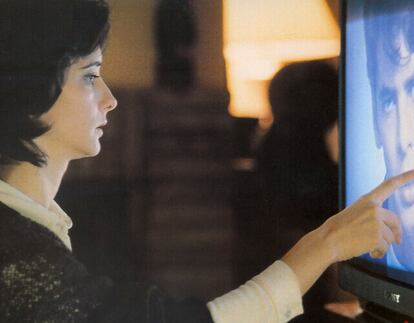
Amenábar was happy because the screening had confirmed that Thesis has not aged: the misadventures of some students who discover a filming plot of snuff movies (films with real torture and murders carried out for the delight of their potential spectator) in their Faculty still captivate audiences of new generations. “Technology has changed, although the reflection on our view of certain images has not. I considered the snuff movies like an urban legend. Today we know that human evil, looking at Epstein’s files, is capable of that and much more.”
Analyzing his career, he has stressed that he has not changed his way of directing or his passion. “Not even my childhood dream of going to a shoot. The only thing is that now I don’t look through the combo (the monitor from which the crew sees what was filmed), but rather I use a screen very close to the actors. Ah, now I sleep like a baby; before I had problems sleeping.” He continues to claim an “operatic conception of cinema,” and that is why he composes his soundtracks. “I have also been lucky enough to have the freedom and the last word in all my films. Are blockbusters different? Only in that it is as if you were driving a bigger car,” he said.
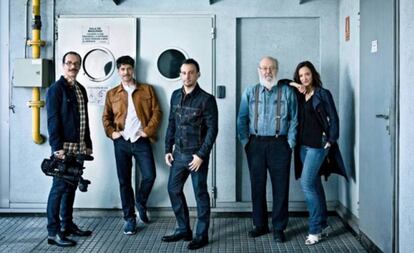
Thesis It cost 696,000 euros (at that time, 115-116 million pesetas) and raised 2.6 million euros. The legend also claims that the day after winning, on January 25, 1997, seven of the eight Goya awards – including film, novel direction and original screenplay – for which she was competing (only the best actress one escaped Ana Torrent), the VHS copies of Thesis They were sold out at the Vips chain, which at that time still had stores next to the cafes in its stores. At what moment did Amenábar discover that he was changing the history of Spanish cinema? “I would tell you that now, with this tumult. When you film, you have to believe that you are going to make a great movie, even if reality catches up with you later. I didn’t come away particularly happy from the filming of Thesis. At the beginning of 1996 he opened the Panorama section of the Berlinale, and I remember playing in the snow and a very bad session technically because the speakers on the left of the room failed. Yes, the Goyas were very good, but it was already in the pre-production of Open your eyes, and that was a nightmarish shoot.”