

_
_
The co-director of the documentary ‘Mr. Nobody against Putin’ receives the Pau ¡Justicia award from the Film and Human Rights Festival in Valencia
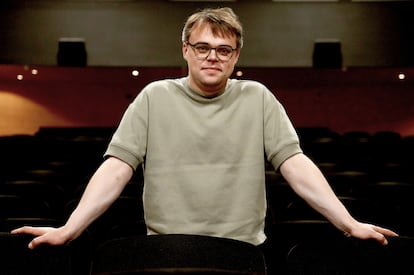

Pavel Talankin, 35 years old, is an outlaw in his country, a “foreign agent”, a pest for Vladimir Putin’s government. His crime: having told how the students of the Russian school where he worked are indoctrinated to handle drones or not to be “afraid of dying for the country” in the “denazification” from Ukraine. He did it in the incisive film Mr Nobody contra Putinwith which he won the Oscar for best documentary in the last edition.
Because of the documentary he had to go into exile two years ago. He now lives in Prague, but this Friday he is in Valencia on the occasion of the Pau ¡ Justicia award that was awarded to him by the 17th edition of the International Film and Human Rights Festival, Humans Fest. Hours before, he arrives punctually at the Generalitat Film Library with a face that is somewhere between serious and reserved, dressed in shorts and fanning himself with a fan to alleviate the intense heat.
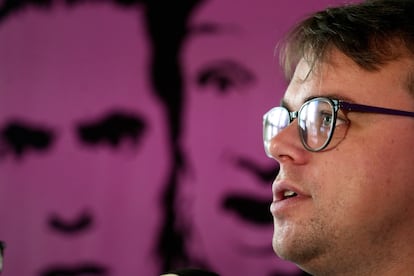
“When the film went viral, agents from the FSB (Federal Security Service, heir to the KGB) came to the school, gathered all the teachers, my former classmates, and told them that they could not talk about the film. And neither could they in other schools. They told them: ‘Listen and memorize: this film does not exist nor did it exist, this person does not exist nor did it exist; you neither write nor speak to this person,’ the former pedagogue in the small city of Karabash, in the Ural region where Russia splits between Europe and Asia.
He does maintain a relationship with the students who have already graduated from the school where he was recording daily life, in the first two years of the invasion of Ukraine, since February 2022, and where his mother is a librarian. “Yes, we talk, we communicate. My mother learned to use Instagram,” he comments, sketching a slight smile, which he repeats throughout the conversation, breaking the initial rigor of the expression on his face. His mother also learned to use VPN (virtual private network that encrypts the Internet connection and hides the IP address) to access blocked pages in Russia. You also have support groups in your country.
Trailer for ‘Mr. Nobody against Putin’
n
“}},”video_agency”:false,”alt_image”:”Trailer for ‘Mr. Nobody against Putin'”},”url”:”https://cloudfront-eu-central-1.images.arcpublishing.com/prisa/QEDXNIFJLRCXDPUPIZDM7GXBS4.jpg”,”alt”:”Trailer for ‘Mr. Nobody against Putin'”,”ogWidth”:16,”ogHeight”:9,”floating”:false});

02:04
Trailer for ‘Mr. Nobody against Putin’
Her mother, Talankin continues, is going to retire this year, after half a century, although someone interestedly anticipated the news: “She called me while she was at work and told me that she had read in the newspaper that she had been shamefully fired from her job, even though she was there, at her job working.”
The professor, who co-directed the documentary with American David Borenstein, was fully aware of the possible repercussions of his work. “I did know what could happen and it has happened. And a week after winning the Oscar I was already on the list of foreign agents (banned from all public life in Russia under the accusation of acting “under foreign influence”). I assumed all the risks. Schools in Russia are closed organizations in which even the parents do not even realize what is happening. And I was able to record because I was a professional there and I had the right to do so.” A Russian court has banned the broadcast of the documentary because it contains “signs of propaganda that convey a negative attitude towards the Russian Government and the special military operation.”
Talankin responds ironically that he would only return to Russia now if he sought to lead a very orderly and stable life, with inflexible schedules, without freedom, alluding to the prison routine. He cannot be certain that during the time of the flight to his country, for example, an arrest warrant is not issued against him. A woman received eight years in prison just for giving aid to Ukraine and for retweeting a publication on social networks you can get more years in prison than for murder.
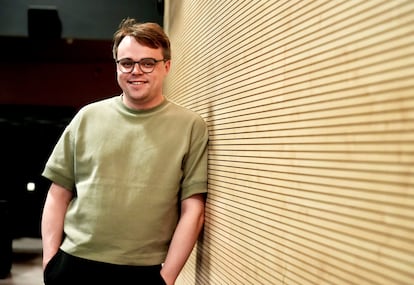
In Prague he claims to feel good. People, in general, do not judge him so much for being Russian, but for what he is like, although they have heard some critical comments remembering the former USSR, when it crushed with its tanks the openness of the “Prague Spring”, led in 1968 by the reformist Alexander Dubček, when he was elected first secretary of the Communist Party of Czechoslovakia.
He does not rule out being watched in his new life in the Czech Republic, but he also has no evidence. He uses humor again to allude to a distressing situation: “I feel safe, but I can’t say with certainty that no one follows me. Because those people wouldn’t say hello or greet me either, right?”
There he dedicates himself to working with his film, taking it to festivals, making it known. In this sense, the Oscar has contributed to giving an undoubted boost to the promotion of the film. “The direction of my profession has changed, because before I was a pedagogue and now I work more in art, although I want to say that the work of a teacher is also creative. So they are more or less similar,” he comments, before showing his solidarity with the Valencian teachers of non-university public education who have been on an indefinite strike for three weeks.
The importance of what is said
He says that, as is the norm among Slavs, he took the content of his words at the Oscars very seriously. “It is very important for a Russian what is said, not just what is done,” points out translator Iulianiia Novikova, a Russian journalist exiled in Valencia, emphasizing her compatriot’s message. Talankin was surprised by the notable impact his words had. He was very warmly welcomed by the star system from Hollywood, although he does not maintain any stable contact from those days.
It has so many cinematographic references that it cannot decide on one. He really wants to see the movie Minotaur, of his compatriot exiled in Paris Andrey Zviaguintsev, winner of the Grand Jury Prize at the last edition of the Cannes Festival. “I am very happy for him, that he can return to work as a director. It is very difficult to realize himself in other countries and return to the same level. Let’s see if he serves as an example to the rest of us,” he emphasizes in reference to the director of the penetrating Loveless (his last feature film shot in Russia, in 2017) or Leviathan.
He also says goodbye with humor. He admits that he has not put on cream to protect his white Slavic skin from the sun, because in his town in the Urals, having tanned skin, even “sunburned,” is a sign of distinction, “of rich people.”
Filed Under