
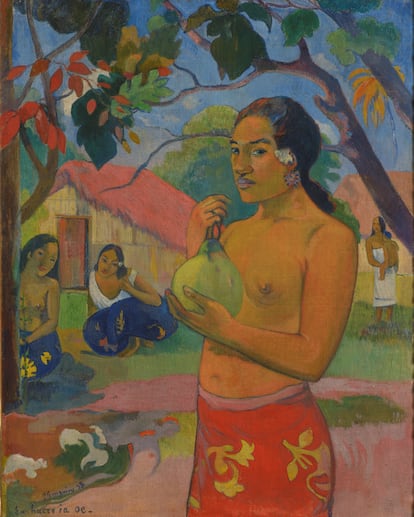
At only 25 years old, Paul Gauguin represented the image of a young bourgeois who had prematurely achieved success in finance. He worked as a liquidator at the Bertin bank and every afternoon when he left the office he returned to his house with a garden on Cancel Street and kissed his wife, Mette-Sophie Gad, a Protestant Dane with a tough character. He wore expensive clothes, pencil pants, well-brushed patent leather ankle boots, and smoked Egyptian cigarettes with a gold mouthpiece. At the bank they allowed him to speculate on the stock market, which provided him with an added fortune with which he gave himself the pleasure of buying paintings painted by artists who had been rejected by the hall of the Universal Exhibition of 1867 and were despised by critics. These were painters like Renoir, Monet and Cézanne.
In the midst of social success, Gauguin was attacked by a strange virus that prompted him to start painting on his own as an amateur. His wife thought it was a passing fancy, but she began to complain that he stayed home on Sundays, wrapped up in a smock, smearing canvases, instead of taking her for a ride through the Bois de Boulogne in a horse-drawn carriage.
The matter worsened when his wife, very prudish, discovered that her husband was painting a nude and that that nude was that of the maid Justine. The family altercation got worse when he learned that one of those nudes had been admitted to the Salon des Independientes and that it had earned a very favorable review from the poet Mallarmé. The public scandal that arose was a sensation that, as a bourgeois, I had never imagined, but in those times in Paris it always preceded glory. One morning this young banker named Paul Gauguin did not get out of bed. It was not that he felt sick, but that he had been touched by an incurable evil of a sacred nature. I had decided to be an artist and leave finance; He asked the bank director to resign and then dressed himself as a bohemian, whose first job was to abandon his wife and five children. She, spiteful, went to live with her family in Copenhagen and left her husband alone and penniless in Paris.
Someone told him that in Pont-Aven the owner of a boarding house offered bed and food to a group of painters in exchange for work. There Gauguin painted cows, green landscapes and naked Breton women without managing to sell a painting. Attracted by his admiration for Van Gogh, he traveled to Arles to meet him in person. They were two crazy people who soon came into collision. At the end of the aesthetic disputes they always came to blows, to the point that on one occasion Van Gogh was abducted, cut off one of his ears and gave it to a whore. The wheel of fortune offered the possibility for Gauguin to cross several seas until he reached Tahiti and then left for Martinique. There he first perceived the wild wind and the pure light of primitivism. It was a revelation. He returned to Paris accompanied by a macaque to show his new aesthetic. On November 4, 1893, he exhibited 44 canvases and two sculptures in a Durand-Ruel gallery on Laffitte Street.
The bourgeoisie took their children to the exhibition so they could make fun of the nonsense painted by that painter, a certain Paul Gauguin. People laughed louder at those pictures of naked Javanese women. Isn’t this, they said to themselves, that crazy man who had been a banker for years and had abandoned his wife and five children to dedicate himself to painting? With the promise that this gallery owner would send him monthly money to continue painting, which he did not fulfill, Gauguin said goodbye to civilization definitively to return to paradise. The night before heading to Tahiti again, he was approached by a prostitute on a street in Montparnasse. And as a gift he took syphilis to Polynesia, where he lived surrounded by the pleasures of wildlife and the love of indigenous people, happy adolescents, among the coconut trees. His painting did not need any imagination, but his body soon began to rot.
On his dying bed he was cared for by some young Polynesian women and at his side was one of the cannibals crying inconsolably, who upon seeing him already dead bit his leg so that his soul would return to the body, according to their rites. The indigenous people surrounded the cabin. They dressed the corpse in the Maori way. They anointed him with perfumes and crowned him with flowers. A missionary bishop rescued the remains to bury them in a Catholic cemetery. Under the pallet Gauguin had left only twelve francs in loose currency. That happened in Atuona, on May 8, 1903, at the age of 54. Gauguin’s work consists of about three hundred paintings and he is undoubtedly the most sought-after painter in the history of art today.