

One of the most fruitful and original careers in the history of crime fiction began its journey, without the protagonist still knowing it, on December 29, 1996. The murder that day of the young Belinda Pereira in Dublin, never solved, the reaction of some when it was discovered that she was a prostitute and the negligence of the police infuriated a young freelance journalist from the Irish Times who at that time was reading the teacher Ross Macdonald diligently. His name was John Connolly and that rage, that need for justice, that redemptive impulse crystallized in everything that dies (1999), the first story starring detective Charlie Parker. Almost 30 years later, we meet Connolly (Dublin, 58 years old) in a hotel near Retiro Park and, therefore, the Madrid Book Fair, where he is spending this weekend as an illustrious guest. It comes with a premiere under its arm (Children of EveTusquets, like all his work) and has learned Spanish since the last meeting with this journalist. But let’s go back to the beginning.
“I had a draft, but not a conception of my first novel as it turned out in the end. I consider Ross Macdonald the poet of compassion in the crime novel and I felt a very strong connection between Belinda’s case and the empathy he had with his characters. It is important not to be complicit in evil, to be aware that there are no second-class people, neither in literature nor in life,” he comments, very concentrated, underlining each word. It is, in short, that “splinter of ice stuck in the heart” of which he speaks, quoting Graham Greene, in Parker, A Miscelany (small limited edition treasure for collectors) where, in addition, he confesses that what he likes most about the genre is how it addresses the position of good men and women in the face of evil. The criminal literature that he cultivates is one in which the heroes are bound to do something, even at a high cost to themselves, because otherwise they become accomplices in what happens.
With these ingredients, Charlie Parker—whose adventures take place in the United States, especially in the Maine area—could have been one more notch on the list of detectives mistreated by life, with a dark past and a desire for justice. However, its connection with certain dark forces gives the stories a supernatural factor that makes them unique. A strange and difficult route to take. “Given my reading in my youth, the most natural thing for me was to mix it up, although at first I suffered the distrust of some critics, readers and booksellers. I was going the opposite way to the rationalism on which the genre had been based. However, we are not one hundred percent rational, so everything cannot be explained. And, furthermore, I am Catholic!” Add to this mix the great Gothic tradition of Irish literature, which he has frequented so much as a reader, and you have the Connolly Formula.
However, all this does not explain why Maine, why North America as a setting. “The United States has always been a land in which the Irish have been able to create a new life. I had problems finding models in the literature of my country because for many years there was a great distrust of the genre, so I looked at their type of detective, but without imitating them. The differential effect is the supernatural,” he explains.
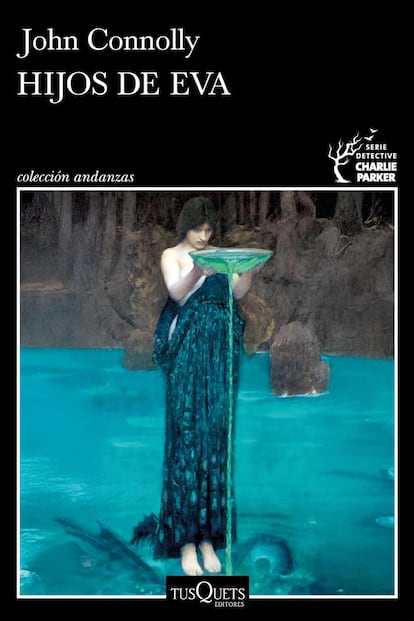
In Children of EveParker investigates the disappearance of a friend’s boyfriend, who ran away leaving a cell phone behind with a message: RUN. With this plot excuse, Connolly deploys his entire narrative arsenal and connects the investigation (in which there are kidnapped children, drug traffickers and stolen archaeological objects) with the deep history of the series’ protagonists. In a Borgesian echo, the mystery here is more interesting than its resolution, although the author’s craft always brings the cases to a successful conclusion.
Defined by his creator as “a being of rage but even more a being of empathy,” Paker investigates with the help of Angel and Louise, a couple of criminals (the first a thief, the second a professional murderer) who have accompanied him from his first steps. As does the ghost of his dead daughter, Jennifer, who continues to visit him. In this latest adventure, as in the immediately preceding ones in the series, which is in its 23rd installment (25 if we add two short novels), this dark element is accentuated; the end, the collision of the two worlds, is sensed, not so far away. Parker searches for a redemption that he cannot find. “He is haunted by the ghosts of the deaths of his loved ones. In the following novel (A River Red With Blood) their relationship with God becomes complicated, it becomes more hostile, and Jennifer shares that hostility.” And even, Connolly advances, the life of Angel and Louis is not what it seems: their passage through the world may be just a form of punishment. And that will affect Parker given that, in the end, this series would not be the same without the stories of friendship between men, one of the author’s favorite themes.
I don’t want to end these characters, I need them in my life, I love seeing the world through their eyes, but I will have to
“I’m preparing readers for the end,” he acknowledges after a long sigh. “I don’t want to end these characters, I need them in my life, I love seeing the world through their eyes, but I will have to do it,” he says. When? “I see books as chapters within a larger narrative. I know the destination, but not the route. And I even know the title of the latest novel and I could write the last chapter, but I don’t want to, not yet.” He has calculated, he later confesses, around 30 novels in total, although the process has been complicated. If you want to watch the television series before reading the books or to complete the experience as has happened with other living myths of crime fiction (see, for example, Harry Bosch), don’t look for it, it doesn’t exist. However, that could change and determine the final fate of Charlie Parker. A pilot with Bryan Cranston and Colin Farrell is going to be filmed for Amazon, he says, and if it works, there will be five seasons. The producers demanded to know the ending, a privilege they share exclusively with the author. “Not even my wife knows!” says Connolly, somewhere between amused and desperate. “I am in an unusual creative position,” he concludes.
Evil is the thread that weaves Connolly’s bibliography. One of the most chilling approximations occurs in Wickeda story outside the Charlie Parker series but linked to him by the protagonist, the police officer Sharon Macy, who is now his girlfriend. Connections inside and outside Parker’s universe that are repeated in his more than 30 works. Plus, its hero has faced some of the best bad guys in the history of the genre. Mr Pudd or The Collector have left an indelible mark of concern and fear on hundreds of thousands of readers. “It’s easier for me to talk about evil, to build these characters that come to me with an image and a name, I never have to think about it,” he celebrates. “We cannot say that I believe them in opposition to Paker, Louis and Angel because they are not completely good either. There is a conflict with evil and what interests me there is survival. For Parker, for example, this makes him someone more good and compassionate.”
Readers don’t have time and I want to give them something of value every time
The recognition from the public and critics has not relaxed Connolly. He is now preparing two novels outside the universe of his most famous saga: one, set in the Watergate era, and another in the Italy of the Borgias. He knows that they don’t have the same impact, but they keep him alive and alert. Anyway, that explains why a flow of energy runs through each Parker novel as if it were the first. “I don’t want to spend three years on a book I don’t want to write. Thanks to the other experiments, I return to Parker with enthusiasm,” he admits. “It’s still early,” he jokes, “but if they remember me for anything it will be Charlie Parker, so I want to give the best version possible.” There is also a moral element: “Readers don’t have time and I want to give them something of value every time. Furthermore, I know that there are many who will read my books just for the pleasure of being with the characters, who are much more important to them than the plot. And I don’t want to exploit that advantage with bad novels.”

He thus follows the teachings of his teachers. Ed McBain, creator of the District 87 series, prolific and excellent narrator, taught him in his youth the value of characters, of serialization. With Macdonald he acquired a compassionate gaze and with James Lee Burke the poetry of the landscape. These are the detective stories of an author who has always been writing and who, at the age of six, poisoned by the fiction of Enid Blyton and the television series of Tarzan, was given five cents per story by his teacher Mrs Foley.
Looking back, Connolly says he would like to go back to 1999 to improve his works. “In the first one there is too much violence. It is a young man’s novel and I have had to live with the consequences of having used conventions that are too close to the cliché. After publishing, I see the mistakes, but we have to live with them, start again and make different ones,” he admits with sportsmanship. At the end of the talk, Connelly’s gaze through those small eyes of an uncertain blue maintains the same load of empathy that led him to literature three decades ago. Parker’s followers have hero(s) for a while.
John Connolly
Translation of María José Díez Pérez
Tusquets, 2026
456 pages. 22.90 euros