
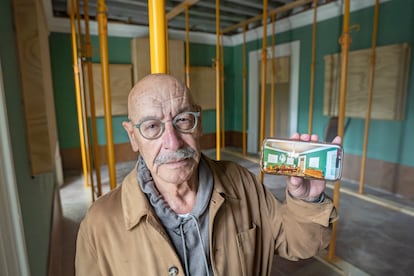
The path that leads to what was once the opulent headquarters of the Academy of Fine Arts of Cádiz is a gloomy labyrinth between construction props, deteriorated stairs that go up and down, boxes and packed furniture. It is the only safe way to reach rooms in which there is no longer a trace of those crystal lamps that illuminated its century-old collection of sculptures, paintings, engravings and the most important artistic bibliographic compendium in the city. Everything has been packed and moved for eight years, fearing that the building that houses it – the old School of Arts and future expansion area of the Provincial Museum – will collapse.
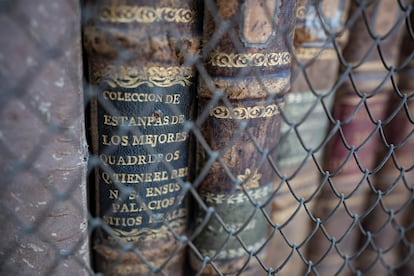
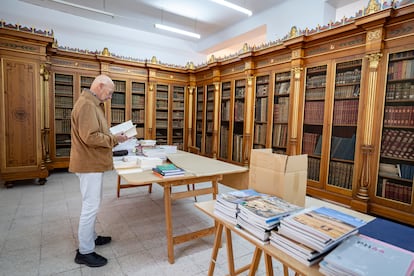
“What we defend is to return, but what we see is something very different,” summarizes the director of the entity, the photographer Pablo Juliá, surrounded by the immense 19th century bookstores that made up its entire library, now relocated to another area of the building that is safer, but also inaccessible to visitors. It was at the end of 2018 when the delicate state of the building that has been its headquarters since the beginning of the 19th century forced the institution to pack and dismantle all its assets and move it to a wing without risk of collapse, where it has remained stored since then and without access.
The institution maintains, as best it can, its cultural activity in a headquarters provided by the City Council since 2024. But the inability to use most of its extensive artistic and bibliographic collection treasured in 238 years of history curtails a good part of the Academy’s operation. “We are forced to reject a number of requests from researchers because we cannot access the funds,” criticizes Juliá, saddened, while organizing the partial move of a limited part of the assets to that municipal headquarters. Among the packed goods are, in addition to all its vast bibliographic and documentary heritage, plaster casts of classical sculptures commissioned from Rome in the 18th century, valuable antique furniture, the paintings that decorated the ceilings of its rooms and various works of plastic arts ranging from the 18th century to the 20th century, such as the fifty avant-garde works made in 1966 by various artists as a tribute to the poet Rafael Alberti.
All this enormous heritage was stored on display in the four rooms that the Academy has in the old School of Art, since 1838. The institution came to that place from the Palace of the Marquises of Recaño, its founding headquarters in 1788, when the Cádiz City Council offered to move there, after the Confiscation of Mendizábal left part of the old Franciscan convent of Cádiz free. That move was, over the years, the seed of the current Provincial Museum of Cádiz – whose collection of fine arts comes, in part, from funds that came to the Academy in those exclaustrations. Two-thirds of the building was dedicated to the Museum and the headquarters of the institution and the city’s Art School in the other third. For 36 years now, that entire wing of the building was also planned as an extension of the Museum that was never executed.
In fact, the Academy is the last tenant left in that deteriorated part of the building, after the Junta de Andalucía moved the Conservatory and the School to a new building. Originally, the plans were for this building managed by the Board, but formerly municipally owned, to be rehabilitated for this new museum use shared with the Academy with the investment of the Ministry of Culture, owner of the provincial museum collection. But with no intervention plan in sight in the short term, the space languishes and the cultural institution desperately contemplates the quagmire in which it is immersed. “It seems like interest has been lost,” Juliá complains.
The Ministry of Culture of the Government of Andalusia assures that this long-awaited expansion of the Museum “is a question of the political will of the Ministry of Culture”, which it urges to move forward in “administratively resolving the formula to intervene in the building.” But from the Ministry they explain that they have just invested 735,000 euros in the works of the two roofs of the building – after years of delays due to leak problems – and that the second planned action is “the renovation of the museography of the Casa Pinillos”, a nearby property that has been waiting for that investment since it was inaugurated in 2012 to also function as an extension of the Provincial. “Given the immediacy of the elections in Andalusia, once the new government is formed we will meet with the Ministry to resume coordination regarding the Museum of Cádiz and the rest of the Ministry’s interventions in the community,” they clarify from the State Administration, while highlighting the willingness to collaborate on the demands transmitted to them by the region.
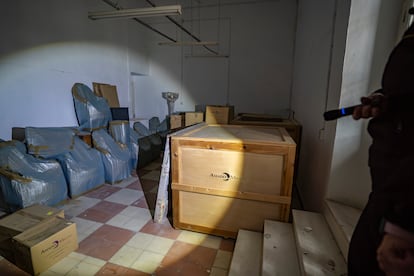
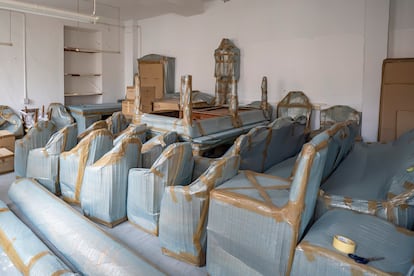
Far from that dispute between offices, Juliá and the academic and former director of the Museum, Juan Alonso de la Sierra, erect a huge plastic that acts almost as a curtain. On the other side, dozens of classic plaster sculptures await their final destination. “They were entrusted to the Spanish Embassy in Rome in the 18th century for teaching and they arrived by sea. It must be taken into account that the Academy had a lot of money in a thriving and cosmopolitan city,” explains Alonso de la Sierra, art historian and author, together with his brother Lorenzo, of the best contemporary treatises on the city’s artistic heritage. One floor above, in another former classroom of the School, a huge parquet protects the paintings that decorated the ceiling of one of its rooms, made by the nineteenth-century painter Alejandrina Gessler, known as Anselma.
The present period of lethargy imposed on the Academy by the worrying state of its headquarters contrasts with that brilliant past. Created in the same classicist fury in which the San Fernando school in Madrid was born, the school in Cádiz soon understood that being “a school of the three noble arts, architecture, painting and sculpture,” as Alonso de la Sierra recalls, was also a form of power. Hence, at its foundation, the people of Cádiz decided to recruit from Rome the main student of the painter Mengs, Domingo Álvarez Enciso, responsible for that first class of 1789 in which 400 students enrolled.
Then, in the first half of the 19th century, Nicolás de la Cruz y Bahamonde, Count of Maule and key patron to enrich the institution’s heritage, would come. Also, the neoclassical architect Torcuato Benjumeda, author of some of the outstanding religious and civil buildings in the province and professor at the institution. With each new entry from an artist, “a donation of a piece,” as Alonso de la Sierra adds. And so on until forming that valuable heritage that now waits, without a clear date, to be able to once again be the subject of visits, studies and investigations, now stopped. Who was going to tell the founders of that school created to teach the noble arts that all its fruits would end up packed in dozens of moving boxes.