
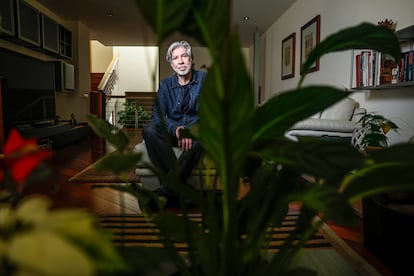
Manuel Valdivia (Madrid, 69 years old) has a resume full of successes. family doctor, Companions, Police, in the heart of the street These are just some of the television series that have come from the head of this creator. The pandemic left another on education and one on street musicians in the pipeline, but the appointment with EL PAÍS is for another reason: the publication of his book Wanting or not wanting (An editorial), where he tells the story of his family. A mother who suffered from a mental illness, although at the time it was said that she was “nervous”, an execution in the Civil War that disrupted everything and a home that was blown up.
Ask. I promise you that we are going to talk about your book, but I have read somewhere that it is considered the first showrunner Spanish. What does that mean?
Answer. I was the first without knowing what it was, I didn’t even know that word existed. He is the chief creative officer of a series, of the stories, of how they are told, sometimes he directs, he writes… he has to agree on everything so that each episode, each season is coherent… come on, the showrunner He’s the fucking master.
P. It is behind many of the great successes in series, especially in the nineties. What other project would you have liked to sign?
R. David Simon is one of my references. I have read everything he has written and within his series there is one in particular that may not be one of the best known, but that fascinates me, Treme. It was made in New Orleans, after Hurricane Katrina. He talked about people’s lives after that disaster, and I loved how music, jazz, was involved in all of that. I like series that speak from the truth. Now I’m following The Pitt week by week. Of the Spanish ones, I like them a lot To want y Jakarta.
P. He was a director of Telemadrid for a time.
R. It happened at a time when it was freelance because I didn’t like having bosses at all, but one day I ran into my friend José Miguel Contreras on the street, then director of Telemadrid programs, and he said to me: “Hey, why don’t you do an end-of-year special, but not the typical one, but from 1992?” And it was 1991. I did it, it went well and that’s how I got in. José Miguel convinced me to be responsible for fiction and entertainment programs. Every week for the first two months I came into the office and told him: “I’m leaving, I can’t stand this, I can’t.” I was there for a year and a half, it was a wonderful, imaginative, independent stage, where I launched my first fiction, Senior College.
P. He says he likes series that speak from the truth. How much did it cost to tell it in your book? Wanting or not wanting?
R. First I considered writing fiction, a thrillerbut then I thought: I need to tell something real, something that matters to me. And I had all the doubts in the world, because the first day I went to tell my mother that I wanted to talk about our family history, I was at the door pointing my finger at the intercom, not knowing whether to press or not. I knew that if I went up and we started talking, maybe it would hurt me and reopen emotional wounds.
P. Had it been a long time without talking to her?
R. He hadn’t seen her for three years. He called me from time to time, in those conversations that lasted just a minute. My first dilemma was: should I write or not write? The second: am I going or not going? But when I started talking to her and saw how lucid she was, and she started telling me details that I didn’t know, I think my job, that of a storyteller, got the better of me. “Manolito, this story is very good,” I told myself, and it served as a shield to understand what happened to us that made us think that we were happy, that my mother had overcome her illness, and that we ended up destroying ourselves. I think for the first time I have told a story that I didn’t know how it was going to end. I put an end to it because it had to be done, but life does not have resounding endings.
P. What is your relationship with them like?
R. For many reasons my brothers divided into two sides. The two little sisters, on the one hand, and my older sister and another brother, on the other. They wanted to attract me from everyone, and from an absolutely cowardly position, I decided to avoid it. I shirked part of my responsibilities out of pure survival and ran away from them.
P. What body do you have left after writing 657 pages?
R. Many things have satisfied me. I knew some of them, like when they shot my grandfather and blew his face off. My mother, as a child, not only was her father shot, but she was forced to attend the public execution of those who had been responsible, and that caused her a trauma that was what brought her, when she got her period, the first symptoms of an obsessive neurosis that lasted for decades and that not only marked her for life, but everyone. My father discovered that his wife was sick on their wedding night. I have found out a series of family matters, I have restored things I did not know. But, on the other hand, I have verified that the wounds are still alive. I was separated from my mother when I was 11 months old because she was not capable of taking care of me; she became groggy from the medications and electroshocks. I didn’t see them again until I was 12 years old. And I am privileged, because I was with my grandparents and I got rid of everything that was there. When I arrived, I asked why I lived with them and they answered: “Mom is nervous.”