
Laurent Pelly rarely settles for naturalism. In each operatic production, the French stage director builds an unmistakable visual universe, where costumes and meticulous dramatic work on the characters merge through a deliberate cultural filter. He already demonstrated it three years ago with his Turkish in Italy Rossiniano, conceived from the Italian romantic fotonovelas of the fifties, and in 2024 with some Mastersingers Wagnerians whose cardboard Nuremberg functioned as a metaphor for cultural ruin. This season, your Eugene Onegin by Tchaikovsky in Les Arts he opted for extreme purification, while in the Maestranza in Seville he transformed the forest of A Midsummer Night’s Dreamby Britten, in a dreamlike and disturbing space.
His new production of The sold brideby Bedřich Smetana, premiered with enormous success at the Teatro Real on April 14, in co-production with the Lyon and Cologne Operas and La Monnaie of Brussels, confirms that same creative logic: finding a precise cultural reference that illuminates the work from within. The result is a complete success, capable of naturally balancing the poetic and the absurd in this founding title of the Czech national opera, premiered in 1866 and reworked until 1870. As he acknowledged to this newspaper, his starting point has been the Czech school of animation of the fifties and sixties, and more specifically the naïve, satirical and surreal world of the puppets of Jiří Trnka – the Walt Disney of Europe of the East—, whose Splinter (1947) portrayed bohemian rural life in a fable tone, with its festivals, its dances and its circus.
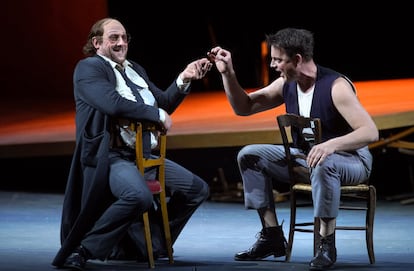
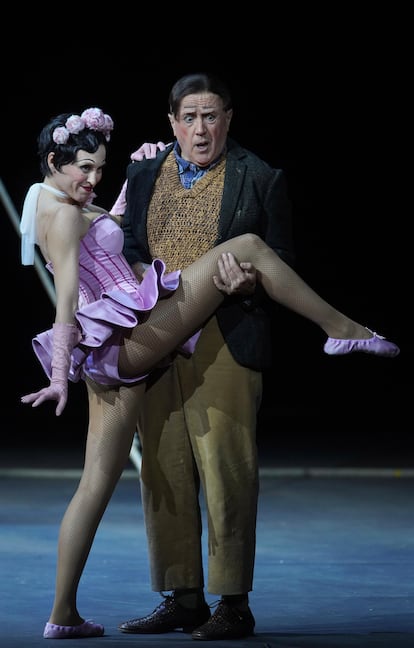
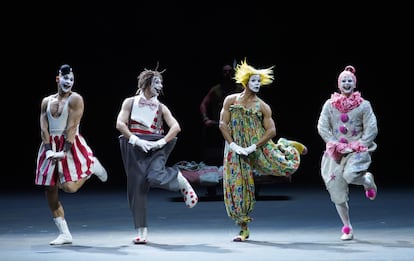
Faithful to his method, Pelly once again uses costumes to sculpt the personality of each character in this Czech reinvention of the comedy of artwhere love, intelligence, money and happiness end up prevailing. The main couple is drawn with finesse: Mařenka, the sensitive, willful and temperamental bride; Jeník, her lover and false traitor, who negotiates the transfer of his beloved from himself to himself and also charges for the transaction. But the French director shines even more in the drawing of the comic characters. Kecal, the fat and talkative matchmaker, ridiculed by Jeník’s trick, here adopts the air of a down-on-his-luck lawyer; Vašek, the village idiot and stuttering simpleton, is portrayed with his infantilized haircut and the brilliant discovery of the bicycle. Around them, the parents of both protagonists—the distrustful Ludmila, the biting Háta—occupy the same morally reprehensible plane, while the circus characters of the third act fit seamlessly into the naïve and satirical tone inherited from Trnka.
The set design by Caroline Ginet, already Pelly’s accomplice in Mastersingersonce again combines simplicity and impact. A cloud of furniture floats over the stage as a transcript of the material goods that fly over the plot; The second act is resolved with the simple sketch of an uneven tavern; and the third, with a circus tent that is set up in plain view. Everything is wrapped in the fabulous tone provided by Urs Schönebaum’s precise lighting.
The vocal cast offered a couple of lovers of good level, although with nuances. The soprano Svetlana Aksenova seemed more comfortable in the tragic profile of Mařenka: she phrased her third act aria with pleasure, Oh, what sorrow… That dream of lovewhere the protagonist regrets her lover’s betrayal. However, in the duet with Jeník that follows, the Russian singer failed to transform herself into the angry and stubborn teenager, revealing a strained, faded treble. Tenor Pavel Černoch is an experienced Jeník, but his vocal evolution toward more dramatic roles—especially Janáček—has taken away some of the charm and lightness that the role demands. However, she shone in the second act with her aria When you see… How can you believewhich he sang with fluidity and confidence.
The two winners of the opening night were, however, Günther Groissböck and Mikeldi Atxalandabaso. The Austrian bass offered a brilliant incarnation of the matchmaker Kecal, a character that he had already sung successfully in German and that he handled with complete solvency in Czech, savoring the phrases of Karel Sabina’s excellent libretto that Smetana seasoned with shades of Rossinian buffo. Groissböck showed off a splendid middle and high register, and was able to intelligently compensate for a less solid bass area. For his part, the tenor from Bilbao composed an outstanding Vašek, which he gave with the right dose of comedy, with excellent vocal means in both his aria in the second act and in the third.
Among the supporting cast, three Spanish singers stood out, ideally characterized as parents of the lovers: the baritone Manel Esteve (Krušina), the soprano María Rey-Joly (Ludmila) and the bass-baritone Toni Marsol (Mícha), who were joined as a luxury by the experienced mezzo-soprano Monica Bacelli as Háta. The four of them especially shone in the beautiful sextet in the third act with Mařenka and Kecal. Of the rest of the cast, soprano Rocío Pérez was an ideal showgirl as Esmeralda alongside bass-baritone Ihor Voievodin as Indio, and tenor Jaroslav Březina was an excellent Principal Comedian, in addition to having supervised the ensemble’s Czech pronunciation.
The Main Choir of the Teatro Real faced with admirable quality, both musical and prosodic, the various choral numbers of the opera, in which Pelly also requires them to move and dance. They shone with a polka rhythm, although their best moment came with the male section in the drinkers’ chorus that opens the second act. The Main Orchestra, for its part, was once again at a high level, with a sharp string section along with beautiful solos and woodwind ensembles.
In fact, the main director of the Teatro Real, Gustavo Gimeno, was another of the winners of the night. After directing intense productions by Prokófiev and Bartók, this comic opera by Smetana represented a considerable stylistic leap. We are talking about a composer who at the age of eighteen left a revealing aesthetic confession in his diary: “By the grace of God and with his help, one day I will be a Liszt technically and a Mozart in the field of composition.” The Valencian seemed to take sides with the Lisztian tension in the famous overture, which he scored by taking risks with intensity and precision. That same energy was maintained in the rest of the first act, although at the cost of such a resounding symphonic quality in the pit that at times prevented the theater from flowing onto the stage.
Everything improved from the second act, where Smetana’s most Mozartian side breathed another life into the stage action. The production, faithful to the definitive version of 1870, nevertheless chose to play the raging with the curtain lowered as an intermission, as was done in the 1869 version – the first divided into three acts, still with recitatives recited according to the tradition of the Singspiel—. The best of the night came after the break: in the third act, a greater luminosity in the wood allowed Mendelssohnian overtones to emerge, and a more airy direction allowed for a virtuosic brilliance close to Berlioz. However, more spark and humor was missing from the pit in many moments, such as in the famous jumpy of the third act, converted by Pelly with great intelligence into a number starring four actor-clowns who set up the circus tent in full view of the public.
‘The Sold Bride’
Music de Bedřich Smetana Libretto by Karel Sabina
Manel Esteve baritone (Brush); María Rey-Joly, soprano (Ludmila); Svetlana Aksenova, soprano (Marenka); Toni Marsol bass-baritone (Spinal cord); Monica Bacelli, mezzo-soprano (That); Mikeldi Atxalandabaso, tenor (Vasek); Pavel Černoch, tenor (Jack); Günther Groissböck, low (Kecal); Jaroslav Březina, tenor (Lead Comedian); Rocío Pérez, soprano (Esmeralda); Ihor Voievodin, bass-baritone (Indio).
Choir and Orchestra of the Teatro Real.
choir director: José Luis Basso.
musical direction: Gustavo Gimeno.
stage direction: Laurent Pelly.
Teatro Real, April 14. Until April 30.