
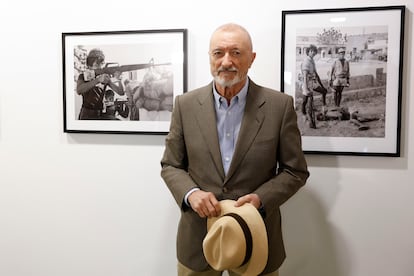
“They are covering up the war from us,” said the writer and journalist Arturo Pérez-Reverte this Wednesday morning at the Ateneo de Madrid, at the launch of his new book, Special correspondent (Alfaguara), an anthology of the chronicles he wrote when he was a war correspondent between 1974 and 1985, first for the newspaper Pueblo and later for Spanish Television. On the occasion of the publication and together with PHotoEspaña also presents the exhibition war photographs (1974-1985), which can be visited from May 7 to 31 in the same place and which show 30 black and white images taken by him, which he believes are “inadmissible in today’s world.”
The 21 years he worked as a war reporter, Pérez-Reverte said, helped him become the author who writes his current novels and he explained that a faithful follower of his books will find in the new publication a series of keys that will make sense to it. He has not been told about the war or the horrors committed by man, he has repeated, because he experienced them firsthand in the war conflicts in Sarajevo, Beirut, Nairobi, Baghdad, among others: “They have distanced us from reality: war is a terrible horror. War smells bad, it reeks of rotten meat, of burnt plastic, of blood. In war people scream, the wounded howl, their guts come out.”
And that experience has been used to criticize the coverage of conflicts in the current press today. “Now war is being pixelated,” he said, referring to the fact that the crudest and most shocking images are “voluntarily censored” so as not to bother the public who, in turn, also have a responsibility in this denial of reality, because “no one wants the party to be spoiled” since “war is really annoying.” He has also added that “the world deserves what it has” because, he has exemplified, if Donald Trump manipulates, it is because someone “asked” him to do it.
But he, along with the team of colleagues who accompanied him during the years of coverage, “wanted to stir consciences,” and that is what is reflected in both books, the one of stories and the one of photographs — which in addition to the exhibition are also collected in print. Instead, he has accused that now reporters cannot leave the hotels or be in the middle of conflicts, so they must feed the information with images and testimonies captured with soldiers’ cell phones or drones flying over the confrontation. “There is no longer any reliable war,” he said, because they, the correspondents of their time, were a guarantee that what was happening was real. “I have not seen children with their heads crushed or with their guts sticking out. Not even a mutilated, bleeding man, I have not seen an injured person howling in pain, I have not seen that. I am referring to the latest coverage.”
In their time, he recalled, if one of them was arrested or was in danger, they did not ask for help from the authorities or the Army, but rather they solved their problems alone. When asked by the public about his perception of journalists who are killed today in armed conflicts, he responded that this has always happened: “Being a journalist and being killed is included in being a war journalist.”