
The history of the Fabra i Coats complex in Barcelona is made up of threads that connect its industrial past with current artistic creation. For more than a century, until its closure in 2005, the linen and cotton strands that arrived in bales at the old Sant Andreu factory were converted into spools, skeins and balls. These days its brick warehouses have been used to weave other types of plots and tessituras: those of the librettos and scores of three micro-operas commissioned from young creators by the Gran Teatre del Liceu and the Design Hub of the Barcelona City Council.
It was to be expected that, after the success of its first four editions, the project Oh! that’s right directed by Àlex Ollé dared to explore beyond the walls of the Rambla theater in its new alliance with the Grec Festival. The very language of Fura dels Baus, a company of which Ollè was the founder, was forged far from conventional settings: in a slaughterhouse, a prison, a funeral home, a market, a building under construction or an abandoned factory. There the public was not a mere spectator, but a fundamental ingredient of the most transgressive stage experimentation.
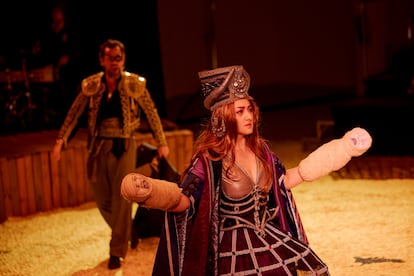
On July 2, the Espai Josep Bota was filled with albero-colored confetti to receive, with the seats arranged in a circle, the premiere of Life by the hornsa bullfighting rereading of the myth of Theseus. To the composer Anna Colom, who worked as a backup singer on the tour The evil will of Rosalía, two main voices (those of the singer Pere Martínez and the soprano Aseel Massaud), a dancer (Rubén Heras) and three instruments on a small tablao (guitar, trumpet and drums) were enough to claim the expressive richness of the always elusive flamenco opera.
The verse writing of Pablo Macho Otero’s libretto, served by the agile staging of Alexandre Rodríguez i Fons and the formidable costumes designed by the students of Idep Barcelona, allowed the Andalusian copla, the cante jondo and the bullfighting pasodobles to be integrated naturally into a score that aspired to be mestizo but that wasted the enormous lyrical potential of Fedra’s erotic agony. Which brings us to the classic dilemma of the Theseus paradox: how many elements can opera be stripped of before it ceases to be opera?
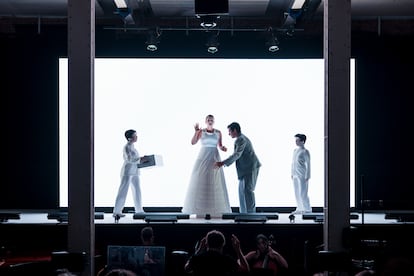
Next, in the Multipurpose Room 1 of Fabra i Coats, the I cloud by the composer Sergi Puig Serna, disciple of Beat Furrer in Graz and former student of Ircam. The challenge here was to transform the science-fiction plot of Alicia Kopf’s script, an adaptation of her novel, into sound material. Echo Memory, which, at times, was difficult to follow: after a heartbreak in a dating app, the protagonist hires the services of a technology company to digitize her consciousness and edit her memories.
The instrumentation (saxophone, cello, piano, electronics and percussion) managed to recreate the futuristic atmosphere of the data center through extended techniques and a vocal line, based on the breakdown of the legatowhich the soprano Montserrat Boixadera and the baritone Pau Camero brilliantly defended under the orders of maestro Miquel Massana. The stage concept of director Lucia del Greco, the narrative lighting effects of Helena Mateos-Serna and the robotic choreographies of Ariadna Monfort ended up giving shape to a show of great visual impact.
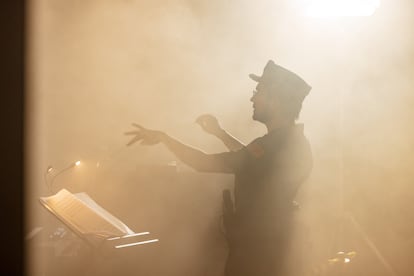
The shortlist was closed with Operetta by the composer Arnau Brichs. The text by Pol Guasch, the latest prodigy of Catalan literature, begins with a traffic accident: before the audience has taken their seats, the emergency services burst into the room under the noise of sirens to rescue a man from a smoking car stuck against a beam. What follows is a delirious, fun and endearing dialogue of suspended consciousness with an ironic divinity that denies him the privilege of dying in an imaginative stage adaptation by Marc Salicrú.
Brichs’ music makes this limbo a powerful resonance box. Urban sounds coexist in it (synthesizers vintagecinematographic resources and even a passage of brake drums on the bodywork) and episodes of transcendence kitsch entrusted to the vibraphone, the marimba and the celesta, all under the baton of Marcel Ortega i Martí. The baritone Arnau Segura supported all the dramatic weight of the work, while the soprano Larraitz Navas monopolized the moments of greatest lyricism. Tenor Héctor Ruiz completed the leading trio with ease.
With this there are now 17 micro-operas (no more than half an hour) promoted by the program Oh! that’s rightwhich in its five editions has mobilized some 350 students and a hundred professionals from different disciplines to discover talent, teach, open new paths and imagine the future of the Liceu in a big way. Anything goes when it comes to rethinking opera as total theatre, but the decision to amplify the voices and instruments in the three titles released this year is very difficult to justify and unnecessarily detracts from the final result.
Oh! that’s right
Life by the horns. Music: Anna Colom. Libretto: Pablo Macho Otero. Aseel Massoud, Pere Martínez, Rubén Heras. Musical direction: Exequiel Coria. Stage direction: Alexandre Rodríguez i Fons.
I, cloud. Music: Sergi Puig Serna. Libretto: Alicia Kopf. Montserrat Boixadera, Pau Camero, Anna Climent, Glòria Garcia Garrido. Musical direction: Miquel Massana Stage direction: Lucia del Greco.
Operetta. Music: Arnau Brichs. Libretto: Pol Guasch. Larraitz Navas, Héctor Ruiz, Arnau Segura. Musical direction: Marcel Ortega i Martí. Stage direction: Marc Salicrú
Fabra i Coats Campus in Barcelona, from July 2 to 5, 2026.