
The controversy has existed since the 17th century. And even today it emerges among researchers, specialists, critics, theater people, spectators and anyone who wants to join the dispute. Although the 21st century has arrived, the confrontation, civil, elegant and respectful, is full of nuances and puns. Now there are no longer two sides, if there ever were any, but many adopting and creating new theories. The case is apparently very simple: there are those who maintain that Cervantes, the great promoter of the modern novel, was not a good playwright and those who defend the opposite. There are reasons and voices, all of them wise and full of knowledge, that defend one thing or another. And there are those who defend both and provide new theories.
The fact is that the 49th edition of the Almagro International Classical Theater Festival, which opens this Thursday and will run until July 26, a great European reference when it comes to talking about the Baroque scene, has programmed eight productions this year that cover texts by Cervantes, although none of them is actually an original theatrical text by the author of the Quixote.
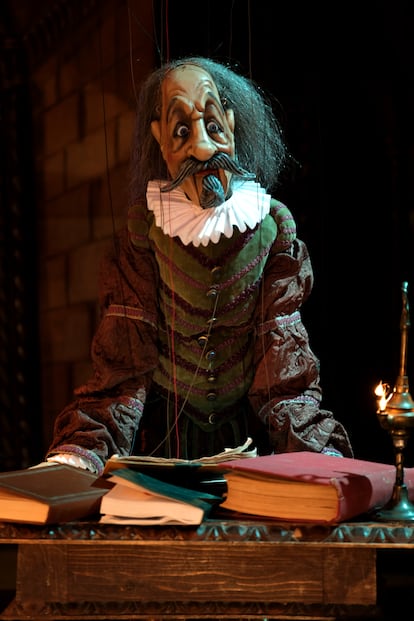
One of the big bets is dog word, a text of Juan Mayorga conceived “under the impact of the brilliant Cervantine narrative The colloquium of the dogs“, indicates the playwright. Other premieres are The miraculous compound of Cervantes and Saavedraa monologue by Brenda Escobedo performed by Ernesto Arias; Captives by Cervantes, a show that focuses on the women of The baths of Algiers, The great sultana y The gallant Spanish; The trujamán between Cervantes and Shakespearewhich relates both authors; Don Quixoteby the historic Italian puppet company Carlo Colla & Figli; Quixoticby Julieta Soria, and the musical show for family audiences To the sound of Cervantes. In addition, the film will be screened The captive, by Alejandro Amenábar.
Festival director Irene Pardo maintains that Cervantes has such a presence this year “because, in some disturbing way, this society is beginning to look too much like some of the darkest parts of the Golden Age.”
There is another theme that has appeared naturally in the programming and that is deeply Cervantine: captivity. “Many times we think that captivity is something far away, and it really is just a way of losing freedom,” Pardo recalls. “There is physical captivity, of course. But also fear, intolerance, fanaticism, prejudice or poverty… are forms of captivity. And Cervantes writes about how to preserve dignity when everything seems ready to take it away from you.”
Regarding the controversy, there are those who make their inclination clear. Eduardo Vasco, director of the Spanish Theater in Madrid and previously of the National Classical Theater Company (CNTC), and a Cervantes scholar, has no doubt: “Cervantes should be a matter of State, his corpus and his figure would have to be something that helps structure our culture from the roots.” Vasco thinks that his great theater, his comedies, were seen in his time as a theater out of datebeing outside the Lopesque mold, “but in our time they appear as a fascinating laboratory theater.” And as for the hors d’oeuvres, he does not hesitate to affirm that there is little better theater in our dramatic history.
Close to this theory is Pardo, who speaks out regarding the eternal controversy over whether or not Cervantes was a good playwright: “Perhaps history itself is the one that answers, since Cervantes continues to fill the stage four hundred years later.”

The most discordant voice about the benefits of Cervantes’ theater is, without a doubt, one of the most authoritative. Felipe Pedraza, professor of Spanish literature specialized in theater, has attended numerous conferences and meetings, confronting with judgment and knowledge colleagues with whom he has never stopped getting along well. Pedraza remembers that Cervantes expressed his passion for theater in some words that he put into the mouth of Don Quixote (II, chapter Also that the author pursued success in the incipient comedy corrals. “But heaven did not want to thank him for the easy versification and agile structuring of the drama,” he points out.
Furthermore, it highlights what happened in the author’s life: “In the middle, the monster of nature, the great Lope de Vega, then entered and rose with the comic monarchy. It was a thorn that he always carried stuck in his heart. Heaven, fair and equanimous, compensated him by allowing him to intuit the paths of the modern novel.” And he concludes between orthodoxy and humor: “Non omnes omnia possunt” (No one is capable of doing everything).
His colleague in the academic field and researcher Javier Huerta knows that the thing about theater and Cervantes was not a reciprocated love: “In fact, he published his theater when he was barely known in Eight comedies and eight hors d’oeuvres shortly before he died, leaving us his dramatic work for the future.” He points out that, although Cervantes was more conservative in technique than Lope, out of respect for classical precepts, he was more revolutionary in terms of content.
There are many connoisseurs of Cervantes’ work who affirm, like Huerta, that Cervantes’ novels have a lot of theater. “That is why there have been so many dramatizations of the chapters of the Quixote“The truth is that the list of theatrical versions of the Quixotecomplete or partial scenes, which have existed for centuries. Without forgetting the film adaptations, some with leading international figures at the helm. There are also countless operas, ballets, series and comics.
Juan Mayorga, director of the Teatro de la Abadía in Madrid and the Corral de Comedias in Alcalá, in addition to being the most international living Spanish playwright, addresses the issue by stating that there is a lot of dramaturgy in Cervantes’ narrative, and there is a great desire to bring it to the stage. That is why he has now embarked on writing a version of the novel The colloquium of the dogs, which he considers to be full of theater and not only because of its dialogic form.
And although it may make things more confusing, it clarifies the Cervantes controversy: “If this author had found a theatrical form at the height of his extraordinary imagination, as he found it in narrative, Spanish theater would have been different,” Mayorga points out. “Our theater would have found an extraordinary path if it managed to imagine its extraordinary fictional characters on stage, it would have had that other dimension that we do not find in Lope and we do find it in some Calderón.” And he adds: “In Lope and other playwrights of the Golden Age one perceives the will to obey their king or, at least, not bother him, while Cervantes’ compassionate but severely critical gaze, if it had reached the stage, would have led the audience to imagine another world.”
A world that Francisco Nieva beautifully captured in a montage in the middle of the Spanish Transition, with captivity very present, called The baths of Algiers. That show knocked out Laila Ripoll, current director of the CNTC, who has passed through Cervantes in several productions. This does not mean that he confesses that he has never been passionate about his playwriting: “I admit that it is difficult for me as a theater, but not so with his interludes, texts to which it would be interesting to return and not so much to long plays.”