
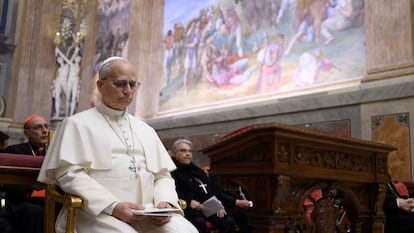
Pope Leo XIV published his first encyclical this Tuesday, Magnificent Humanityfocused on the ethical and social challenges of artificial intelligence (AI). The document, extremely interesting, raises ideas such as that AI must be at the service of human dignity and not concentrate power in the hands of governments or technological giants; that technological advance cannot justify the destruction of employment or the replacement of human relationships; or that the development of autonomous systems applied to war represents an unacceptable risk. The reactions, for and against, have not been long in coming, and among the most notable comments on social networks and articles is the name of one of the most famous writers of the 20th century: John Ronald Reuel Tolkien, whom the pontiff quotes in his encyclical.
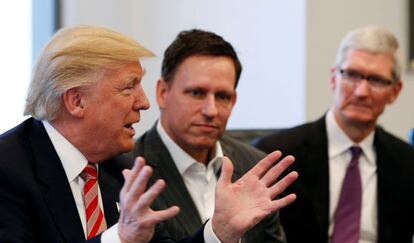
Of all the companies linked to AI, the one that most profoundly represents the opposite of what the Pope asks for in his encyclical is Palantir, which precisely takes its name from the seer stones in Tolkien’s masterpiece, The Lord of the Rings. Dedicated to mass surveillance and omnivorous data collection, their name could not be more appropriate to name one of the most powerful and opaque companies in the entire digital ecosystem. The most visible figure in the company, Peter Thiel, is no stranger to religion: in addition to being the confessed patron of the vice president of the United States, JD Vance (converted to Catholicism in 2019), Thiel was not long ago in Rome, precisely near the Vatican, giving a series of talks on the advent of the antichrist.
The relationship between the Holy See and Thiel is openly hostile: Paolo Benanti, the Vatican’s AI advisor, wrote in March in The Great Continent that Thiel’s career is “a challenge to the very foundations of civil coexistence.” He knows what he’s talking about: a few weeks ago, Palantir made global news for the dissemination of a manifesto that divides civilizations between vital and dysfunctional, attacks “empty pluralism,” calls on Silicon Valley to lead the United States and talks about preparing to compete with China in almost warlike terms. The manifesto (and the book on which it is based, The technological republicwhich Palantir CEO Alex Karp published last year) is the perfect reverse of everything that Leo XIV asks for in Magnificent Humanity: a Silicon Valley that rules the world with an iron fist, from intellectual and weapons superiority.
Land for tillage
The fact is that within the papal encyclical, a paragraph has caused a lot of commotion on the internet for citing a source that is rare in this type of writing: “A Catholic writer of the 20th century, John Ronald Reuel Tolkien, through the mouth of one of the protagonists of one of his novels, described our responsibility like this: ‘It is not up to us to dominate all the tides of the world, but to do what is in our power for the good of the days in which we have lived, extirpating evil in the fields that we know, and leaving those who will come after a clean land for farming,” writes the pontiff.
The paragraph in question, which belongs, of course, to the lord of the ringstakes place in the middle of the third part, The return of the kingin chapter 9, The last deliberation. The text It is pronounced by the wizard Gandalf during the final war council: after saving the city of Minas Tirith from the siege of the forces of evil, the heroes decide to start a suicidal march towards the Black Gate of Mordor to distract the villains while the hobbits Frodo and Sam try to sneak into the enemy’s lands to throw the One Ring that forms the backbone of the entire plot into their volcano.
Comparing the book, one detail draws attention powerfully. On the same page – in fact, a few paragraphs earlier – Gandalf makes the only reference to the Palantir in the entire chapter: “The Seeing Stones (the Palantir) do not deceive: not even the Lord of Baraddür could force them to do so. He could perhaps decide what the weaker minds will see, or cause them to misinterpret the meaning of what they see.”
It bears repeating: “It could decide what weaker minds see, or cause them to misinterpret the meaning of what they see.” The phrase, in the current context of the flow of information intervened by AI, takes on a different meaning and accurately X-rays the great evils that humanity faces if AI runs rampant in the hands of a few. It cannot be assured that the Pope chose his phrase because of its proximity to that other one, but it is still curious. The chapter, by the way, ends with the heroes embarking on the march towards almost certain death: “It is the last step of a dangerous game, and it will be in some way the end of the game,” concludes the chapter Aragorn, who agrees to lead the suicidal attack against Mordor, before unsheathing his sword: “I will not sheathe you again until the last battle has been fought.” All of us who live in this world fueled by AI are in that situation. Including Pope Leo XIV, who seems to have already unsheathed his pen.