

When the auction season ended this past May in New York, that recognizable image of a sector in which million-dollar figures are broken every season, sales of the same great artists are repeated, while the few names capable of paying 181 million euros for a Jackson Pollock painting or 107 million for a Brancusi bust remain unrevealed. This hundreds-of-years-old ritual seems immutable in the eyes of those who do not belong to that 1%. Bonnie Brennan (Michigan, 53 years old), who has been CEO of Christie’s for just over a year, assumes that she has to preserve that traditional collector who finds a safe refuge in art when everything else seems to collapse; without stopping looking for new millennial buyers. They also have to adapt to their new way of buying that does not always fit in the sumptuous auction rooms of their building in New York’s Rockefeller Plaza.
“Young collectors are different,” acknowledges the head of an auction house with 260 years of history, “they prefer to bid online from their phone, and they are more interested in watches, jewelry or a Jeff Beck guitar for which they are capable of paying more than a million euros.” The so-called luxury auctions and popular culture pieces have become the perfect entry into the auction system for these new collectors. Once inside, Brennan explains, it is easier for them to end up taking a look at the contemporary art auction catalog.
“Every year more than 30% of our buyers are new clients,” he explains in Madrid, one of the stops that Brennan makes during the month he is going to spend in Europe visiting the different Christie’s headquarters. “Of those new buyers, about 46% are millennials or even younger. We can’t just always talk to the same people; we have to constantly build a new customer base.” To whom, by the way, the CEO sends a message: “Although the average value of the lots exceeds 100,000 dollars, the median is below 10,000. There are many more affordable options than people imagine.”
It is not just about renewing the customer portfolio, but about offering them something more than just the weeks of sales in the big capitals. “It is no longer enough to just organize auctions, we have to evolve in the way we do them, continue with private sales and turn to our client base to continue with services such as financing supported by works of art,” he lists some of the challenges that lie ahead. “Anticipating those ways we could add value to a collector’s life is what I’m always thinking about. Plus, where aren’t we right now?” The latest Christie’s report, published this Wednesday, places the auction house in the leadership of this market with sales that have exceeded $3.5 billion, a growth of 71% year-on-year. “It has been our first best semester in the last five years,” specifies the person in charge.
Brennan points to two places on the map: South Korea and India. New objectives in Asia, after the great growth of China —“Despite its recent ups and downs, it has returned strongly at the recent May sales, held at our new headquarters in The Hendersonan iconic building in Hong Kong that allows auctions and exhibitions to be held throughout the year”—and Japan, in addition to the entire Middle East, now affected by the war in Iran. “These potential clients are also interested in popular culture, you just have to analyze the impact of K-pop,” describes the CEO. “It is one of the best regions to connect with new buyers and it is also excellent for our luxury categories.”
The global expansion of the auction house is one of the keys that explains the resilience of the art market while the rest of the world lives in a state of cyclothymia that depends on in what mood the president of the United States, Donald Trump, wakes up and decides to impose tariffs on countries and products or better choose to start a war. “It is very complicated, but we have an advantage: we have a global platform and multiple sales rooms around the world, which allows us to adapt. In addition, a large part of the art market is protected by regulatory exceptions. Works of art, for example, are not subject to many of these tariffs. Where we have noticed the most difficulties is in the luxury sector,” he explains.

The art market has been able to correct the losses of the pandemic in constant growth since 2022, almost like doping. The main refuge is once again the old masters or their contemporary art peers such as Picasso or Pollock himself, one of the stars of the last week of the auctions in New York. But among the men’s list, female artists are beginning to consolidate and advance positions. “There is an extraordinary demand for female surrealist painters. Collectors are rediscovering Leonora Carrington, Dorothea Tanning and Kay Sage, among others,” says Brennan, recalling that five years ago Christie’s created the sale called Auction of the 21st Century, dedicated to art created from 1980 to the present, which is not only of interest to younger buyers, but has allowed greater visibility for women.
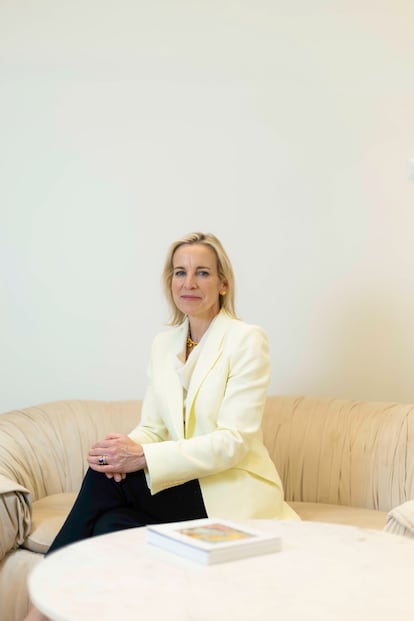
“Trend reports show that women are increasing their purchases of art, antiques and decorative arts at a higher rate than men. And that directly influences which artists receive attention,” adds the head of the auction house, “which is why it is no coincidence that there is so much demand for artists like Georgia O’Keeffe or Frida Kahlo. The same goes for Grace Hartigan, Joan Mitchell and Lee Krasner. For a long time they did not receive the attention they deserved. Museum exhibitions and publications like the book 9th Street Women They are helping to change that.” Brennan’s team has also identified how women not only buy for their private collections, but do so for philanthropic purposes.
From NFTs to AI
In 2021, Christie’s was a pioneer by selling an NFT for more than 69 million dollars (more than 57 million euros), that is, a digital piece made from codes that make it unique. Beeple’s work, Everydays: The First 5000 Days (Every day: the first 5,000 days), a collage of 5,000 images, became one of the milestones of a bubble that burst less than two years later. The market went from sales of almost $2.9 billion to just under $1.5 billion in 2023. “We learned something that is valid for any category of art: quality is what remains. The market has corrected itself and has become more selective,” Brennan concedes about that sale and what came after in the cryptocurrency sector.

Now its focus is on creators like Refik Anadol. “An excellent example of digital art as a solid proposal,” defends the most important AI artist at the moment who has just inaugurated Dataland, his own museum in Los Angeles.
At the same time as NFTs rose and fell, in the last moments of the pandemic, when younger people flocked to the auction house, Christie’s also accelerated its digitization. “Today, around 80% of our clients bid using digital tools, it does not mean that it is 80% of the total value sold,” he says and gives an example: “I offered one of our traditional clients the possibility of bidding on it over the phone and he told me that he preferred to do it from home. That was a wake-up call.” They have invested in audiovisual production, bidding platforms have been improved, technologies have been developed to better visualize the works: high-resolution photographs, 360-degree views of sculptures and even holographic systems that allow works to be presented around the world without having to transport them.
—Does all this diminish the importance of in-person auctions?
-At all. Many people want to be present in the room and experience the emotion of the moment, be part of that community and say that they were there when a work broke a record. What has changed is that this experience now coexists with a global audience digitally connected from anywhere in the world.