
Imagine you want to visit a neighboring city, but there’s no direct bus. To get there, you first need to travel much farther to a different city, wait for a connection, then take another bus back to your original destination.
Your first reaction would probably be the same as anyone else’s: this is a waste of time, the trip takes longer and relies on multiple connections, so more things can go wrong. And it’s expensive.
In many parts of the world, this is how the Internet works. Just like on the bus, when data can’t stay local, it travels farther than necessary, driving up costs and increasing the risk of failures. As a result, you have a slow, unstable, and expensive Internet experience.
When Internet service providers, content networks, and other operators exchange data through a local Internet exchange point (IXP), keeping traffic closer to where it is generated and consumed, it’s a different picture. This reduces the distance data has to travel, lowers the cost of moving it across networks, and improves speed and reliability.
Local traffic also impacts Internet affordability for users: if the cost is lower and speed and reliability are higher, Internet service providers can offer customers lower prices. Of course, affordability relies on many other factors, like the local policy environment, market competition, currency dynamics, international connectivity, and broader economic conditions. But if transit and operation costs are high, there is little room for change.
Are Countries That Strengthen Local Interconnection Seeing the Internet Become More Affordable?
Internet Society Pulse curates data from trusted sources to measure the availability, evolution, and resilience of the Internet. Pulse reports “average Internet cost” as the percentage of an average person’s income that’s needed to pay for a low-consumption mobile broadband package, using at least 3G technology, including a minimum of 1GB of data. We analyzed data on the progression of Internet cost in countries where the Internet Society Foundation provided grants for IXP development or local peering ecosystem support between 2020 and 2024, and we saw the needle move.
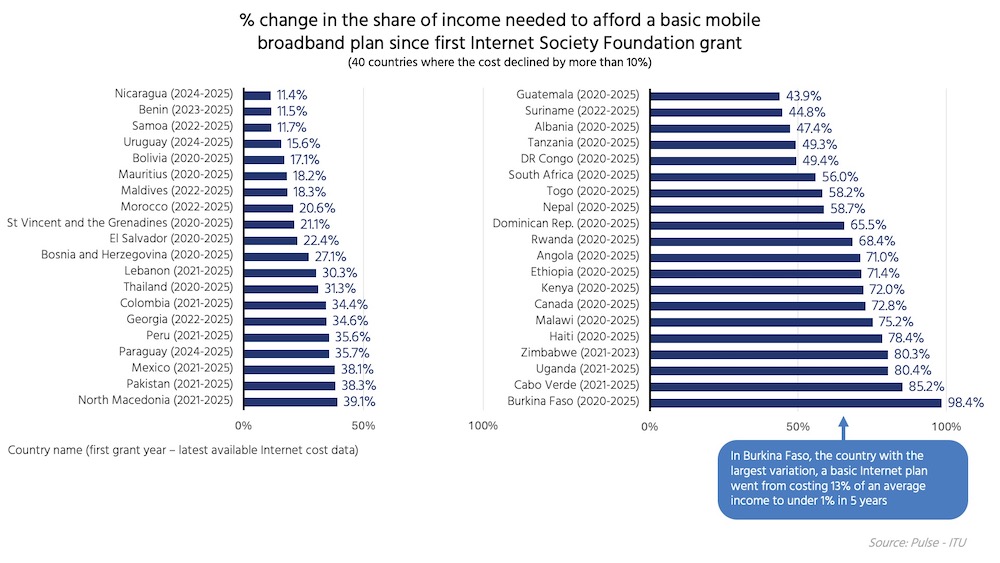
In 40 out of the 50 countries we analyzed, the share of income needed to afford basic mobile broadband fell by more than 10% between the year of the earliest grant and the latest available data (2025, in most cases). In several countries, the improvement is far larger—well above 50%—suggesting substantial shifts in affordability over time.
While many factors influence Internet prices, the consistency of this downward trend across a wide range of geographies, income levels, and network environments points to a common theme: strengthening local Internet infrastructure is associated with healthier, more efficient Internet ecosystems that are better able to deliver affordable access.
The largest shift occurred in Burkina Faso. In 2019, the Burkina Faso Internet Exchange, or BFIX, reached out to the Internet Society for support to improve its network design and implement IXP best practices.
The Internet Society went to Ouagadougou to deliver a week-long training program for BFIX’s network engineers. This enabled the BFIX community to significantly improve its traffic capacity (from 0.5 to 6 Gbps at peak times), which enhanced service quality and cut costs for network operators.
“Before, to be able to access content on a local network, it used to take more than 300 milliseconds because data needed to go outside the country and then return. With the IXP, it takes 15 to 20 milliseconds, which is a huge win in terms of user experience,” said Jean-Baptiste Millogo, director of Internet technology and development at the Internet Society.
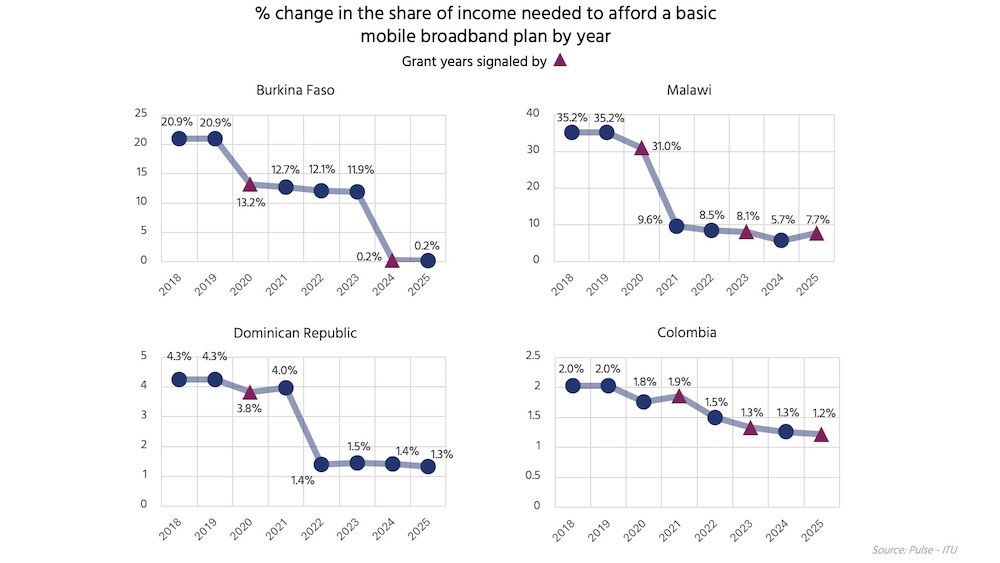
In 2020, a person in Burkina Faso would need to spend 13% of the average income on a low-consumption mobile data plan. The traffic exchange capacity has grown constantly in the past five years, and 80% of networks are either members of IXPs themselves or are customers of IXP members.
In 2025, Burkina Faso residents only needed to spend 0.2% of the average income to afford the basic mobile broadband plan. Because the IXP lowered service costs for Internet providers, they could offer lower prices to users in Burkina Faso. This, coupled with better service quality, has brought more people online.
“People who might never have used the Internet before have adopted it because it serves practical needs, fits their budgets, and improves how they work, communicate, access e-gov platforms, and participate in daily life,” said Jean-Baptiste.
Affordability Gains Across Regions
This pattern of affordability improvement expands beyond one region: in Uganda and Kenya (East Africa), the package cost declined by over 70% since the Internet Society Foundation awarded a grant to the local ecosystem. In the Caribbean, Haiti’s package cost declined 78% and the Dominican Republic saw a reduction of more than 65%.
These cases suggest that where costs were highest—and inefficiencies most acute—improvements in local Internet infrastructure coincided with some of the most dramatic gains in affordability.
Changes in Landlocked, Low-Income Countries, and Small Island Developing States
The trend is particularly meaningful in places where access has historically been most constrained. In landlocked and low-income countries, such as Burkina Faso, Nepal, Rwanda, and Uganda, affordability improvements accumulate across multiple years after strengthening local interconnection capacity.
In Small Island Developing States like Suriname and the Dominican Republic, where dependence on submarine cables and off-island routing typically drives up costs, affordability trajectories also show steady improvements after early investments in local exchange infrastructure.
What these contexts share is not geography, income level, or market size, but the presence of active technical communities working to keep traffic local, improve peering, and strengthen national network resilience. Engineers, network operator groups (NOGs), national research and education networks (NRENs), ccTLD managers, and other local actors play a central role in making these systems work.
As more data becomes available in the coming years, especially for countries that received grants more recently, tracking these trends will help sharpen our understanding of how local infrastructure investments shape affordability over time.
Supporting Sustainable, Community-Led Infrastructure
The Sustainable Peering Infrastructure Grant Program supports exactly these efforts: building new IXPs where none exist, strengthening existing ones, and ensuring long-term sustainability through community ownership and local governance. In 2026, the program continues to focus on parts of the world where access is most expensive and least reliable, particularly in Least Developed Countries and Small Island Developing States.
“The success of an Internet exchange point is not just about the infrastructure itself. It depends on community engagement and the broader enabling environment—policies that encourage local hosting, support digital payments, protect data, and foster competition. For an IXP to function, you need multiple service providers, and as in any industry, competition drives better quality, innovation, and more affordable services. As these pieces come together, a local digital ecosystem begins to take shape, with more content hosted locally and more value created within the country,” said Michuki Mwangi, distinguished technologist for connectivity and insights at the Internet Society.
Pushing for Meaningful Connectivity
Meaningful connectivity is about being able to use the Internet in ways that create real opportunity. To support this, one of the Internet Society’s strategic goals is to reduce barriers to access while improving speed and affordability.
While affordability is a critical signal, it is only one dimension of a broader challenge that also includes reliability, quality, safety, and local relevance while maintaining the Internet’s core principles: openness, decentralization, and interoperability.
As we continue to track these affordability indicators, we also need to connect this approach with other initiatives that tackle meaningful connectivity from different angles, so we can better understand not only whether costs are falling, but how a more integrated ecosystem approach to infrastructure, policy, and capacity building is improving daily life and economic participation.
Learn more about our work to support peering infrastructure.
Image © Chris Gregory