
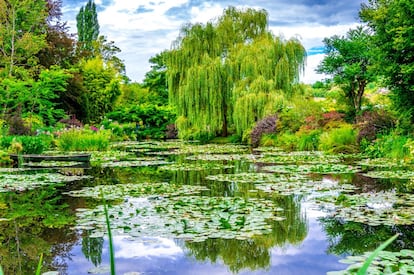
Within the varied catalog of museum offerings there is a specialty that has more devotees every day. They are known as author museums, created in the same place where the artist lived and created his work. The more or less realistic recreation of these spaces captivates an increasingly large public, because not only are they full of keys that enrich the knowledge of researchers. Visitors also get an experience that makes them feel closer to the artist’s work.
Paloma Alarcó, head of Conservation of Modern Painting at the Thyssen-Bornemisza Museum and curator of exhibitions, believes that discovering the private and intimate world of artists is an unstoppable trend of great interest to scholars, because it is the best way to delve into the bowels of the work of art.
Through his work, Alarcó has had the opportunity to visit numerous artist museums. One of the ones that excited him the most is the one dedicated to the legacy of Georgia O’Keeffe, divided into two locations in Santa Fe and Abiquiu, both in New Mexico (United States). He also finds the way in which Joan Miró’s workshop is displayed at his Foundation in Palma de Mallorca spectacular and confesses that one of his favorites is Claude Monet’s house museum in Giverny (France). He says that this is an example of the knowledge that can be offered about an artist. “You end up knowing things that seem like mere curiosities, like that he liked to cook. And you also find out something as relevant as that he decided in detail what the gardens that he would later paint were going to be like. First he planted the bulbs and cuttings. When the garden sprang up as he had planned, he painted it. He did the same with the water lilies in the ponds,” he adds. “The letters and drawings that he left in his workshop certify that he did not portray what he found. His paintings were planned in detail.”
Whether an artist’s home and workplace ends up converted into a museum usually depends on the author himself and his heirs. Some of the most famous and successful cases are Frida Kahlo’s Blue House, in Coyoacán (Mexico); the home-studio of Louise Bourgeois, in New York; the Rodin Museum, in Meudon (France); the Fortuny Palace, in Venice, or the Joaquín Sorolla, in Madrid. Cultural institutions do not always collaborate, so most depend on their own income.
César Manrique, about five volcanic bubbles
In Spain, one of the most spectacular author museums is the César Manrique Foundation. Its director, Fernando Gómez Aguilera, says that the opening of the center in Taro de Tahíche, in Lanzarote, Manrique’s former home, was born in 1992 linked to the public presentation of his Foundation during the artist’s lifetime. The director believes that his main asset is the building itself. “It was originally a house built by Manrique in a lava flow at the end of the sixties, after his return from Madrid and New York to permanently resettle in Lanzarote. The building, of more than 2,000 square meters, reinterprets with a modern attitude the popular architecture of the island on the main floor, while on the lower level it adapts five natural volcanic bubbles as living spaces, connected by the artist, and adds a common leisure space where the swimming pool, a small dance floor and a pop-inspired barbecue.” In the purely museographic part (currently under review), his most environmental painting and sculpture are exhibited; muralism design works and a way of living that turns life into art (“The art of living”), in the words of the director.
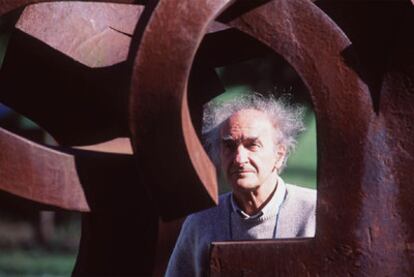
The powerful relationship with nature is also one of the greatest attractions of Chillida Leku, the museum where the sculptor’s most representative work is located. Located on the outskirts of Hernani, very close to San Sebastián (Gipuzkoa), it consists of an outdoor sculpture area and an exhibition space inside the Zabalaga hamlet.
Mikel Chillida, grandson of the sculptor and director of the museum since April 1, affirms that the hallmark of his museum lies in the fact that Chillida Leku responds to the principles, values and processes of the artist himself. “When we talk about this place, we have to understand that it is the work of an author. My grandfather dedicated the last 20 years of his life to building a home for his works. From the beginning he considered this dream a project, not a studio or a workshop, but a something which he shaped in the same way he worked on any of his works. Following a scent and working in the present. If this were not enough, here we see the works in their context, like a tree well rooted in its place in a natural way, in a forest of beech and oak trees or in a traditional 15th century farmhouse.”
What would be the most valuable information offered by a museum as personal as Chillida Leku? “There are layers and contexts,” says the director. “The information that is shared with the general public is what is necessary for the correct exhibition of the work, which corresponds to the general criteria and conventions. Then there is the artist’s own will, which in the case of my grandfather was very poetic, he wanted the works to speak for themselves and also did not want to condition the person who contemplates the work more than necessary, all opinions being valid according to himself.” And he clarifies: “As a museum and as an institution, our commitment is to the correct dissemination of its legacy and for this we have specific guides and additional information in QR codes.”
The archive, in addition, “is available on demand for researchers, curators and other professionals, providing a final layer of great value for these specific profiles. We are the epicenter of the Chillida universe, we have a strong commitment to the correct provision of its tangible and intangible legacy, a place of reference. And we love being it, it is our reason for being,” he boasts.
Fenosa’s hospitality
Each artist museum adjusts to the personality of the person who lived within its walls before becoming part of history. In the case of the Catalan sculptor Apel·les Fenosa, you have to know his Foundation in Es Vendrell, Tarragona, to decipher a unique style that balances between modernity and classicism. Since Nekane Aramburu began directing the space in 2022, his goal has been to spread a legacy as extraordinary as it is unknown. Closely linked to Picasso and his environment (the man from Malaga was his greatest collector), Fenosa and his wife, Nicole Florensa, bought the Renaissance mansion on which the museum is based in 1958.
Exiled in France since the end of the Civil War, they dedicated each floor of the building to a different activity: a sculpture workshop, a drawing workshop, and his wife’s painting and engraving studio. Half the year they lived in Paris and the other half in Es Vendrell, with the visits and company of numerous artists and intellectuals who spent time with the Fenosa family.
Aramburu has recovered that sense of the couple’s hospitality in the form of residences for artists, so that the heritage is exhibited on the first floor and on the upper floors there are spaces to “accompany and offer hospitality for research and creation. This is a meeting place, an open house where heritage, hospitality and creation merge,” Aramburu concludes.
Unnecessary recreations
The interest aroused by so-called author museums has led to the proliferation of recreations of what could have been an artist’s studio. In a recent report in the specialized newspaper The Daily Art It is explained that moving an artist’s studio to a museum is not an easy task, both due to its material and narrative ambitions. The studios of Francis Bacon, Alberto Giacometti and Constantin Brancusi, three modern artists, are singular examples of this form of museification of artistic creation. In Bacon’s case, the entire contents of the London studio were moved to Dublin. Barbara Dawson, director of the museum, said in the aforementioned report: “We moved everything, even the dust from the studio… It wasn’t enough. There was the dust and their cigarette packets, but the authenticity of the workshop or the house in which the artists have worked and lived was missing.”
Mikel Chillida has not been able to see any of these recreations, but he has a clear opinion about the phenomenon: “We do not always have the tools or the ability to activate an author’s space with the conditions and demands that this entails. Many times I think that we are very lucky, since my grandfather (grandfather, in Basque) built this wonderful place that allows us to be that tangible anchor in the world of what Eduardo Chillida is, and I think that all artists would want their own Chillida Leku,” he ventures.
Although later, looking at it with perspective, he adds: “A very strong choral commitment is needed to maintain it. The family has to be there, but not alone, it has to accompany society, the visitors, the institutions, the business and philanthropic fabric… There are many agents that keep these places strong. My thought is that there is no small project, there is no author’s space, reproduction of a workshop or study that is not worth it, as long as whoever is behind it is consistent with launching a resource of this magnitude and responds with responsibility and demand to the future of time.”