
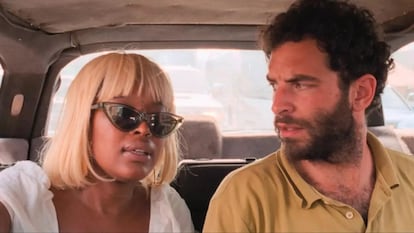
“It’s always the same story; you come here, with your love and your affection, and you want to heal the wounds that you yourselves have caused us.” This is the response-slap that Sérgio (Sérgio Coragem), the protagonist of Laughter and the razor, at a party queer in Guinea-Bissau. Young and with an adventurous air, he arrives in the country as an environmental engineer for an NGO. But his work for a road construction project report will mutate into a transformative and unexpected journey, in which he will learn what his mere presence in the old neighborhood means.
Second film by the Portuguese Pedro Pinho, this overflowing and ambitious journey into postcolonial conflicts and contradictions mixes genres and perspectives—it is a “polyphonic journey,” according to its director—to put on the table the condescending and paternalistic guilt of the European view of Africa.
Premiered in the Un Certain Regard section of the last Cannes, where the magnetic Cape Verdean actress Cleo Diára was awarded, Laughter and the razor —which takes its title from a song of the same name by Tom Zé— moves unprejudiced and always with passion between the road movie, the adventure film, the political essay, the satire, the documentary and even the thriller fiction. Shot in 35 millimeters and tinged with a brave sexual drive, which highlights the place of power of the white man, in it, the strength of queer bursts in like an unforeseen surprise. Their bodies here are a radical and free response to any established order, past and present.
The result, to which 10 scriptwriters have contributed, is built on situations that do not seem written and whose impressive flow justifies its three and a half hours of footage, a reduced version for its theatrical release. Like a great mosaic in front of which it is impossible not to feel the same embarrassment and guilt as its protagonist, Laughter and the razor confronts us with an ungraspable reality – priceless the sequence in which a woman asks Sérgio with an incredulous smile if it is true that in Lisbon they pour drinking water into the toilet or the entire solitary and feverish final journey of the character – which reveals our gaze, that of a (progressive) European spectator who, like Sérgio himself, believes he understands and empathizes with the wound of colonialism.
It is curious, not to say sad, to see that, while Portuguese cinema has been unraveling this African wound for years, Spanish cinema has barely done so; even less with so much immersive and critical intention. The reasons do not lend themselves to simplifications, although there are plenty of examples. Of the mocking melancholy of Miguel Gomes in films like Taboo o Grand Tour to the Cape Verdean drifts of Pedro Costa in Youth on the move, Horse money o Vitalina Varelato cite two recent renowned authors from a country that dares to question a colonial memory with which Spain still has an outstanding debt.
Laughter and the razor
Address: Pedro Pinho.
Interpreters: Sérgio Coragem, Cleo Diára, Jonathan Guilherme.
Gender: drama. Portugal, 2025.
Duration: 211 minutes.
Premiere: April 24.