
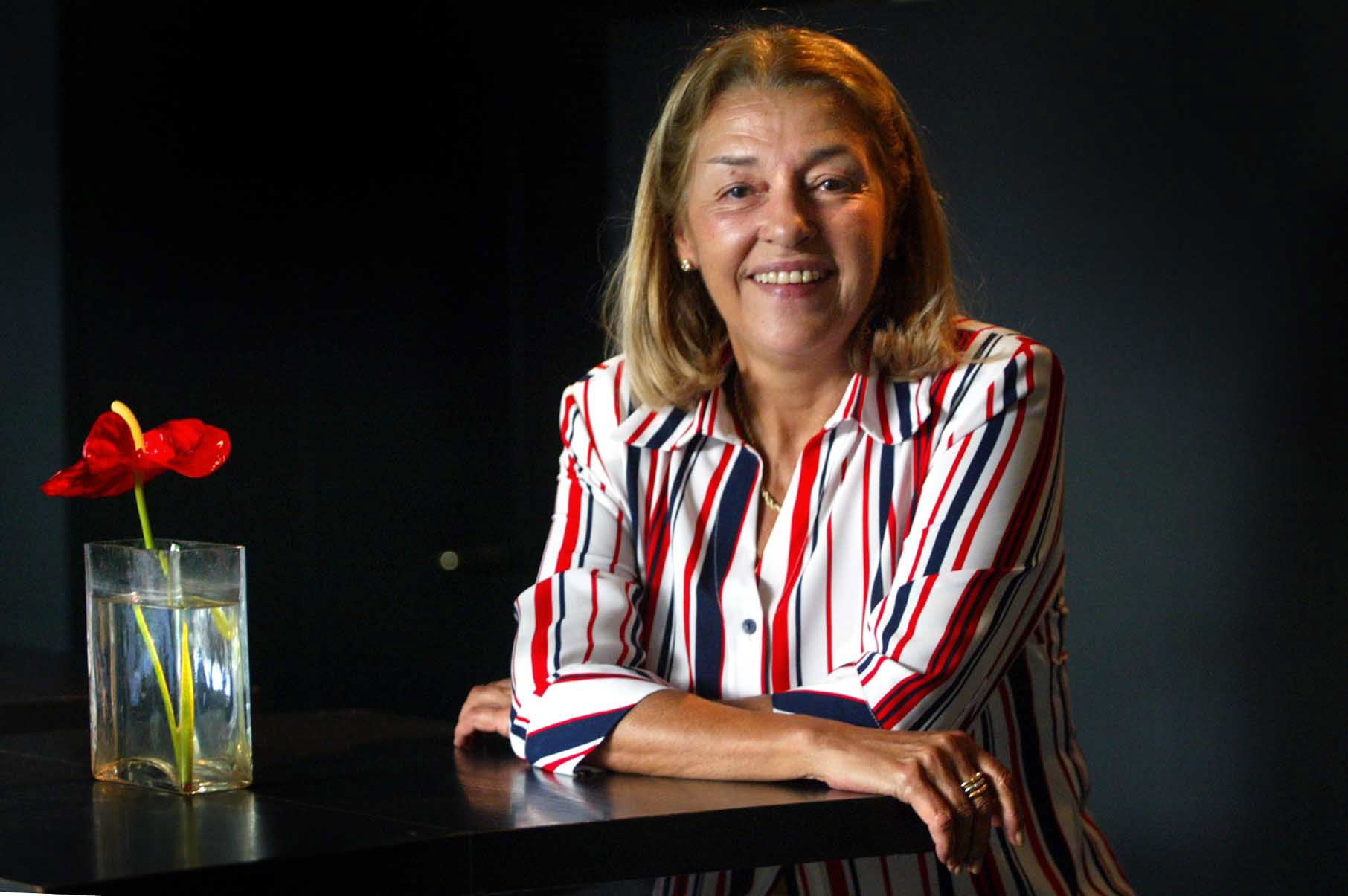
Beatriz was an exceptional woman. I can’t stop thinking about it now that he has left us, and while I feel the pain of his absence increasing. But I also consider myself very lucky, like all of us who worked alongside her, because with her we learned almost everything about the book trade, and we had the privilege of working with a top-level editor.
Carlota Álvarez Maylín, his biographer, has told it in A curiosity without barriers: That beautiful young woman, daughter of the Brazilian consul, burst into Barcelona at the end of the 1950s, and immediately became the personified joy of a group of budding photographers, writers, architects, filmmakers, who formed the Divine Left. The photos that Xavier Miserachs and Colita took of her, among others, some paintings by Óscar Tusquets, are very eloquent, but above all the many anecdotes of those who treated her, who remember her discussing and defending some books, but also dancing and laughing heartily, in Cadaqués or in Barcelona’s Bocaccio, perhaps the most modern and advanced places at the end of the Franco regime. That young woman who spoke several languages, who had friends throughout Europe, in the anti-Franco regime and in the best European publishing houses of the moment, and who went from the festive part to working literally like a mule, is the one who founded the Tusquets publishing house in the dining room of her house, as Cristina Fernández Cubas recalled.
That mix of a fun and festive woman, and at the same time demanding and disciplined, is what those of us who are part of Tusquets Editores met. His sympathy and stubbornness explain that that tiny and exquisite incipient publishing house, in which Groucho Marx, Beckett, Freud and García Márquez appeared (Story of a castaway) but also authors such as Enrique Vila-Matas, Cristina Fernández Cubas, Julio Ramón Ribeyro, Sergio Pitol and Mario Vargas Llosa, it was also a label that was immediately so relevant and mythical.
When it launched La Sonrisa Vertical with Luis García Berlanga, that collection that took away our dandruff in the middle of the Transition, and opted for a narrative collection, the publishing house then began to play in the great league of international literature. Duras, Irving, Kundera, and later Murakami, Mankell, but also a whole generation of new authors in Spanish who have become references, such as Almudena Grandes, Luis Landero, Fernando Aramburu, Leonardo Padura, Gonzalo Celorio (new Cervantes Prize), Rafael Reig, Antonio Orejudo… and Semprún and so many poets and so many wise men like Antoni Marí and Jorge Wagensberg, give the measure of his great talent and insight.
She fought and was tough, and harsh, in a world that was less kind to female managers, but she was lucky enough to find someone providential who was Antonio López Lamadrid, a true gentleman from Barcelona, who was in charge of taking the economic reins of the company and seducing the part of the catalog that perhaps she could no longer attend to. Together they established an irresistible publishing house that was very much a reference among European colleagues.
When she was widowed, she decided to step aside, and handed over the reins to me, she once again gave another example of her generosity and lucidity: with Cartesian determination she organized her archive, with a very juicy correspondence, she gave it to the National Library, and then she maintained a creation scholarship in memory of Toni López. He told me that I had all the freedom and all his confidence. I have always been grateful to him.
I knew of his doubts and his anxieties in the transition of the company, but he was always an example of how to defend tooth and nail his autonomy, the value of his catalog, the long-term commitment and the rigor, but also the freedom of judgment, to maintain it.
She who did not want a family, children, or Christmas, lived these last few years at home, immersed in her world, with little memory, but lovingly cared for by adorable Brazilian caregivers who, along with María José, were her last adoptive family. On the last visit, they told me that they gave her coconut water, and when they asked her if she would like it the next day, she nodded happily and added: with whiskey. I want to remember her laughing out loud, passionate about some new discovery, sitting on the floor, celebrating the conversation with her friends… But messages from Italian, English, and French editors keep coming, and excited messages from so many authors and friends who remind me that someone truly exceptional has left us.