
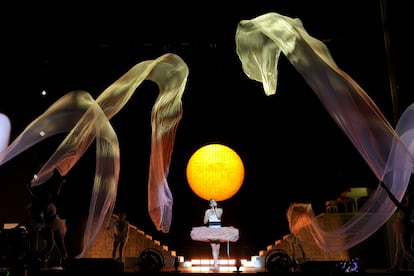
It was difficult to imagine a more favorable calendar for a tour crossed by so many symbols of ecstasy and devotion. He Lux Tour de Rosalía lands in Spain in the middle of Holy Week with her concert this Monday in Madrid, already recovered from the gastric problem that forced her to suspend her performance in Milan. After premiering in Lyon two weeks ago before more than 13,000 spectators, the tour continues at the Movistar Arena in the capital on April 1, 3 and 4, and will continue at the Palau Sant Jordi in Barcelona on the 13th, 15th, 17th and 18th. In total, almost two hours of concert, 24 songs divided into four acts and an orchestra of around twenty musicians installed in the center of the pit and surrounded by the public, a device as powerful as it is unusual. This is a nine-key summary of the most anticipated tour of the year.
A hybrid of classical music and club culture
He Lux Tour It is not intended to be a typical pop concert. Rosalía proposes an artifact that crosses opera, theater, dance, pop, electronics and club culture without establishing hierarchies between them, with the same conviction with which she mixes Vivaldi and industrial techno in her album. The show begins with the singer emerging from a music box, turned into a motionless dancer who will emancipate herself, song by song, through two forms of ecstasy: first the sacred and then the night party. He Lux Tour It aspires to be a total work designed, like operas, to be heard but also seen.
The tour is not the great solemn mass that one might expect
The religious theme runs through the Lux Tour from beginning to end, although not with the solemnity that might have been expected. There are veils, relics and even a confessional, a pit in the shape of a Latin cross and constant references to devotion, trance and penance. But Rosalía integrates these signs into a light and sensual iconography, with openly playful moments. Therein lies one of the subtleties of the show: appropriating the codes of faith to make them more free, ambiguous and carnal.
The songs of Lux they rule, but Motomami doesn’t go
By discounted, Lux occupies the core of the repertoire: Rosalía opens with Sex, violence and tires y Relicthe first two songs on the new album, and he returns to it again and again. But Motomami It also has its role: Just in case, fame, sponge cake o The Versace combi They enter into a game of contrasts that the show manages intelligently. They are added Desperate, last night and several versions: Can’t Take My Eyes Off Youin homage to Frankie Valli’s classic; Thank YouDido’s nineties anthem, and a brief nod to Sweet Dreams (Are Made of This) in it other of CUUUUUuuuuute. The evil will disappears, although a nod to flamenco persists: the third act begins with a cajon solo and with The redeemerrescued from its debut, Los Angeles. The cast of the French premiere sums it up well: of the 24 songs, 15 are by Lux (62%), 5 of Motomami (21%), one of Los Angeles (4%) and three are versions or collaborations outside their albums (12%).
An operatic structure: four acts and a final aria
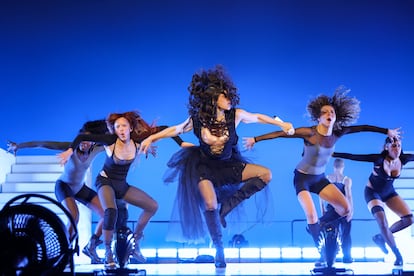
He Lux Tour It has the structure of an opera. The division into four acts and one interlude gives the concert a dramaturgy sustained by constant changes in emotional temperature. The first block is dominated by classical ballet: Rosalía appears in a tutu and on pointe, still restrained. The second goes into the night with Berghainwhere the show darkens and becomes more physical and violent. In the middle, to encourage changes in scenery, a comic interlude is projected starring its dancers, who The World compared (very generously) with Almodóvar’s cinema. The third act opens to the songs of Motomami and a pagan procession among the public that breaks with the initial hieraticism. The subtitles projected on the stage—in French in Paris, in Italian in Milan—reinforce this ambition: they are not only a resource for foreign audiences to understand the lyrics, but the equivalent of an operatic libretto. The last section raises the festive energy before closing with Magnoliaswith Rosalía alone on stage singing a kind of final aria. A suspended ending after all the excesses.
Vocal virtuosity and an orchestra in the center of the pit
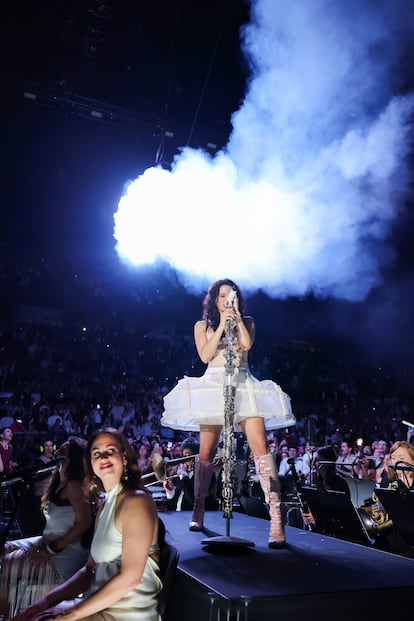
The tour is supported by a high-level vocal demonstration. Rosalía exhibits the breadth of her range and, in passages such as My Christ cries diamondswhere the voice is especially exposed, his virtuosity even aroused suspicions of playback in the debut in Lyon. In Paris, the second stop on this 57-date tour, they were dissipated: the singer voluntarily altered her phrasing and breathing to confirm that she was singing live. In the center of the pit is the London Heritage Orchestra, already accustomed to collaborations with other stars, from Björk to Dua Lipa. Directed by Cuban Yudania Gómez Heredia, the group of 22 instrumentalists will accompany her throughout the tour. Its live sound reduces the weight of the pre-recorded bases that dominated, not without controversy, the Motomami Tour.
The scenery shows the back room of creation
Full of those binary contrasts typical of opera (day and night, light and shadow, black and white), the set design combines bombast and a paradoxical sense of intimacy. The stage, arranged in a semicircle and illuminated with light bulbs, resembles that of an ancient theater. In the background, the set shows the back of a canvas, as if Rosalía wanted to show the back room of the creative process. The cross in the pit—which could be slightly altered in Madrid and Barcelona, depending on the plans of the rooms—reinforces the Catholic iconography, but also allows Rosalía to move among the audience and get closer to her musicians. Conceived together with her sister Pilar Vila, with the stage direction of the Barcelona-born Ferran Echegaray and the Belgian Dennis Vanderbroeck, the show chains living tableaus: Rosalía emerges from the box at the beginning, appears framed like a Mona Lisa contemporary during Can’t Take My Eyes Off You and adopts the silhouette of the Venus de Milo in The pearl. Echegaray had already worked with her in Motomami and has signed other stage proposals for Camila Cabello, Morad or Residente. Vanderbroeck works at the intersection between art and fashion: she has designed shows for Dior and Jacquemus.
Papaioannou and (LA)HORDE sign the choreography for the tour
The dance runs through the Lux Tour from beginning to end with a language that is not limited to athletic exhibition. The codes are, rather, those of contemporary dance. Its architecture is carried out by (LA)HORDE – the prestigious collective directed by Marine Brutti, Jonathan Debrouwer and Arthur Harel, at the head of the National Ballet of Marseille since 2019 – and by Charm La’Donna, experienced in tours by Beyoncé, Kendrick Lamar and The Weeknd. On stage, 12 dancers sustain that sophisticated language. The journey ranges from the tearful piety of My Christ cries diamonds to electric shock The Versace combi. The most successful moment comes with The pearlwhose choreography is signed by Dimitris Papaioannou, one of the great names of the contemporary scene. The gloved hands of the dancers transform Rosalía into a naked silhouette, between a living sculpture and the number of burlesque.
The costumes pay tribute to Madonna, but also to young Spanish fashion
The costume design precisely rhythms the multiple metamorphoses of the show. Rosalía first appears as a dancer, wearing a tutu, white leotard and ballet slippers. Then she adopts veils, caps and lace with a conventual resonance. Later he goes into the black of Berghainbetween feathers, high boots and visible lingerie—a pink bra that seems to wink at Madonna. And it ends close to angelic, with a large lace cape to interpret Magnolias. Among the accredited names are Ann Demeulemeester – the Flemish brand’s designer, Stefano Gallici, designs three bespoke silhouettes –, Antonio Velasco, Maison Vivascarrion and Les Fleurs Studio, the Parisian atelier of María Bernad, a 30-year-old Spanish designer, responsible for the final lace cape, made from vintage textiles. The costume changes allow her to draw a long succession of characters: a classical dancer unable to move, a saint who aspires to be a saint, an emulator of Marie Antoinette (with crinoline included), daughter of Lucifer lost in the night and a winged creature in search of redemption.
Rosalía in the museum: Goya, Degas and the Mona Lisa inspire your show
As already happened in the video of Berghain —full of references to other artists, from Leonardo da Vinci to the Sevillian Pilar Albarracín—, the Lux Tour It is a millefeuille of references to art history. Rosalía first presents herself as a Degas dancer, disciplined and static. Later it becomes a Renaissance Madonna or devotional image. Goya colors the darkest passages, where the scene is filled with deep black, herd figures, birds of bad omen and horns that seem taken from the covenone of the black paints. Then comes the Mona Lisa of Can’t Take My Eyes Off Youwith its dancers turned into Louvre tourists. Seen together, these references underline the logic that accompanies the entire tour: that culture and pop are part, in Rosalía’s language, of the same spectrum.