
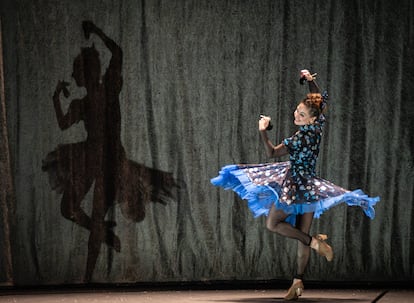
with the show The unpublished of the La Lupi Flamenco Company, concludes today, Saturday, the XXX edition of the Jerez Festival, which for two long weeks has turned the Andalusian city into the epicenter of flamenco dance, Spanish classical dance and its evolutions. In the final stretch of the event, two dancers, María Moreno from Cádiz and Leonor Leal from Jerez, have presented very personal creations with their solo dance as the protagonist, a very well-founded and established choice, with which the Madrid dancer Sara Calero also performed the previous week. Three millenials of dance that, in different calls, were distinguished with the Revelation Award of this cycle and that, with their conversations with EL PAÍS, make up a rich and plural mosaic of contemporary flamenco dance.
Calero (42 years old) received it in 2014 for Maja’s Lookone of the first works of his solo career. She was preceded by an extensive career as a prima ballerina in the National Ballet of Spain, among other groups. She understands the decision to embark on her own path as the natural transition from being a performer to a creator. He describes his time in companies as “very nutritious,” and values learning the creative processes or putting together a show, but acknowledges that he always felt “a very powerful inner voice for doing his own choreography.”
Now she confesses that she feels preparing and directing her own shows as the most exciting thing and feels proud to bring her ideas to the stage. Dancing alone for her is first a necessity, but also a requirement of the system: “I would like to form a company, but it is unfeasible under current conditions.” Perhaps as an essay, in his latest work, Taberna womanpremiered at the last Suma Flamenca, incorporated three dancers.
To the Jerez event, Calero brought his latest work, The rebirthcomplement and continuity of the previous one, The finitudepresented in this same cycle in 2023. These are two productions in which the dancer, beyond the search for formal perfection of youth, “when everything had to be perfect or beautiful” pursues a transcendence, the product of “an expressive urgency”, which coincides with her own vital and mental process: “I am breaking down inside, laughing, crying, getting emotional…”. The plurality of feelings was consonant with the varied sample of dances that he exhibited on the stages of the Villamarta Theater (February 25), a compendium of his rich and plural dance syntax.
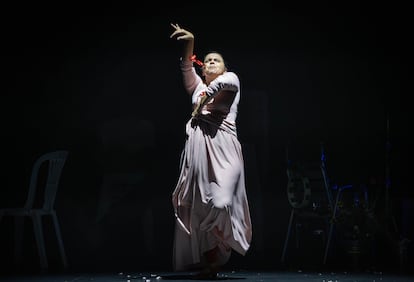
María Moreno (39 years old), 2017 Newcomer Award in Jerez with her first job, wings of memoryrecognizes that since she was little she had a very clear idea of a solo career: “I am very restless and I have always seen myself dancing alone.” Before, she had filmed in companies like Eva Yerbabuena’s, but even at that stage she confesses that “when I saw the teacher or others dancing, I was already thinking about how I would do it.” She also collaborated with other artists, revealing her vocation as a protagonist, which has never scared her.
After his second work, Of the revelation (2018), Giraldillo Revelation of the Seville Biennial of that year, its qualitative leap would come with the show More (no) More (2020), of which he acknowledges having had “a feeling of fullness and his own voice”, sensations that can be related to the understanding he found in the operatic director Rafael R. Villalobos, whom he had requested for stage direction. He would also direct his experimental destructuring of the soleá dance in o../o../..o/o../o (2022) and has provided his external vision for the latest work, Magnificatpremiered at the last Madrid Biennial and presented at the Villamarta Theater last Thursday.
The work is a party, which was the way it was conceived. Moreno, upon observing a painting of The Visitation, which depicted the meeting between the Virgin Mary and her cousin Saint Elizabeth communicating their mutual pregnancy, wondered how she would celebrate the news of her own motherhood. He toured popular festivals to be able to capture a celebration of that magnitude in dance and, in a difficult life stage, putting that idea into practice became a catharsis.
She, who recognizes herself as very selfish, wanted, for the first time, to share the scene and to do so she convinced the performer and performer Rosa Romero, who adds a touch of humor and a touch of irreverence. She was also accompanied by Raúl Cantizano (guitars), Miguel Lavi (singing) and Roberto Jaén (compass). Together, with her permanently on stage, they give a feast in which María’s flamenco dance, overflowing or collected, with a robe, shawl or without, illuminates everything.
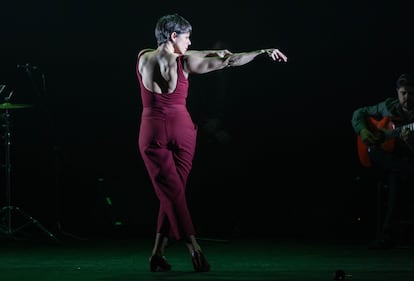
The dancer Leonor Leal (45 years old and Newcomer Award in 2011) recognizes that, after starting professionally with Andrés Marín and in the Ballet Flamenco de Andalucía, the world of companies did not suit her. Even today, he declares that he is not interested in dance groups and that his vision of flamenco is individual, as an expression of a personal search, with a name and surname: “I wouldn’t be able to create a choreography for anyone,” he states emphatically.
His career, which accumulated more than a dozen small productions, was thus built alone, with one striking exception, the work JRT Painter and flamenco (2016), together with Úrsula and Tamara López, which represented a radical change in her approaches, because with her she came into contact with María Muñoz, from the Malpelo Dance Company: “That opened my mind, because it gave me a new look at the scene and I learned to speak from my language, which is flamenco.”
Also in that show she met her husband, the teacher and percussionist Antonio Moreno, who has collaborated on most of her productions. The work premiered in Jerez, Martinicos I gave to my body (CS Blas Infante, March 6) is, however, a work developed jointly with the singer David Lagos, brought together for this project almost by chance. He describes her as an open dancer who “knows the tradition well, but dance fits very well when we talk about a concept.”
In this case, this concept revolves around the theory of the Lorca duende, of which each one offers their own vision with their respective languages. Lagos puts on a vibrant song, which revolves around death, with poems by Hernández, Bergamín and Lorca. She seeks the bodily vision of that elf with an expressiveness that we would say is minimalist (less is more). The two, with the complicity of the Lorca Project (J. Jiménez, winds and A. Moreno, percussion) and the guitar of Manuel Valencia, combine and conspire to pursue the emotion, the moved air of the duende. And by faith they achieve it.