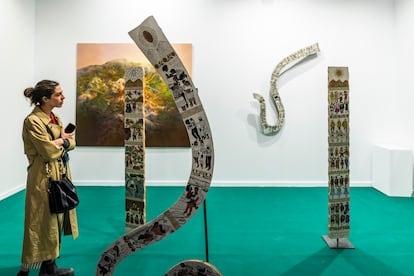
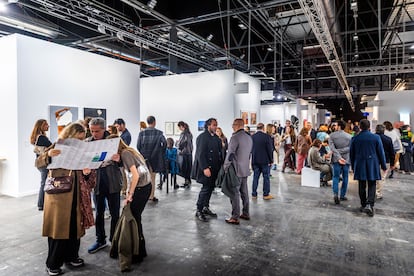
At 9:00 in the morning, Pedro Sánchez responded to Donald Trump’s threat to cut all commercial relations with Spain with four words: “No to war.” At 11:00, also in Madrid, the 45th edition of Arco was inaugurated. Only one gallery owner from Dubai has not been able to make it to the major international contemporary art fair due to the American and Israeli attack on Iran, the consequences of which are already spreading throughout the region. The rest of the guests, that includes buyers from all over the world, are here, at Ifema, ready for another year to spend on works. And based on the crowd that populated the two pavilions in which the fair is held on this first day, there did not seem to be any obstacle to negotiation and purchase. How can the new US military incursion into the Middle East affect an event like this? “It’s too early to know,” replied Maribel López, director of Arco. “Art gives us hope and the idea of possibility,” the cultural manager concluded.
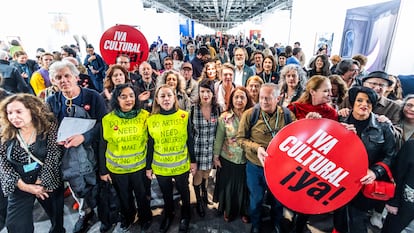
Only the demand for the reduction of cultural VAT by the galleries has resonated with some political force in Arco. At 12:45 p.m., 140 artists, convened by the Consortium of Galleries, have demanded that the Ministries of Finance and Culture lower the tax that places Spain at a disadvantage in the purchase and sale of art pieces compared to its European peers.
Shouting “Cultural VAT now!”, artists like Concha Jerez have recalled that a buyer who buys a piece from this Wednesday to Sunday in a gallery in Italy will be charged a rate of 5%, or in a French gallery, 5.5%. While if you want to acquire a work by that same creator in a Spanish space you will have to add a 21% rate to the price. “There is no dialogue between the Treasury and Culture,” they explain from the Consortium of Galleries, “this is stalling and we do not see any intention of it being resumed.” The group announces more protests during the fair, but at the moment they have not materialized. “We support our clients,” López said about these actions, in which Arco will not participate.
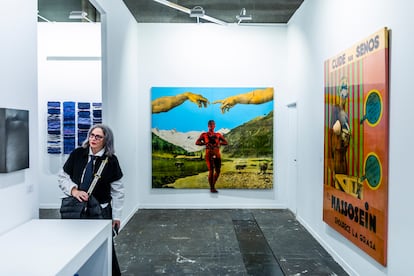
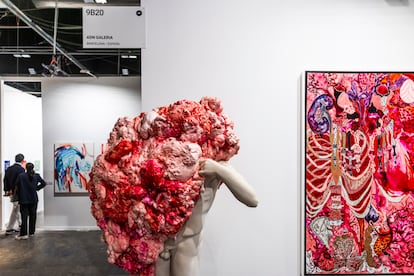
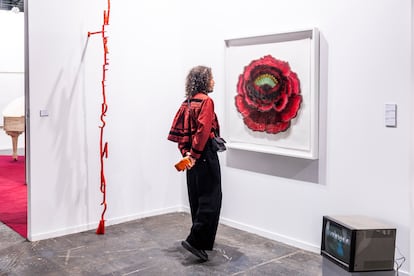
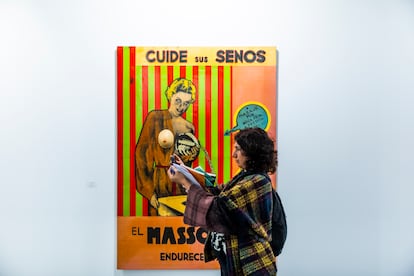
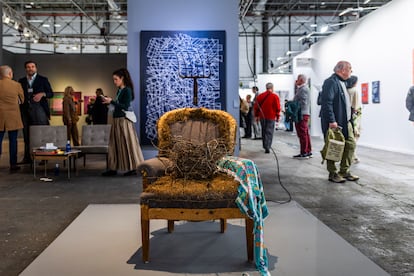
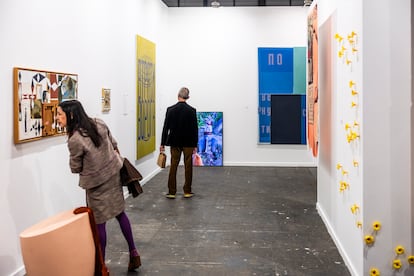
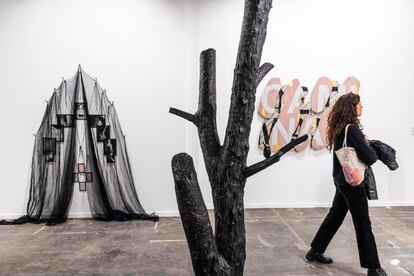
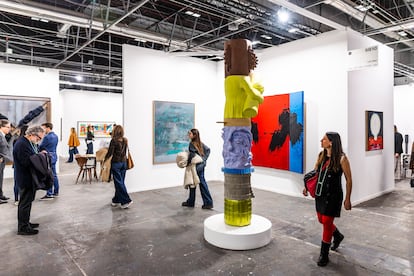
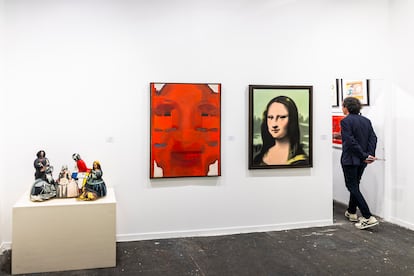
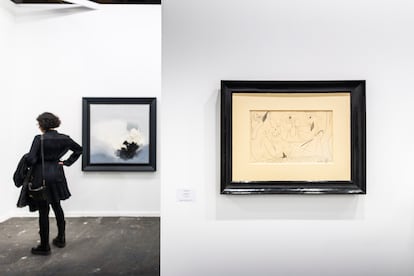
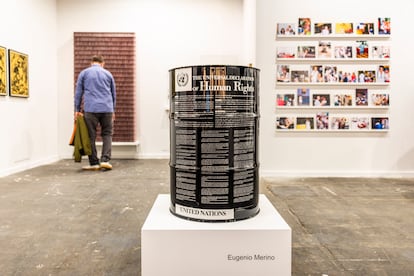
Thus begins a new edition of this fair in which once again, the most political demand is encapsulated in the so-called controversial pieces, a label that is already a tradition in Arco. Among the 211 galleries, from 30 countries, participating this year, steps must always be directed towards a handful to satisfy this need. The tour usually begins in ADN, where Eugenio Merino does his thing; on this occasion with Oila drum of this fossil fuel on which the Universal Declaration of Human Rights has been stamped. “Oil is the engine of wars, which makes it incompatible with life,” comments the author of White Washing, the dishwasher in which he put the extreme right in the previous edition, also responsible for locking Franco in a refrigerator, creator of a king’s ninot and organizer of Picasso’s burning chapel. “What rules is this extractive force,” accompanies Miguel Ángel Sánchez, the head of the gallery, who points out another work by the artist. The door of fascisma doorknob with a Nazi swastika.
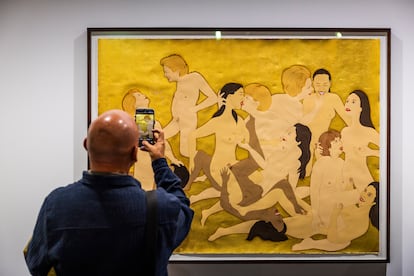
This direct social criticism has encountered a tough competitor in this Arc. The Eric Mouchet gallery, with offices in Paris and Brussels, has dedicated most of its space to the Afghan artist Kubra Khademi and her series Bread, work, freedom. With this title she makes portraits and collective paintings in which she undresses world leaders such as the former candidate for president of the United States, Kamala Harrias, the former chancellor Angela Merkel, the person in charge of European diplomacy, Ursula Von der Leyen, and the Mexican president Claudia Sheinbaum, among other leaders.
“This nudity is not a provocation or a reduction to eroticism,” they explain from the gallery, “but rather the affirmation of free bodies, in perpetual motion, resilient and combative.” In their explicit orgies between the representatives, the Arco public has found a meeting point, curiosity and morbidity—why not say it—. Khademi, artist, performer and activist, exiled from her country in France since 2021, has managed to convey her message with this attention. Bread, work and freedom are fundamental rights denied to women still in Afghanistan; In exchange, the Taliban government condemns them to poverty.
The artist chose the same protagonists to whom she wrote a letter in 2023 asking them to unite their power to fight for women in Afghanistan. “That letter remains unanswered,” Eric Mouchet says in the gallery. Khademi does not want to compromise them by having them carry out these sexual practices, but instead aims to “symbolize the power of femininity, tenderness and love in the face of war and patriarchy.”
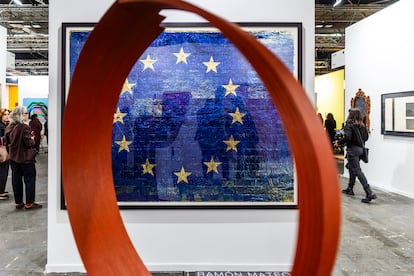
The Freijo Gallery has recovered a 2017 work by Ramón Mateos. In European Fortress, The artist paints the flag of the European Union on a thermal blanket, the same one that migrants covered themselves with during the crisis that year when leaving the Mediterranean. Almost a decade later, the piece takes on an updated reading. At Espacio Mínimo they have dedicated a large part of their stand to the Ukrainian artist Sergey Bratkov, who fled Russia at the beginning of the invasion of his country to move to Berlin. The creator presents a series of works with strong superimposed words such as “betrayal” and “underground school.” This work is complemented with the video My brother’s cats, in which you can see these animals playing on a bomb that did not explode in their brother’s garden.
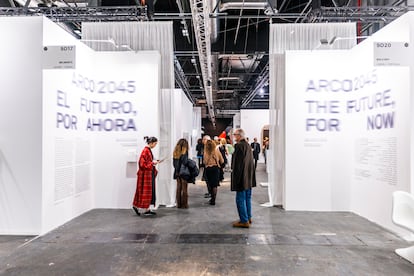
Despite the constant efforts of art experts and critics to find a theme from which to explain each edition of Arco, there is no common exhibition proposal here. There is no story about Gaza, for example. Nor is there a single view of the new world order dictated by the megalomania of a few leaders. This is a market in which annual balance sheets are adjusted, attention is drawn to contemporary art and, occasionally, some reflection is raised. In this edition, without a guest country or geography, the fair has proposed to talk about the art that comes in the section Arc 2045. The future, for now. Curators Magali Arriola and José Luis Blondet have called on more than a dozen artists to look to the future, but, they warn, without predictions. That is, these two areas do not function like crystal balls. Few conclusions are drawn along the way. The answer is almost as confusing and damn artistic as the distorted typography used on the poster announcing the 2045 Arc.