
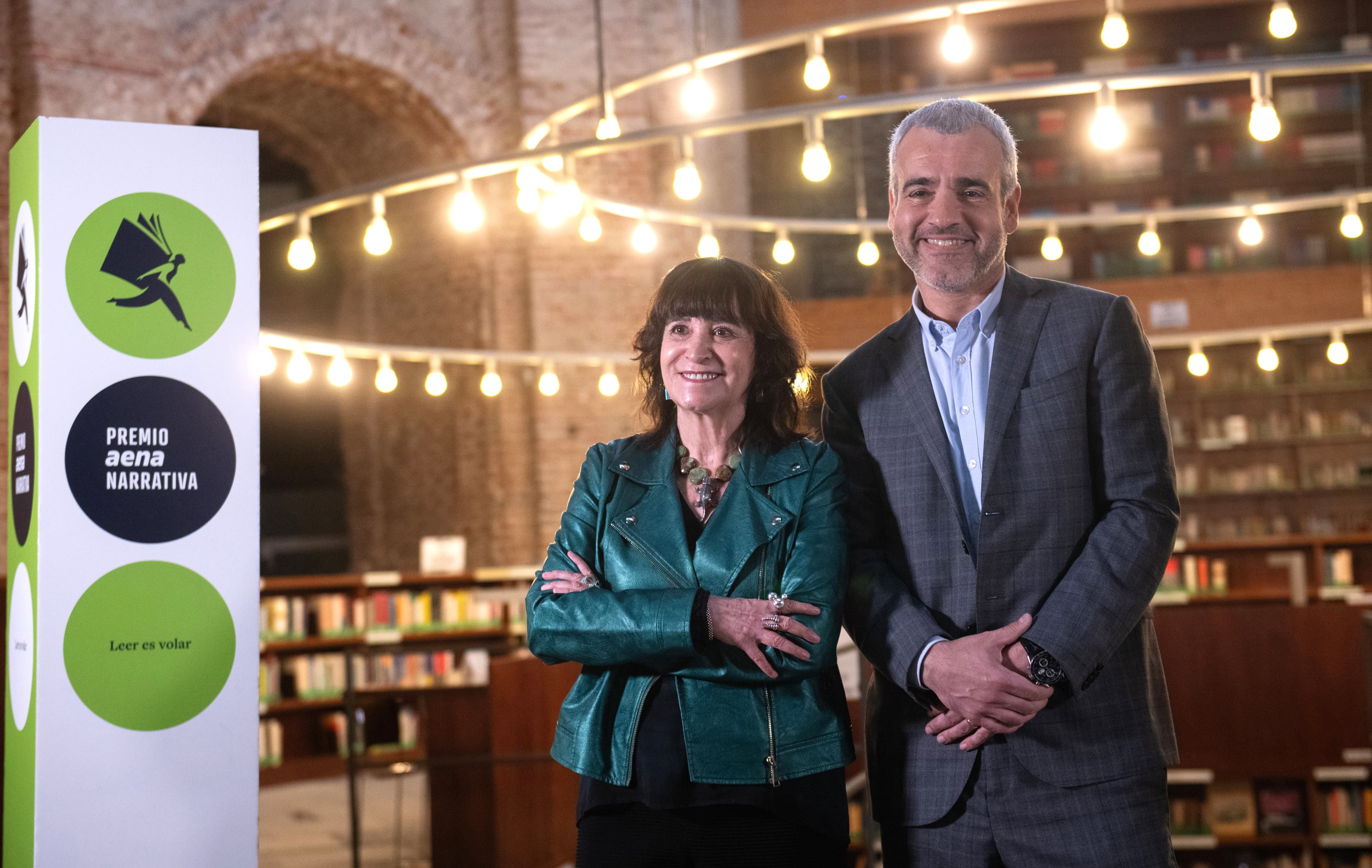
It is difficult to think that there is a lack of literary prizes and awards in Spain; one might rather conclude that this section is saturated. And yet, this Thursday a new award was announced in Madrid, the Aena Narrative Award, which aims to fill a gap and represents a real earthquake in the sector. Maurici Lucena, president and CEO of Aena, accompanied by Rosa Montero, who is the president of the jury for the first edition of the award, announced that the award is endowed with one million euros for the winner, equaling the endowment of the Planeta award, the best paid in the Spanish language, something that has been “a point of reference,” as Lucena pointed out. The new award distinguishes a work of narrative published in the previous year (2025) and is not promoted by a publisher. It is not, therefore, a hidden advance, and it moves away from the possible commercial interests of the awards of large groups. The winner will receive one million euros and the percentage of royalties of subsequent sales.
In addition, the authors of the four narrative works shortlisted for the Aena award will receive 30,000 euros, and the company, 51% state-owned, will invest more than another million in the purchase of copies of the five titles that reach the final round of deliberations. These books will be delivered to the institutions and administrations of cities where Aena has airports so that they reach schools and libraries. The company will also purchase those books for its employees.
The objective of the new award is to promote reading and literary creation. A list of the finalist titles will be made public in mid-March and the award ceremony will be held on April 8 in Barcelona. Works of poetry, theater and “pure essays” are excluded, explained Rosa Montero. The writer highlighted that beyond the endowment of the new award, this initiative “mobilizes the entire sector and enhances our language.” Books written in the co-official Spanish languages that have been translated into Spanish and published in 2025 may receive the award. “Trying to make a Booker seems essential to me,” he stressed, referring to the respected award in the English language.
The new award is a recognition with a transatlantic vocation that was born under the motto “reading is flying”, and has as partners the Gabo Foundation and the Vargas Llosa Chair. At the UNED Library in the Lavapiés neighborhood, the UNED rector Ricardo Mairal welcomed us, highlighting the importance of promoting the promotion of reading and creation.
Compared to the Booker Prize in English or the Goncourt Prize in French, the Spanish language, with nearly 519 million native speakers, has so far not had a prize of such prestige that distinguishes the book of the year. More than 1,200 prizes are awarded annually in Spain, the vast majority for unpublished works, and the best paid are promoted by major publishing labels (Planeta prize, Nadal prize, Alfaguara prize). There are also important institutional awards that recognize a literary career, such as the Cervantes award. The Vargas Llosa Novel Biennial, created in 2014 to award the best novel every two years and endowed with 100,000 dollars or the Finestres award, which in its five editions has distinguished the best book of the year written in Spanish and the best in Catalan, as well as the Tigre Juan point in the same direction as the Aena award, but the ambition and impact that the new award aims to achieve implies an important leap.
The bases of the new award establish that each member of the preselection team (“scouts” as defined by Rosa Montero) will choose 10 works on which it will issue an individual report ―based on “literary quality, originality and narrative treatment, cultural and commercial value and other favorable aspects”―, and each member of the jury will be able to add one more title to the list. In this first edition the group of scouts has included journalists and critics such as Jordi Amat (coordinator of ), Paula Corroto or Karina Sainz Borgo. The jury, chaired by Rosa Montero, includes Pilar Adón, Leila Guerriero, Luis Alberto de Cuenca, Jorge Fernández Díaz, José Carlos Llop, Sergio Vila-Sanjuán, Jesús García Calero and Elmer Mendoza. The jury will change every year.
“This initiative tries to reinforce the habit of reading and encourage the publication of good books,” said Lucena, who framed the new award within the corporate social responsibility or social sustainability policies of the company he presides over. “Reading is good and healthy and reinforces equality of possibilities.” Lucena stressed the strength of the Spanish language: “Our desired It is that, if we persevere in the effort, we will get closer to the Olympus of international awards.” The president and CEO of Aena for eight years, about to renew his mandate for four more, committed to continue with this initiative while he remains in office and trusts in its consolidation. “The Goncourt award has no financial endowment and I hope we achieve that the prestige of this award leads us to that,” he responded. “We care a lot about the wickers with which we have built this award and that it can fly on its own.” Rosa Montero pointed out that one of her concerns is to try to bring to light books that have had little exposure and not just “reward what has been awarded.” The award, she said, “will improve” and grow.
International awards
In the presentation of the Aena Narrative Award, Lucena and Montero referred to major awards in French and English that distinguish the best books of the year. The Booker Prize was born in 1969 to reward the best fiction book published in the Commonwealth countries (the US was outside) with the support of a large business conglomerate that had just started a literary division (after taking over 51% of the royalties by Ian Fleming and years later he added the copyright by Agatha Christie or Harold Pinter). The jury changes every year and the prize is 50,000 pounds for the winner and 2,500 for the finalists. Since 2015 there has been an International Booker (before there was the Man Booker that Americans did access), and this year’s Argentine Gabriela Cabezón Cámara is on the list of finalists in this category, announced this week. In the case of the Goncourt, the prize does not carry a financial award, but its award has a great impact on sales. It is awarded by the members of the Goncourt Academy.
The absence of an award of this importance in the Spanish language until now perhaps reflects the fragmentation of the Spanish-language publishing market and the not so fluid communication between both shores, which the Aena Narrative Award aims to promote. “The consolidation and impact of the Booker have to do with the prestige of the English language and that this market is sufficiently global. It is the dominant language,” says Gustavo Guerrero, writer, professor and editor of literature in Spanish and Portuguese at the Gallimard label. “The still complicated circulation of literature in the Spanish-speaking world, despite important initiatives by small publishers and large groups, makes clear consensus still difficult to achieve.” At a time of cultural war and strong politicization, Guerrero celebrates initiatives that promote and exalt literary value. “It is very important that the awards clearly define what they are going to celebrate (a career, a title, etc.) and that the people who award them have a certain autonomy,” he concludes.