
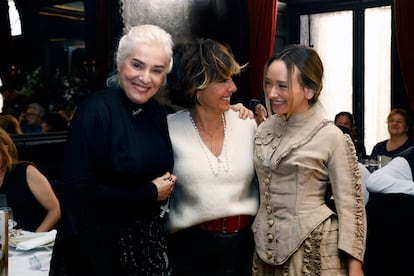
“I never imagined that what I wrote would carry my name,” the journalist and writer Sonsoles Ónega said through tears this afternoon at the L’Hardy restaurant in Madrid. Opened in 1839 and a silent witness to history from the very center of the town and court, the restaurant is the ideal setting to feel like you are in the 19th century. And, for that reason, it was the perfect place chosen by Ónega to present her new novel, will bear your name (Planeta), the first to be published after the overwhelming phenomenon that was The maid’s daughterswith which in 2023 he won the coveted Planeta Prize.
Ónega (Madrid, 48 years old) is one of the most recognizable voices in journalism and television in Spain, but the truth is that he has a literary career that has always had an impact—sometimes enormous—on bookstores. Trained in the editorial office of CNN+ and with a good part of her career as a parliamentary reporter on Telecinco, she later became a presenter of large-format programs and magazines. Since 2022, he has hosted the evening program And now Sonsoleson Antena 3, combining his television work with writing. His bibliography began in 2005, when he published his first work, Havana Street, Obispo corner. And yet, Ónega’s literary turning point came in 2023 with The maid’s daughtersa work with which he won the Planeta Novel Prize – worth one million euros – in its 72nd edition. The novel followed the saga of a Galician family in the canning industry during the first half of the 20th century. Since its publication in November 2023, the book quickly established itself as a publishing phenomenon: it was the best-selling fiction book in Spain at the end of that year and continued to lead the sales charts in 2024, reaching more than 20 editions and exceeding half a million copies, according to Planeta figures. Despite this resounding commercial success, The maid’s daughters was not exempt from negative criticism – “The feeling of ridiculousness is suffocating. Because of the plot, because of the style, because of the prudery, because of the staleness, because of the simplicity,” he wrote in his harsh criticism in Jordi Gracia—. However, the impact of the novel on readers was undeniable and its series adaptation premiered at the end of last year.
“I have written this new novel with anger, to prove myself and demonstrate that the award was not a coincidence. In a way of vindication,” Ónega explained this Wednesday. “Things were said with The maid’s daughters that violated my soul. Playing with the vocation was very painful. My vocation as a writer was questioned, and it hurt me tremendously. You can say that the novel is shit. But am I a product? No and no”, he stated.
Historical fictions, romances (historical and contemporary) and some thriller they mark his bibliography. will bear your name It is his eighth novel and, as The maid’s daughters o After love, is located in a historical context. Set in Spain at the end of the 19th century (the story begins in 1882), will bear your name tells the story of Mada Riva, a young woman accused of a crime in her town (Comillas) who is forced to flee to protect her family honor. In Madrid, Mada tries to rebuild her life and reclaim her identity in a society accustomed to reducing women; because the female characters and the structural difficulties they face are another of the trademark themes of Ónega’s house. “It has cost me more to write this novel,” he confessed in the presentation. “Literature expels family, friends… Virginia Woolf was very smart about having her own room, especially in a professional world with so much noise,” she refers, of course, to her daily work as a journalist. Do you think there is a special hostility from critics towards the figure of the presenter-writer? “There has always been a conflict between the writer who is cherished by critics and the writer cherished by readers. And I choose the latter,” she stated, in the presentation organized by Planeta, in which there was a small interlude in which Anabel Alonso played Sister Vicenta María (a real character recovered for the book; a nun who took young girls off the streets and taught them a trade), and Lucía de la Fuente played the protagonist, Mada Rivas.
“I wanted to delve into the 19th century,” said Ónega. “It was a fabulous moment for the first times. At this time, women discover culture to save themselves and to vindicate themselves, and I think it is a great moment to talk about an environment in which women are beginning to get their heads out of the hole.” And the present? Are we living in a time of anti-intellectualism today? “I’m not sure. I think it’s read more than ever, and there’s so much talk about books that supermarkets sell, which I love, and about David Uclés. Whom I hope to sign in September…” she slipped, laughing. A sweet atmosphere suddenly fills the room. The waiters bring out the restaurant’s typical dessert, the famous L’Hardy soufflé. It smells like vanilla, which mixes with other smells: something solid is cooking in the kitchen. In the dining room, however, something more elusive and valuable is brewing: a future literary success.