
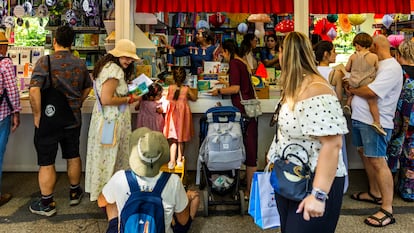
The “Spanish book miracle” continues. The publishing sector grew in 2025, for the twelfth consecutive year, reaching a turnover of 3,138 million euros. It is the record only surpassed by the figure from 2008, the year in which the current one began policrisis and that preceded a period of decline until 2014. Since then, in those 12 years, 942 million growth has been accumulated, which represents an increase of 43%. The data is extracted from Advance of the Domestic Book Trade Report of the Federation of Editors’ Guilds of Spain (FGEE), presented this Thursday at the Eugenio Trías public library, the geographical and temporal environment of the Madrid Book Fair. “We are catching up to the levels of other developed OECD countries,” celebrated Manuel Moreno, president of the FGEE.
Book sales, in all formats, grew by 3.3% compared to the previous year, driven, above all, by fiction books for adults (mainly contemporary novels) and by children’s and youth literature, which grew by 17%. It represents more than 20% of the total turnover, despite the widespread cliché that young people do not read, the data shows that they are the age group that does it the most.
“We have a hopeful future, because, from the moment children are born, families are buying books,” says Moreno. In adolescence there is a drop, due to the understandable distractions of such a turbulent age, but it does not drop below 70% of readers. “It continues to be one of the bands that reads the most,” adds the president. In fact, the oldest groups are the ones who read the least. And women tend to surpass men as readers at all ages, a phenomenon that is fed back by the current rise of literature written by women.
The third most read group, after fiction and children’s and young people’s literature, is non-fiction. It is also where the most titles are published, and even so it falls by 9.2%. The anomaly could be attributed to piracy, photocopying, downloading, although there is no data to support this. Comics and similar products only represent 3% of the total turnover, but have experienced a very notable growth of 38% compared to the previous year, according to the report, which was led by researcher Roberto Corral.
89,107 titles were published (61,800 in paper, 27,300 in digital) at an average price of 15 euros, which remains very stable. “A very reasonable price to sustain this growth,” says Corral. Above all, taking into account inflation and the rise in raw materials such as paper. “This stability in book prices is due to the juggling act of the editors, that is also a miracle,” jokes Moreno. Bookstores and bookstore chains remain the main distribution channels, with 60.6% of sales, although independent bookstores are suffering from the strong impact of real estate speculation and the absurd increase in store rents.
And although the printed book remains the undisputed king of reading (not like its first cousins, physical music or audiovisual formats, devastated by digital), the electronic book format increases its turnover by 5.3% to reach 173.9 million euros. It already represents 5.6% of the editorial pie. “Audiobooks are experiencing growth, very adapted to new lifestyles, such as listening to audios when one is doing sports or driving,” said Corral. They still represent only 0.5% of total turnover.
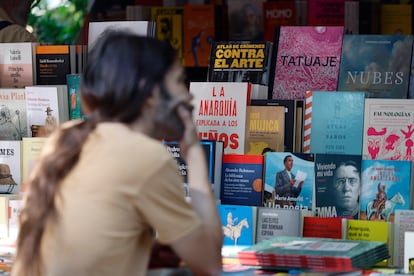
“We can talk about a Iberian phenomenon which includes Portugal (which grew more than twice as much as Spain this year, 8%): the southernmost countries in Europe have maintained an average of 6% growth since the pandemic, more than other European countries, which even register a decline in Germany and France,” says Moreno.
When something grows for a long time, it is in the human spirit to wonder when it will stop. Demographic advance (when all generations are readers) or the attention crisis caused by technology can stabilize the market in the medium-term future. “It is not our job to guess the future,” Moreno jokes. According to him, there is still room to get closer to countries like Germany in terms of purchasing and reading. “We have a horizon of progress,” Moreno concludes.