
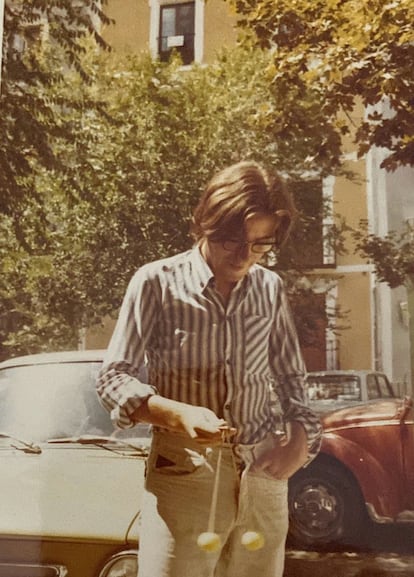
Quico Rivas (Cuenca, 1953- Ronda, 2008) was already a fascinating character long before he was a character. The summer of his 15 years was spent in Campillos, a feared boarding school in the province of Malaga to which the good families of Seville sent the bad students. The fact is that he was not there for that, but for quite the opposite. A brilliant student, the previous year he had insisted on taking both the Bachelor’s degrees in Science and Literature, and although he only had three subjects left, his father—the Count of Salceda—did not tremble.
A letter from Quico to his family that summer of 1968 reflects the helplessness of a teenager and at the same time the insurgent that was already boiling inside him: “I am burning with the desire to see you. You have to see the trick you have played on me. You have not written to me or sent me a package or anything, of course you will be having a stupid summer without me. Don Diego came to get the book by Carlos Marx and I don’t know why… I brought it for nap time, which I had a great time.” Bored without being able to read or speak, and like sleeping I don’t fall asleep…”
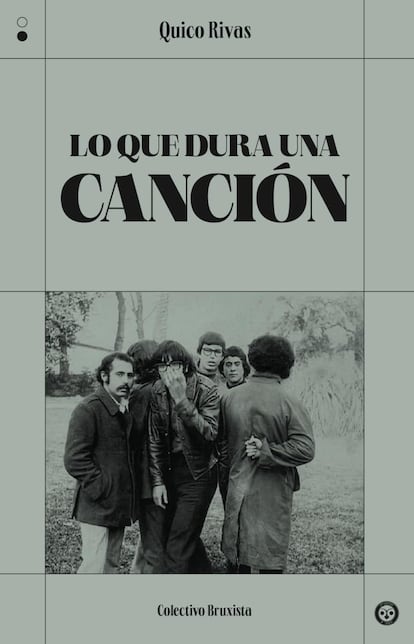
That letter from Quico Rivas appears in the prologue of How long a song lasts, the first and only novel by the art critic, editor, poet, exhibition curator and a thousand other things, among them that of a character in the Sevillian counterculture, the hall of the Madrid Movida. That is precisely what the book is about, set in 1968 but written at the end of 1980 and whose existence was a rumor until the journalist and cultural critic Fran G. Matute asked Eva Rivas to give him access to her father’s archive. And there were—stuffed in an envelope—some 200 typewritten pages with infinite hand-written corrections that the editor Jandro Alvargonzález, with the help of Matute and the permission of the daughter and heir of Quico’s legacy, was turning into a precious book from the Colectivo Bruxista label.
The beauty of the new volume lies in Rivas’ text, but also in the prologue written by Matute, an expert in the counterculture and avant-garde of the late 60s in Seville, hence his essays. This time we come to hit (Flint) and To Quico Rivas, for a revolution in everyday life (Athenaica). Fran G. Matute says that he did not know Rivas, but that he has read many of his letters, his poems, his art criticism, and that in contrast to the public image he may have had in those years of the Movida (“that of a noctivagoa brute of the night”), in reality he was someone with a lot of sensitivity, who could even seem innocent. Precocious and restless, at the age of 16 Rivas set up the legendary Multiple Team with his high school friend Juan Manuel Bonet.
“The luck of this novel,” explains Matute, “is that Quico wrote it very young, at 25 or 26 years old, shortly after the time he recounts and that he lived. And although he already has a point of disenchantment, he retains a very tender look. Instead of blaming that younger Quico, instead of scolding him, what he does is understand that everything that happened at the end of the 60s to these people as young as him was an emotional whirlwind and a moral whirlwind; a whirlwind that affected his daily life. And in the case of his character in the novel, which is his. alter egothe fun is seeing how out of place he was. It is not a heroic novel about hippismo“There are no people taking drugs, there is no aestheticization of the hippy world, but it is really a view from the outside, from a bourgeois child who would have loved to be part of that revolution, but his political, cultural, religious, educational background does not allow him to fully enjoy that.”
Quico Rivas actually came from a very different territory. Her daughter Eva tells it very well: “I didn’t deal with him when I was little, but he caught me when I was a pre-teen and thank God, because my family is very traditional, very posh, very Catholic, and my Quico taught me at the perfect age what contrast is, that there was a world beyond. He gave me the right books, he took me to the right places. He was only 18 years older than me, and I went on adventures with him that you can’t even imagine. And we never left to have contact until he died. As a child I always thought it was a father’s nonsense, but now I think: how good, how fun and how much it has taught me… “
Eva Rivas remembers that her father finished the novel in the family home in Grazalema and then left it half forgotten. “He said that he would only save the title. He always said that the title is the project, that with a good title, whether it was for an exhibition or a book, he was almost all the way done. I believe that he never had the intention of publishing it in life, but like so many other things by Quico. It was the one that never finished, the one that never finished, I don’t know if it was because of shame; I don’t know… But I think that right now he would be delighted with how the book has turned out and the reception it is having.”
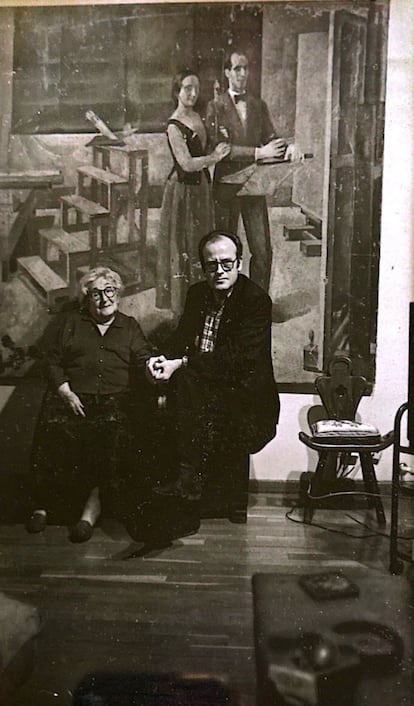
After the death of Quico Rivas on June 1, 2008, the Sevillian writer Diego Carrasco, who had known him since he was wearing shorts, wrote an obituary in this newspaper that speaks of a brilliant and refined character, a count without the manners of a count, “a title that, when it belonged to him, made him proud as much as his condition as an unbribable insurgent. Because his thing was permanent insurgency. Provocative, restless, versatile, tireless reader, a good lifer, he wrote the most beautiful lines on art and literature, scattered in hundreds of catalogs published out there.”
Like so many others, remembers the essayist Fran G. Matute, Rivas left Seville early because he felt that he had outgrown it, but he always returned, especially during Holy Week, although those who always “had him at an altar” were the anarchists of the CNT: “He has always been very loved here. In fact, all the proposals to vindicate his figure are being made from Seville.”
On the back cover of How long does a song last? There is a phrase by Quico Rivas that can be an epitaph, but also a life project: “I myself cultivated the legend of my bad fame, which is the only respectable fame.”