
In June 1926 Agatha Christie published The murder of Roger Ackroyd and something changed forever in the history of literature. It was his sixth novel, the third in the Hercule Poirot series, an equally irritating and brilliant character with whom he had launched his literary career six years earlier. The success was immediate. The outcome of the story, unpublished and controversial, catapulted Christie’s popularity and the novel paved a successful career with almost unbearable figures: over 1,000 million copies sold in English of her more than one hundred books, as many in the rest of the languages; only Shakespeare and The Bible they surpass it. Paradoxically, this global success and her prolific nature have blurred the edges of an author who is much darker, deeper and more disturbing than she may seem, a writer so immersed in the DNA of crime fiction that her effect is not perceived, a plotter who, a century ago, already blew up some of the best endings in history.
“She is an intergenerational author; her novels are very well done and have a bright point. She is trivialized for being prolific and for being a woman, but she does not write short novels, not at all: they are great novels. And it has not gone out of fashion, quite the opposite,” says editor Miriam Vall, who directs Espasa’s publication in Spanish of all of the British author’s work. They have almost a hundred books and aim to complete this arduous mission in 2028. Readers, including young people, have responded enthusiastically: “With Agatha you see but you don’t see, you don’t want to go back, you get into the story. And the kids love that. The novel turns them into detectives, it asks them for a little help and they stay trapped.”
Not always recognized, the mark of Christie (Devon, 1890 – Oxfordshire, 1976) on contemporary authors is immense. In the latest book by Juan Gómez Jurado (LieEditions B) the influence of the author of Death on the Nileespecially from that unreliable narrator who debuted in the aforementioned The murder of Roger Ackroyd. Not in vain, the author of Red Queen He is one of her great defenders: “She taught me that the reader deserves to be respected. You can surprise them, you can manipulate them, but you can’t lie to them. All the information has to be there. Christie is apparently simple. That transparency is the result of brutal work, not of its absence. That she sells hundreds of millions of books and critics still raise their eyebrows only speaks of those who raise them.” This Stakhanovite method was fueled by tireless activity (he took scattered notes of everything, which only later took shape), discipline and a great capacity to drink from reality: his novels are anchored in the type of society in which he always lived, well-off, with large houses and service, but in a certain moral and economic decadence.
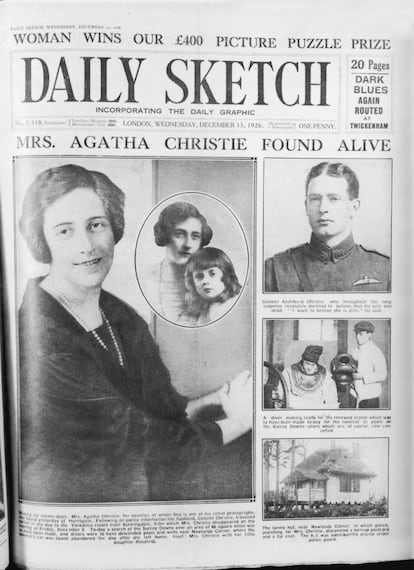
Despite finally knowing success, 1926 was a turbulent year for her. In December he disappeared for 11 days and the case shook British society. He left his home in Berkshire without telling anyone. Later, his car was found abandoned at Kings Cross station, from where it was later learned that he had taken a train to Harrogate (currently home to one of the best crime novel festivals in the world) to stay in a hotel. Some employees recognized her and gave the notice. She had registered under the name of Nancy Neele, a golfer who was a family friend and lover of her husband, whom she did not recognize when they met again. He never talked about it with anyone. The divorce came two years later. In the midst of the hurricane, in 1927 he created the insightful Miss Marple, who appears for the first time in The Tuesday Night Cluba story published in Royal Magazine. María GS, a 14-year-old from Madrid, defends the underrated researcher from her passion for the British woman’s books: “Although it seems like she reserved the best cases for Poirot, I love that Agatha Christie included a character like Miss Marple at a time when the presence of female protagonists in literature had barely developed yet.”
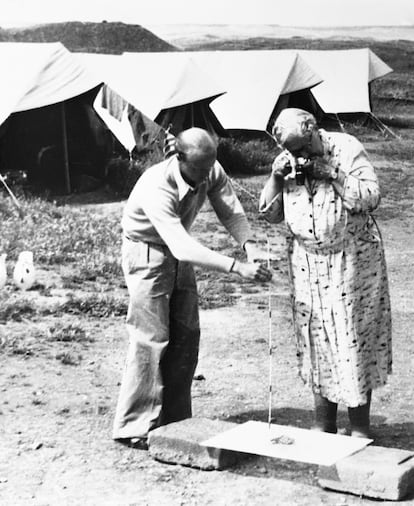
The short stories will form another narrative wealth: more than 160, published in 14 anthologies. Production was not going to stop and it would not take long for her to reach an average of two novels per year, supported by the public success and the emotional and personal stability she found with her second husband, the archaeologist Max Mallowan, whose work in various excavations around the world became Christie’s other great passion.
At this time she created the pseudonym Mary Westmacott (under which she wrote six romantic novels) and some of her masterpieces starring the peculiar Poirot: Murder on the Orient Express, death under the sun o Appointment with deathto collect three of the most famous. Alice Hallett, known as the Agatha Christie of the 21st century for her daring updating of the master’s technique in works such as The appeal o The deadly question (published in Spain by Ático de los libros), comments on a very particular aspect of Christie’s success: “She wrote about 70 novels, but only five or six are really known today. It seems that the author of the first period is more liked, that of the surprising puzzles, stories with funny twists, while the later and darker Christie has remained only for the most specialized fans.” If you want to get away from the titles that are already part of the canon of Western culture, perhaps you could delve into High tides of lifeone of Poirot’s darkest cases (recently published in Espasa); in The mysterious Mr. Brown (Nazis, spies and lost documents in the first case of the duo Tommy and Tuppence) or in blood in the pool (Booket) recommended by Hallett herself and very summery.
A screenwriter by training, Hallett came to Christie precisely through television adaptations (a genre in itself, almost incomprehensible) and film adaptations, which began in the 1940s. “Its structure is perfect. It creates a group of characters that fit together perfectly and integrate into the mystery and only then does it tear everything to pieces and move the characters so that you begin to believe that it was each one of them. Manipulating the reader like this is not easy at all,” says Hallett to explain why it has been adapted so frequently.
A round business
With two brothers 10 and 11 years older than her, as a child Christie spent a lot of time alone, with her imagination as her only support. Hence those plots that fold and unfold with unprecedented solutions, a unique capacity that enriches the rereading experience. Try, for example, the celebrated The murder of Roger Ackroyd, The crooked house o Murder on the Orient Express: When you know those groundbreaking endings, returning to them, looking for every trace that explains the outcome, is an experience. Marina Sanmartín, writer and bookseller at Cervantes y Cía in Madrid, provides other keys: “I think that what makes it unbeatable is everything that is not seen, that Christie’s texts are in themselves a great trap. They seem simple, they are brief and their outline is easily drawn once we finish them. However, they are very complex sleight of hand games, pure magic.” His latest novel, The double disappearance of Abril del Pino (Salamandra) pays tribute to the teacher: “As a novelist, I try to make my texts be seen in yours for three reasons: its timelessness – today it continues to sell in a sustained way and to all types of readers -; its ability to play with the reader and keep him in suspense until the last page and his ability to outline settings and characters in a few words, but tremendously accurate.”
The British woman was successful in almost all fields, although towards the end of her life she cultivated theater a little more, where she produced 25 plays; the best known is The mousetrapwhich holds the record for the play performed for the most consecutive days in history: from 1952 to today in three different theaters. Overwhelming figures for an immense business that has been managed since the middle of the last century by the Agatha Christie Limited consortium, currently led by her great-grandson James Prichard. According to British law, they have exclusive rights 75 years after his death, which occurred in January 1976, at the age of 85. They therefore have a quarter of a century left. And to name just a few of the projects underway, in addition to the constant reissues of all his novels, the series premiered at the beginning of the year The seven spheres (Netflix), Sophie Hannah will expand the list of authorized continuations of Poirot’s novels (she has six, which speaks of the reading thirst for these stories) and in September the first Miss Marple will be published under license from her heirs: Death at the Grand Alpine Hotelwritten by Lucy Foley.

The managers of this narrative treasure eagerly seek new markets to attract new generations. One of those young women is María GS, who has noticed her mark on other successful authors: “Today, for example, I see the presence of Agatha Christie in the endings of the English Holly Jackson’s books and in the resolution of the mystery. That satisfying but frustrating feeling at the same time when you finish a story, you think that everything fits together, but you ask yourself: why didn’t I realize?”
Final calculated to the millimeter
In the last stage of her life, Christie slowed down to one novel a year, which swept sales at Christmas time, and in the early seventies she closed all her series. The final chapter of the two most famous, however, was written and hidden in a safe since World War II, which gives an idea of the control that this woman exercised over her career and her characters. The plan was for them to be published after his death, but in the end Poirot said goodbye in Curtainwhich hit the market a year earlier. A sleeping crime, The last case of Miss Marple was published posthumously in 1976.
“I am ready to accept death,” she said at the end of her autobiography, written 11 years before her final goodbye. We cannot know if at that point she already knew that her work was going to feed the curiosity, the hunger for adventure and the capacity for fun of hundreds of millions of readers around the world, but the honorable lady of crime seemed to sense it.