
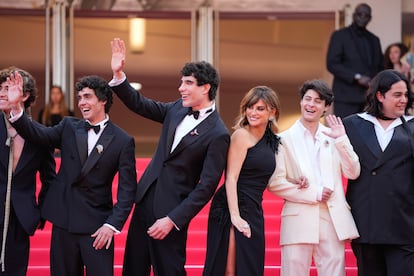
The black ballthe third Spanish film in the official Cannes section, is an emotional search for identity queer Spanish through Lorca and historical memory. Directed by Javier Ambrossi and Javier Calvo, Los Javis, a The black ball Certain excesses can be attributed to it, such as some extra bombastic sequences, but the film is convincing for how it resolves its complex structure in three times, for how it rethinks the Civil War from the perspective of a new generation and from sexual identity and for some brilliant moments, to remember, like that one with Penélope Cruz cheering on the troops in the style of old Madrid. The actress is wonderful and the sequence is exciting with its plea for transforming fantasy in the middle of a fratricidal country.
The film is based on the four pages that exist of The black ball, the only work by Lorca with a declared homosexual protagonist, and also in the play The dark stoneby Alberto Conejero, inspired by Rafael Rodríguez Rapún, footballer for Atlético de Madrid, student of Mining Engineering, secretary of the Barraca and one of the loves of Federico García Lorca. The script of The black ball It is divided into three times that intersect with each other – 1932, 1937 and the present -, and in them the voice of Lorca and his Sonnets of dark lovewritten by the Granada poet during his last years of life, and compiled and published posthumously.
It’s been almost a decade since The call, the Javis’ first feature film, and three years since they reached creative maturity with the series The Messiah The black ball It is the Javis’s second film and it has arrived at Cannes with a bang: it is a very ambitious film that dares to deal with the Civil War from a new generational perspective that finds in Lorca, shot for being a leftist and a homosexual a month after Franco’s coup d’état, a bridge to the rupture of a war that brought 40 years of national-Catholic dictatorship.
An ensemble film, its cast includes Lola Dueñas and Carlos González (mother and son in the contemporary plot, which takes place mainly in Madrid); Miguel Bernardeau and the musician Guitarricadelafuente —who are, respectively, Rafael Rodríguez Rapún and the national soldier who guards him in the Santander prison in 1937— and Milo Quifes, who plays the protagonist of The black ballset in 1932 in Granada. Glenn Close credibly plays a Lorca specialist in the present and Penélope Cruz is that unforgettable star who encourages the troops in Santander.
The entire cast works, but especially Dueñas and Carlos González, in whose mother-son relationship they achieve moments with the unmistakable stamp of the Javis. Bernardeau also stands out as a safeguard of Lorca’s memory. It is a shame that in the two hours and 35 minutes of footage there are unnecessary and redundant dreamlike excesses, such as the pompous ending in the snow of the Granada story, which had already closed minutes before, or the escape climbing a Christ by Guitarricadelafuente at the beginning, with an epic that is too underlined, and even more so in a poor town in that Spain.
But they are secondary details compared to the whole. There was a lot of expectation with The black ball and the film confirms the talent of its creators, capable of bringing the Civil War and historical memory to their terrain.
The black ball competed with another war film queer, Cowarddel belga Lukas Dhont, el director de Close, awarded at this festival in 2022. Set during the Great War, it tells a love story in the middle of that horrible human slaughterhouse. In his impressionistic way, very close to the skin of his two main characters, Dhont builds a story of loneliness, love, theater and transvestism in the midst of mud and blood.