
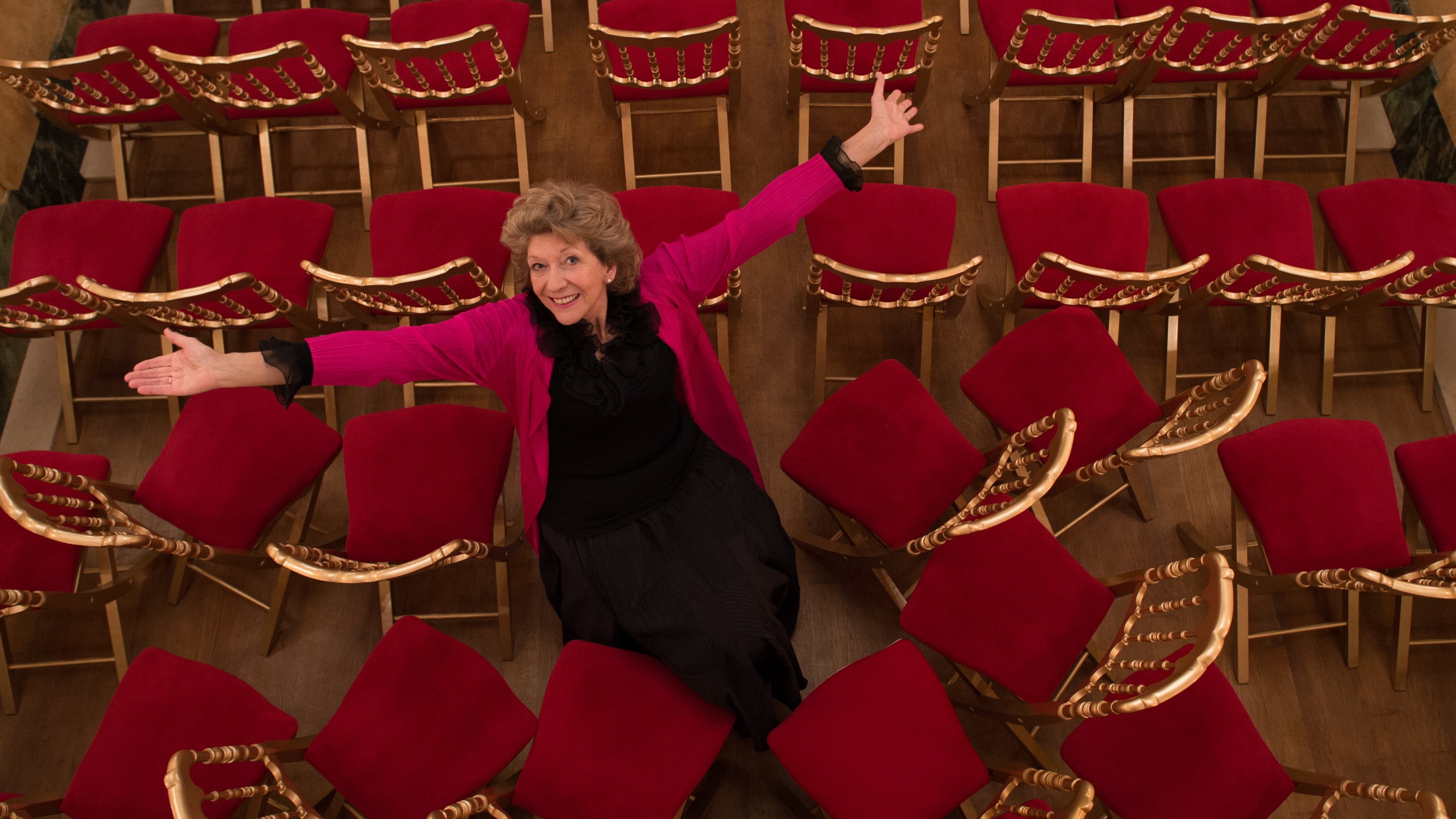
There is a moment in rose knightby Richard Strauss, in which time seems to stop. The Marshal looks in the mirror, remembers the girl she was and understands, without fuss, that her youth is escaping her. Felicity Lott—Flott to her colleagues and friends—sang that first act monologue like no other soprano of her generation: with restraint, irony, and a tearless melancholy, at that exact point between elegance and acceptance that seemed written for her. His performance was recorded in the 1994 Viennese film directed by Carlos Kleiber. And the Madrid public will hardly forget his debut at the Teatro Real with that character, in March 2000.
Just a few days before he died, in an interview with John Wilson for This Cultural Lifeon BBC Radio 4, Lott announced with the same serenity of his Marshal that he was suffering from terminal cancer. She asked that no one be sad, because she had had a “great time.” He died on the night of May 15-16, a week after his 79th birthday. With her disappears one of the most beloved sopranos of her time and, above all, one of the great Mozartian and Straussian performers of the last half century.
Felicity Ann Emwhyla Lott was born in Cheltenham on May 8, 1947, into a modest but stimulating musical environment. His father, an accountant, played the piano in pubs and wrote sketches for post-war variety companies; his mother, fond of singing, performed Madama Butterfly in local groups. Before deciding on the voice, Lott studied French and Latin at Royal Holloway, where he graduated in 1969, and spent a year at the Grenoble Conservatoire.
That philological foundation, uncommon among singers, explains an authority on the melody and the Lied that few Anglo-Saxon colleagues of his generation would achieve. Already at the Royal Academy of Music he won the Principal’s Prize and debuted at the City of London Festival in 1974 as Seleuce in a Ptolemyby Handel, which she herself would remember without particular enthusiasm.
The real beginning came the following year, when the English National Opera commissioned him to play Pamina. The magic fluteby Mozart. In 1976 he participated in the world premiere of We Come to the Riverby Hans Werner Henze, in London’s Covent Garden. And after three consecutive rejections to enter the Glyndebourne choir, the festival offered him the Countess of Whimby Richard Strauss, for a tour.
Thus began a relationship with the Sussex festival that would last decades and would give her the roles where her profile was forged: the Countess of The Marriage of FigaroFiordiligi and Donna Elvira, in Mozart; Anne Trulove en The Rake’s Progressby Stravinsky; Helena in A Midsummer Night’s Dreamthe British; y, and Strauss, Christine de InterludeArabella and the Countess of Whim. Also Octavian of rose knight —a role mezzo-soprano— before becoming the reference of his time as Marshal.
Because if there is a character that already belongs to Felicity Lott, it is the Marshal. He debuted it in 1986, at the reopening of La Monnaie in Brussels, with production by Gilbert Deflo and musical direction by John Pritchard. A year later, during the dress rehearsal in Covent Garden, a man in an anorak appeared in her dressing room at the end of the first act: it was Carlos Kleiber, who came to congratulate her and suggest that they do the opera together. She fulfilled her promise at the Metropolitan Opera in New York in 1990 and at the Vienna State Opera in 1994, where she was filmed alongside Anne Sofie von Otter, Barbara Bonney and Kurt Moll. She was the favorite Marshal of the legendary Austrian director, and that reading remains one of the most valuable audiovisual documents of Richard Strauss’ most famous opera.
With the same naturalness he could approach Offenbach the next day —The beautiful Helena o The Grand Duchess of Gérolsteinthe latter with a scenic grace that vindicated the lyrical dignity of the operetta—, Rosalinde de The batby Johann Strauss Jr., or Hanna by The Merry Widowby Franz Lehár, at Glyndebourne, and in the subsequent live recording for EMI/Warner Classics with Franz Welser-Möst and Thomas Hampson.
His expressive register also reached more dramatic territories, such as Blanche de Dialogues of Carmelites and, above all, the telephone monologue The human voiceby Poulenc, where his theatrical, almost cinematic instinct, found an ideal channel. He demonstrated this at the opening of the 2005-2006 season at the Teatro de la Zarzuela, in a production by Gerardo Vera that also included the stage version of Cocteau starring Cecilia Roth.
And then there was the recitalist. Lott formed with the pianist Graham Johnson, his accompanist since his student days, one of the most prolific couples in the liederistic repertoire. Together they founded in 1976 The Songmakers’ Almanac and they recorded for Hyperion a series of albums dedicated to Chabrier, Fauré, Gounod, Hahn, Poulenc and Schubert. For Chandos he recorded Lieder of Strauss and Wolf, as well as some Last Four Lieder with Neeme Järvi who respected the original order of the manuscript. His voice, lyrical and full-bodied, but never opulent, was supported by an impeccable articulation of the text and a musical intelligence that is not taught.
Spain knew her well. In addition to his debut at the Teatro Real in 2000 as Mariscala, he returned to that coliseum eleven years later with a recital dedicated entirely to the universe of Jacques Offenbach. At the Teatro de la Zarzuela he opened the 2005-2006 season with Poulenc and lived some of his most memorable nights within the CNDM Lied Cycle, where he performed five times between 1996 and 2006. This was the case, in 2002, of Night and Daya program that ran through 24 songs every hour of the day, from Hector Berlioz and Robert Schumann to Maurice Yvain and Cole Porter, and that could also be heard at the Liceu in Barcelona.
In her last years she worked as a teacher. He gave master classes at the Victoria de los Ángeles Foundation, at the Music Museum and in Sant Pau, in Barcelona, as well as at the Higher School of Singing in Madrid, focusing precisely on Mozart, Strauss, Offenbach and the Lied. Her last stage appearance was as the Duchess of Crackentorp in Laurent Pelly’s production of The daughter of the regimentby Donizetti, at the Paris Opera, in October 2024, at the age of 77 and with an intact comic vision.
Dame of the British Empire since 1996, Bavarian chamber singer Since 2003, an officer of the Legion of Honor and honorary doctor from Oxford, London, Leicester, Sussex, Glasgow and the Sorbonne, Lott was married to the actor Gabriel Woolf and had a daughter, Emily. He leaves a fundamental recording legacy in Strauss, Mozart, Britten, Poulenc, the Lied German and melody French. But perhaps it is best defined by that phrase with which he summed up his life before the BBC, near the end: how lucky I have been.