
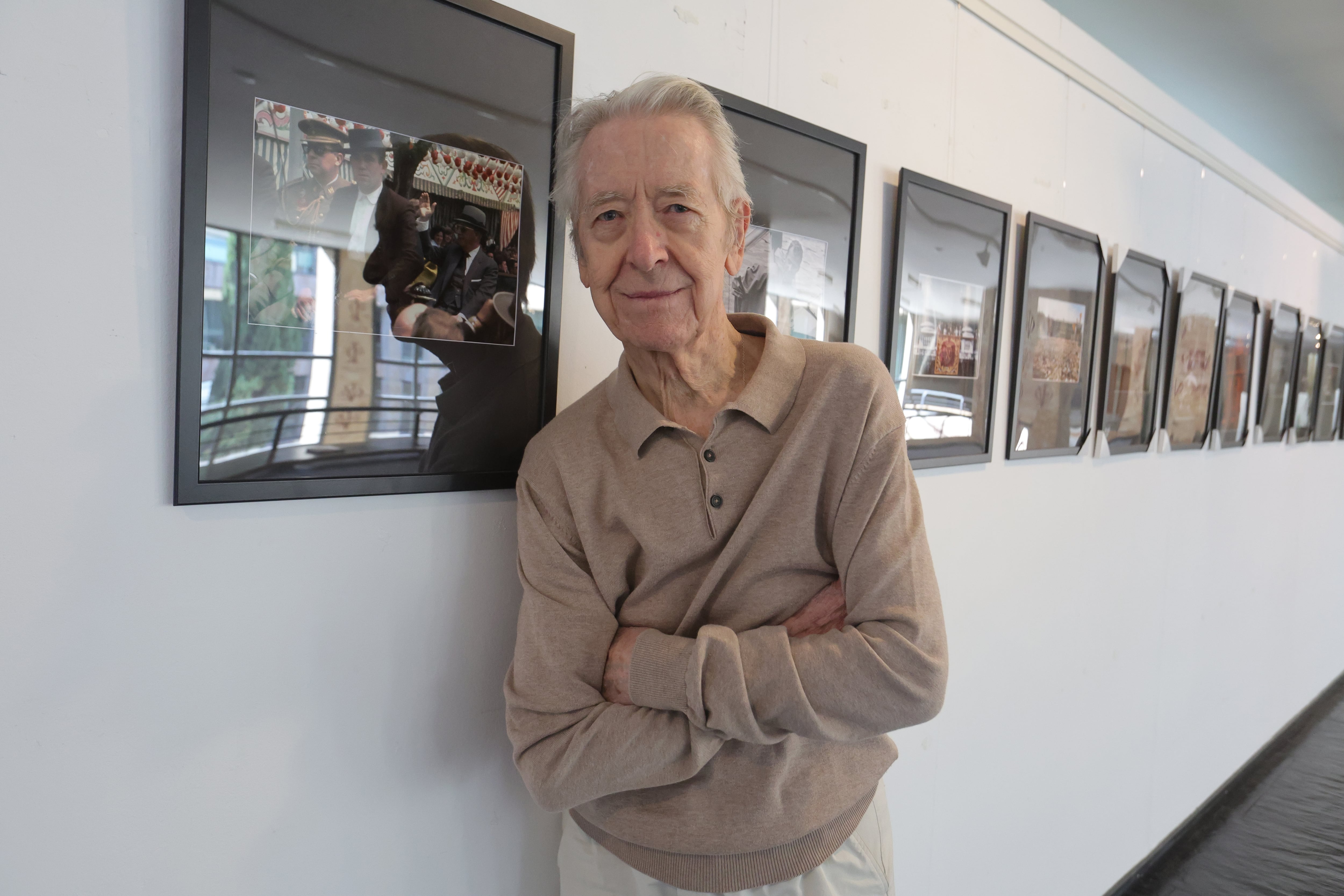
An exceptional witness to the end of the Franco regime and the great change in Spain, Robert Bob Royal, who died this Wednesday at the age of 86, photographed everything in a country with which he fell in love, put down roots and where he has stayed forever. He confessed to me a few weeks ago that in view of the political drift of the current United States it made him even happier to have made the decision to be Spanish. Through his photographic eye he has passed the history of the great change of his adopted country, which he arrived in the sixties when the boom tourism was beginning to appear.
Tall, blond and a good rider, that boy from Alabama who had passed through New York was the perfect size to be a cowboy in those movies of the spaghetti-western filmed in Almería. He wanted to be an actor and there he left his mark. Among other films he would film with Rafael Gil Rocío Roadin the company of Carmen Sevilla, Paco Rabal and Arturo Fernández. You can follow his trail in the credits, just as I discovered him in the signature of his photos reading the New York Times in the seventies and eighties during my time as a correspondent in the United States. Finally I would meet in Madrid in person the photographer of the Timesactive member of the Association of Foreign Press Correspondents, always with camera at the ready.
He worked side by side with the great correspondents and special envoys to the Spain of the Franco regime and the Transition, when the sniffers of the great crises landed in Madrid and found in Bob an expert guide and a friend: James Markham and also Flora Lewis for the New York Timesthe German Henry Kamm or the former head of the Associated Press delegation in Saigon, Malcolm Browne, and even Martha Gellhorn, who returned to a Madrid without the Florida Hotel where she lived with Hemingway during the Civil War. When they appeared in search of the Spain that was in the news, Bob was already there.
A few days ago he recalled the most painful episode of those he experienced in the numerous coverages: the late Franco executions in Hoyo de Manzanares. Before the transit began, the most terrible thing happened. The death penalty returned. When the caravan of cars carrying those who were going to be shot left the Carabanchel Prison bound for the Hoyo barracks, they were discreetly joined by a car that did not raise suspicions. It was unusual for someone to be shot in Europe and from the United States the matter was viewed with total perplexity. The magazine envoy TIMEGavin Scott, and photographer Bob Royal arrived in their vehicle at the gate of the barracks on the outskirts of Madrid. “They let us enter up to a point where we did not see, but we did hear, the shots. I was afraid to even raise the camera surrounded as we were by soldiers. I remember that the army commanders were interested in making it known that those in charge of the execution were not them but numbers of the Civil Guard!” The most dramatic thing, he confessed, was seeing the relatives “broken in the face of the tragedy they experienced firsthand when collecting the bodies.”
There are photos of Bob taken a few meters from Franco, of that black and white Spain and its evolution until today. After its first exhibition at the North American Cultural Center in Madrid, with a selection of his work from ’63 to ’83, the exhibition, which would travel to Granada, was displayed on the Madrid Metro and traveled to the United States. Three continents and one photographer was the title of his exhibition in Malabo, in Guinea. The extensive retrospective that the International Press Club dedicated to him was comprehensive of those years that were so vivid and that were so historic, from 1967 to 2014. The last major exhibition was dedicated to him by the University of Salamanca, a center that has been interested in preserving his legacy. His photographs are part of Spanish and foreign collections.
Robert Royal was also a photographer of advertising campaigns, landscape and monumental photography, formats in which he attested to the technical quality that he had been developing. Half a century of editorial, advertising and corporate photography.
In his extensive work we can contemplate a changing Spain, through the eyes of a man who loved the country he chose and its people. He also endeared himself. A leading figure among the group of foreign correspondents, who were his second family and to whom he dedicated time and enthusiasm in his activities. His three children, four grandchildren and his widow were his pillar until the end. Bob felt especially proud and happy to have created “a Spanish family.” He was preparing a new book, a compendium of his work on Spain, which will be a beautiful testament to that country that he loved so much and which he saw change.