
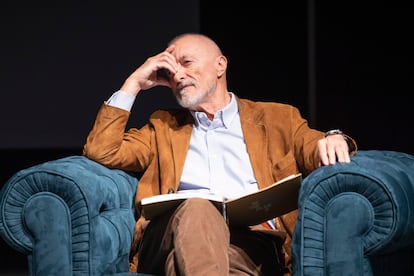
Arturo Pérez-Reverte and Jesús Vigorra announced this Monday that the conferences on the Civil War that were to be held this week at the Cajasol Foundation in Seville, and which were suspended last Wednesday, will finally be held from October 5 to 9. Pérez-Reverte has once again taken responsibility, as he did in the statement in which he announced the suspension of the event, called 1936: The war we all loston the Spanish left: “There was an express threat on social networks from people from the extreme left and from Podemos,” he said, pointing specifically to Pablo Iglesias whom, he announced, he will invite to the event. “So that instead of sending the bots and waves of crackers, come here to debate and discuss in a civilized manner,” said the writer.
In this Monday’s appearance and with an angry tone, the organizers reviewed the facts of an enormous controversy that began when the writer David Uclés (Úbeda, 36 years old)—author of the best-seller The peninsula of empty houses(Siruela), novel based on the Civil War, and brand new Nadal award with The city of dead lights— He announced his resignation from attending, fundamentally, because he did not want to share the bill with the former popular president José María Aznar and with the former general secretary of Vox Iván Espinosa de los Monteros: “They have tripped up democratic values and measures that make us a modern and empathetic society,” Uclés told this newspaper. He had also shown his discomfort at appearing in a cartel under the slogan “the war we all lost.” “I think the correct title would have been the war that we suffer all, which is what I defend in my book, where I deal with the intra-history of the conflict. But we didn’t all lose it,” he added.
“On January 25, I saw two messages from David Uclés saying that he could not be where people were with their hands stained with blood. I told him that I felt like one of his characters in the battle of the Ebro,” Vigorra said. Next, the journalist has charged against the writer: “After Sunday’s statement, Uclés called, very offended, saying that he did not know that Aznar was coming. Well, he did know. On January 7, the Planeta publishing house called me and explained that Uclés had agreed to come to Seville. We even tried to change the time. I have the guasaps here. We even talked about Aznar, he knew perfectly well that he was coming. I have no doubt that (Uclés) knew that Aznar was coming,” has insisted. After all this, will they invite the writer from Úbeda again? a journalist asked. “No way, Uclés will not return here. He has discredited himself and we do not want him to discredit the conference with his presence,” said Reverte.
For these reasons we have postponed the eleventh edition of “Letters in Seville”.
You may be interested in reading the full statement. pic.twitter.com/L8OcQc3TlZ— Arturo Pérez-Reverte (@perezreverte) January 28, 2026
Reverte had commented that the original title of the conference was 1936: The war we all lost?but that an error in the layout had omitted the questions. However, today he said that the question marks occurred to him recently, in order to reduce the controversy. “When the fight started and because they had not understood what the title referred to, I thought about the questions to soften the atmosphere and to leave it open. We gave the order, but it did not arrive in time for the layout and the label came out without the questions,” he alleged this Monday. “There are those who have seized on that and given it a lot of publicity, when it is an unimportant anecdote,” he complained. For the rescheduled events in the fall, however, they will also maintain the title without those questions.
The tone of the press conference was irritated by the controversy that arose, and Pérez-Reverte showed a more emphatic tone than Vigorra. Asked if he still liked Uclés’ prose, the writer began by throwing things out: “Uclés’s literature has nothing to do with this. In fact, I spoke with sympathy about his literature, here literature has nothing to do with it, it is something else,” he concluded.
The organizers have also taken advantage of the event to once again attack the Spanish left, this time personified in the image of Pablo Iglesias: “We suspect that the origin of much of what has happened was a message from Pablo Iglesias saying that there were characters who did not know what they were going to participate in.”
Others joined Uclés’ departure, such as that of the coordinator of Izquierda Unida, Antonio Maíllo; the deputy secretary general of the PSOE of Andalusia, María Márquez; the president of the Council of State, Carmen Calvo; the writer Paco Cerdá, and the sociologist Zira Box, as confirmed by the Cajasol foundation. They have also talked about their departure at the press conference. Pérez-Revente has listed some of the participants, such as Fernando Savater or Teresa Rodríguez, who have spoken with absolute normality. “First, my admiration for Jesús Vigorra and another for Cajasol, who have left us the initiative. All the historians have reiterated that they were coming, except one, the Minister of the Presidency, Félix Bolaños, maintained his commitment with enormous gallantry. The fact that we suspended it is because it was unbalanced, we did not have time to recruit new names,” the writer continued.
27 men and six women were supposed to attend the sessions, a lack of parity that Uclés had also criticized to justify his absence, among other reasons. This Monday Pérez-Reverte admitted the difficulty in finding female speakers: “It is true that we have had problems with parity, it has been difficult for us to find women, we tried until the last minute to bring more women, but the reasons are complex, you have to call, they say yes… We have tried, but there does not have to be parity. Here we do not want 50 and 50%, the people who have to come will come, men and women without distinction,” he said.
Before concluding, Pérez-Reverte insisted that the origin of the controversy, arising from the title of the conference, The war we all lostit’s just “an excuse.” “They knew it a year ago. They have had a year. It is clear that the coup side won the war, but we all lost. And this is said by someone whose father, grandfather and uncle fought for the republic. All of us Spaniards lost freedom, culture, democracy, and the proof is that 90 years later we are still entangled in that garbage. We all continue to lose it.