
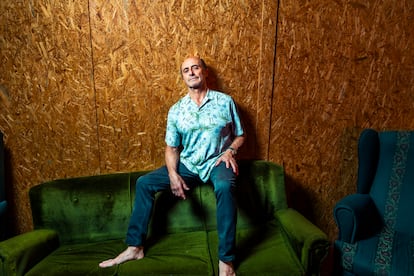
It is impossible to catalog Pepe Viyuela. There are those who consider him as part of the family since his days as a comedian in the competition One, two, three in the nineties. For some he will always be Chema, the shopkeeper of the series Aida. Others see the personification of Philemon in the translation of the stories of Mortadelo and Filemón to the cinema. Circus artist, comedian and actor in multiple films and theatrical productions. Poet with four published books. Active citizen, member of the humanitarian organization Payasos Sin Fronteras and committed neighbor, to the point that a civic center in San Sebastián de los Reyes, where he lives, bears his name. Partner of the actress Elena González and father of the actors Camila and Samuel Viyuela. “Many things. But I like them all, they entertain and amuse,” he says.
Above all, Viyuela is a “good guy.” Close, friendly. Born in Logroño 63 years ago, the actor is now going through a period of fulfillment on stage. On July 2 he will receive the Corral de Comedies Award, awarded by the Almagro Classical Theater Festival, in recognition of his career. A week later, in Almagro he will premiere a recital-concert of popular romances accompanied by the singer Rosa León.
From there he will jump to the Roman theater of the Mérida Festival, where he will star Helm of Athens, of Shakespeare, from July 15 to 19, directed by Hernán Gené. “Because of my age, I may not have many more busy summers. So let’s try to make this fifth act as dignified as possible,” he smiles after a rehearsal of Helm of Athens in a room in Madrid, where this interview takes place.
Ask. With such popular roles on television, how have you managed not to get typecast?
Answer. Well I don’t know. I only know that I have always tried to do what I liked at all times. Of course, I’ve been wrong a few times. I don’t regret anything, but I have done things that now I look at and say: how ugly.
P. For example?
R. There were a few years of television in which I looked terrible, doing things that I didn’t like. And I said to myself: I have to go back to the theater. In fact, perhaps the reason I have ended up doing so many different things is because I have always maintained a presence in the theater.
P. Didn’t you like popularity?
R. It was more of a need to return to the theater. We must keep in mind that there was a time when doing television was taboo for people who did theater. It was like putting yourself down. In the first years of Telecinco, especially, I did not feel comfortable in those galas with so much colorinchi, quickly written jokes, little rehearsal and a lot of improvisation.
P. But he One, two, three It was something else, right?
R. Of course, I felt very good there. The thing is that there was Chicho Ibáñez Serrador, who demanded a lot of rigor.
P. And in Aida?
R. Man, we’re talking about something else. Aida It was a series with good scripts.
P. And now, in Mérida, Shakespeare.
R. I am very happy with this work. Timón, my character, begins the show being a philanthropist who likes to share everything he has. But when he loses his wealth, precisely because he has been wasteful, he also loses those he thought were his friends. Then, he becomes a misanthrope. I find it very interesting to tell that story today. Why people love us, the relationships on social networks, the constant posturing.
P. Do you feel loved?
R. Of course. Not only for my family. I have friends, not too many, that I can trust. And then a wide spectrum of people with whom, without being bosom friends, I feel comfortable.
P. The public also seems to love him. Even in this polarized time, in which you have been politically significant.
R. I have always claimed the right to say what I thought. I don’t believe in shouting and I do believe in calm opinion. As a citizen, furthermore, I believe that politics is an inevitable activity. Being apolitical smells bad to me. For me, politics is defending the rights of minorities, defending the public, caring about the world we leave to our children. I already know that many of my opinions are not going to be shared, but I don’t want to stop saying them. I believe that dialogue is what builds a society and a democracy.
P. In 2004, you were the first to retire from the work Jardiel in love, by Ramón Paso, after it was discovered that the author had been reported for sexual assault. Didn’t you fear reprisals?
R. I couldn’t do anything else. There are many people who tell me: ‘Don’t get wet, why?’ But if you don’t participate, you become a vase. I’ve gotten some slaps on the wrist, angry people on the street who insult you or tell you that you’re a redneck. So far I haven’t been hit like Wyoming, but it’s getting raw. I admit that sometimes, in certain environments, I don’t feel very safe. What I have left are social networks. I see too much hate. There is no dialogue there, only lynchings.
P. At work, has it taken a toll on you?
R. Occasionally, I have been vetoed by some city council that did not want me. But I haven’t had any bumps.
P. Do you believe in the political power of theater?
R. If it continues to exist, it is precisely because it has strength. It can be pure entertainment, but also a tool for reflection. A place to gather, dialogue and receive impacts of thought and emotion. It is not about creating pamphleteering political theater, but about telling stories that affect us.
P. And the humor?
R. Humor helps us to relativize, to put our ideas at risk, to not become dogmatic. On the other hand, it is a defense against aggression and fear. Even in the worst situation of repression, humor will appear. In the Franco era, people wrote with great ingenuity in Spain to circumvent censorship. If you are able to laugh at your attacker, in some way you are defeating him. That is why, throughout history, laughter has been persecuted by institutions. The Catholic Church has considered her diabolical, she could not laugh in the temples. Because seriousness is an invocation to order, while laughter invites disorder.
P. Should humor have limits?
R. There are limits, but they should not be set by outsiders. Society knows how to regulate well. There are sexist or overly rude jokes that can no longer be tolerated. There are also territories where you know that you have to treat certain topics with care because you can hurt sensitivities. But, I insist, it is not the institutions who should set the limits.
P. What is your limit?
R. There is an ethical question. You should not laugh at someone who cannot defend themselves or is weaker than you, because then humor stops having its liberating nature and becomes a repressive element. There is the limit: it must be horizontal. Start by laughing at yourself and, from there onwards, whatever you want. Never down. The power is strong enough, you have to constantly touch its balls. That’s the old jester’s game. Can it cost you dearly? Yes, but that is the humor that has value, the brave and subversive humor.