
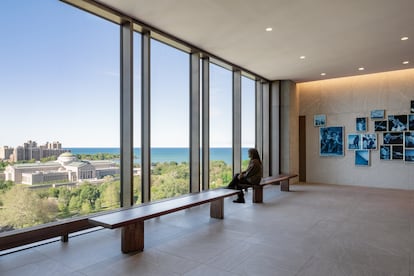
Beyond the policy that they were able to promote, or not, during their mandate, some North American presidents leave an architectural legacy: a building. When that property is built while they are alive, the project usually represents the image that they themselves have of their mandate. Or what they would have wanted to achieve. Thus, whether or not they have helped encourage reading, almost everyone (Franklin D. Roosevelt in Hyde Park, New York or Ronald Reagan in Simi Valley, California) chooses to leave a library that bears their name. However, some manage to go further. And they also send a message of the future with the architecture of said building. It was the case of the Kennedy administration that, in front of the Reagan Library – Mission style and with more visitors to see the presidential plane Air Force One than readers – or in front of the one that Roosevelt has with a colonial style, chose to commission the Kennedy Center in Boston to the architect who would change the face of the Louvre and who had already built the tallest skyscraper in Boston: IM Pei.
These days Barack Obama has inaugurated the Presidential Center that bears his name in Jackson Park, south of Chicago, an area not exempt from racial conflicts where his wife grew up. The architects, New Yorkers Todd Williams and Billie Tsien, are two of the North American professionals who best combine a plastic ambition with an artisanal treatment of the works. That hand can be seen in the radical subtlety of the Barnes Foundation in Philadelphia; in the James Baldwin Library, which they built in Peterborough (New Hampshire); at the American Folk Art Museum in New York or at the new The Obama Presidential Center, which opened this month. This project, explained by Obama himself as a civic center, seeks to make knowledge coexist: sport with horticulture, art with literature, cooking with music. The former president defines him as a “connector for change.” And it is true that this sum of small ambitions makes it a large place that could be great.
It was this idea of putting connection before impact that meant that, among the seven architectural firms that aspired to the commission, Williams&Tsien won the competition when, instead of an iconic building, they proposed building an open campus. If Obama’s goal is to connect art with life to improve, at least in part, the world, the center seeks to do so through its installations and decisions. Thus, the garden—designed by Michael van Valkenburgh, Living Habitats and Site design Group—is as important there as the four-story, concrete and steel building with a New Hampshire granite façade designed by Williams&Tsien. The architects say that the faceted polyhedral shape of the building has as its reference the union of several hands. And certainly the goal is both to be useful and to honor those who have contributed to America’s social improvements—the orchard is named for Eleanor Roosevelt and the 336-seat auditorium is named for Nobel laureate and Jewish Holocaust survivor Elie Wiesel.
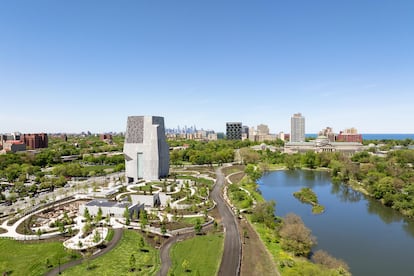
With gardens, a basketball court and that orchard open to the public, the campus also includes a museum of social movements, a library and a culinary laboratory-school. It has play areas, open to the public, and paid areas, such as the exhibition rooms, the auditorium, the restaurant, or the parking lot, for 400 cars.
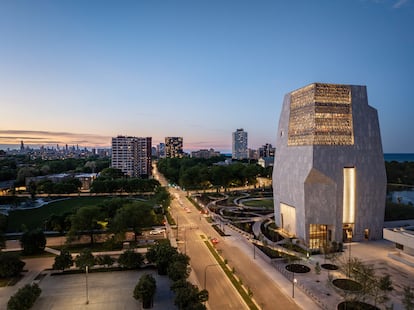
Obama has spoken of the importance of the place. They considered the possibility of building their Presidential Center in Manhattan, next to Columbia University. Also in Hawaii, where he was born. But he wanted it to be in the city where he has lived the longest, and where his wife, Michelle Obama, was born. Beyond being a symbolic location, the care of the place also has to do with sustainability as part of the design. In the garden, 900 trees will provide shade. And water retention and recycling systems will take care of the garden. All air conditioning is geothermal. The building is insulated in the areas with the greatest solar exposure. But it is the lattice that speaks loudest. It is a lattice built with words. Carved in granite, they repeat part of the presidential message that Obama read in 2015 and which reminds us that America is not the work of a single person and that, therefore, the most important thing is the first person plural: us. We the people, we shall overcome. Yes we can. “The word we does not belong to anyone,” he said, “it belongs to all of us.” This is also what its architectural legacy seeks.