
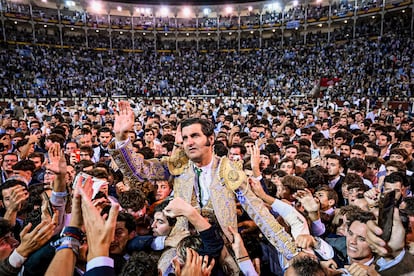
“The plaza (La Maestranza), passionate and in the grip of an intense emotion, asked for and got the two ears, which were possibly an excessive reward given the small size of the bull and the bullfighter’s own work. But Morante is currently enjoying the popular fervor, the people roar when he sees him succeed, they shout at him that ‘José Antonio Morante de la Puebla!’, so that this collective passion allows him to achieve triumphs like today’s, in which being well has not been even remotely “one of his best afternoons in Seville.”
This is how journalist Carlos Crivell recounted in these pages the enthusiasm aroused by Morante in Seville on June 4. That is an image that is repeated in each plaza where the artist from La Puebla makes the stroll. Morante is not just a bullfighter; It is, today, the representation of bullfighting art, and as such it awakens a passion that for many is exaggerated and, perhaps, fleeting. But it is an idol, the god of morantismthat religion that integrates fans and new spectators who vibrate, get excited and have fun with the singularity of a different artist, gripped by a serious mental illness, which adds a special morbidity to his tremendous recognition.
“Morante represents the ideal of the classic bullfighter, the champion of the eternal; he has become the emblem of the Festival.” Carlos Crivell, journalist
Further proof of this uproar is the boom editorial that has caused the morantism. Despite some inadvertent omissions, these are some of the books published about Morante: Morante of Puebla. Bullfighter: myth, tradition, passion. Teodora Gorges (2011); The bullfighting of Morante de la Puebla. Ulriker Gutmacher (2011); Morante de la Puebla: treaty of harmony. Lorenzo Clemente and Andrés Lorrio (2014); Why Morante (then and now). Francisco Aguado (2023); Now that we are all morantists. Manolo Guillén (2025); Morante, full stop. Rubén Amón (2026); Morante, from Calvary to glory. Diego Sánchez de la Cruz and Javier Romero Jordano (2026). Morante’s Memory. Vicente Zabala de la Serna (2026); Chronicles of a genius. Morante of Puebla. Manuel Viera (2026); and The bullfighting of Morante de la Puebla. José Carlos Arévalo, Julio Rodríguez and Javier Cascales (2026).
Why this extraordinary movement around a bullfighter in a context of constant social and political controversy about the bullfighting festival? Who is Morante and what does Morante contribute? What will happen the day he permanently hangs up his suit of lights? Will the current fervor die down? Will he be replaced by another genius?
Five experts, some more morantists What others think about this controversial issue.
Crivell himself, a renowned Sevillian bullfighting critic, states that “in times of routine and mediocrity, Morante represents the ideal of the classic bullfighter, the champion of the eternal; he has become the emblem of the Festival, the icon to admire, the archetype of the romantic bullfighter, all of this in a person of very limited external communication, but who provides his career with details that border on genius.”
“Morante is different from the others and goes beyond vulgarity; this bullfighter is not one more in front of the bull.” Fernando Atenciano, fan
Fernando Atenciano, a native of Écija (Seville), a fan and follower of Morante since his beginnings as a bullfighter, assures that “Morante is different from the others and goes beyond vulgarity; this bullfighter has something that reaches you and he is not just another one in front of the bull.” “But he’s been doing that for many years,” he adds, “and the only thing that happens is that now everyone has gone crazy, lost with Morante.”
Miguel Cid, president of the Parliamentary Bullfighting Association, affirms that Morante “is not the best bullfighter in history, as is being said, but rather one of the greatest, who is covering a very important stage, but who, with certainty, will be replaced by others who will follow him.”
Yolanda Fernández, passionate about bulls since she was little, honorary member of the El Toro Association of Madrid and professor of History, points out that “Morante has been rediscovering himself as a bullfighter in a constant search for roots to face bulls; and he has managed to establish a new interpretation of classicism that we fans must thank him for.”
“New viewers need heroes, and they have seen in their somewhat atrabiliary singularity an almost mythological reference.” Juan A. Carrillo Donaire, professor of Administrative Law
Finally, Juan Antonio Carrillo Donaire, professor of Administrative Law at the University of Seville, and a follower of Morante since his days as a bullfighter, states that “he is a unique and special bullfighter, and that all the mystique that surrounds him, such as the recovery of ancient traditions, makes him very attractive.” “Morante has a magic that makes my hair stand on end,” he says.
Until here, the bullfighter; another reflection deserves the passionate fervor that it awakens—the so-called morantism—and the transcendence over time of his bullfighting.
On this topic, Carrillo admits that there is an exaggerated collective ecstasy around his figure, but he justifies it because “new viewers need heroes, and they have seen in this character, in his somewhat atrabiliary singularity, an almost mythological reference.” “I think this situation favors the party,” he adds, “although it is also true that fashion will pass and another myth will be sought, despite the fact that Morante leaves a huge void.”
“In a world that offers artificial references, Morante represents a point of avant-garde digression.” Yolanda Fernández, honorary member of the El Toro Association of Madrid
Yolanda Fernández focuses on this theory and goes so far as to talk about revolution and avant-garde: “In a world that offers artificial references, where there is no truth, young people discover a character who gives off a point of avant-garde digression within a dirty and old sector such as bullfighting.” “What has Morante offered,” the Madrid fan asks: “A truth of flesh and blood that contains a high revolutionary meaning.” In his opinion, this contagious emotional impact may be temporary “because I don’t think there is another bullfighter who raises the mystery of Morante.”
“The existence of ‘morantism’ seems logical to me; fans are always waiting for the idol.” Miguel Cid, president of the Parliamentary Bullfighting Association
Miguel Cid, former socialist senator, appeals to a phrase by the journalist and art critic Santiago Amón, who died in 1988: “At the party the law of waste governs.” “From that reflection I deduce that it is not strange that idols arise and grow when there are reasons for it, as happens with Morante,” he points out. “It seems logical to me that the existence of the so-called morantism because fans are always waiting for the idol,” he continues. “Before it was José Tomás, now it is Morante, and then it will be someone else; It has always been like this.” In any case, Cid highlights that Morante is a student of bullfighting, “which we should thank him for because it is not normal among bullfighters.”
“It has always been said that there is never a bad year for too much wheat,” says fan Fernando Atenciano in reference to the fervor. morantist and his ability to hang the ‘no tickets’ sign. “I see it as phenomenal,” he says, “and I hope that when Morante leaves there will be some followers left as good fans.”
And the journalist Carlos Crivel agrees that “in a society lacking values, Morante is the new god of bullfighting, who is followed en masse, with the heart above the brain, by many neo-aficionados, and also old connoisseurs, who need bullfighters to place on an altar.” “We should ask ourselves if this unconditional dedication is good or bad for the party itself,” he concludes. “If all those who chant his name today leave the squares when he no longer fights, the effect will have been of dubious effectiveness.”
José Antonio Morante Camacho, 47 years old and 29 years old, the bullfighting character of the present era, a brilliant bullfighter and creator of a movement with an unpredictable future.