
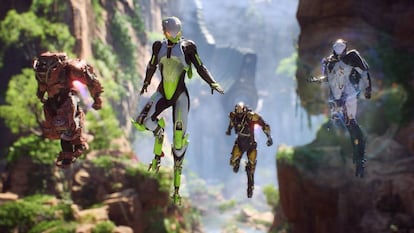
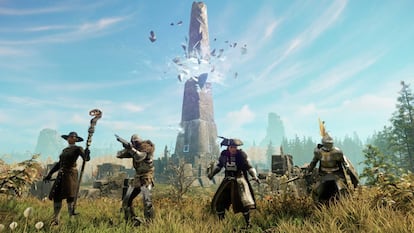
From one day to the next, players received a statement: on January 12, the servers of your video game will be turned off. It meant the end of service, access and the game itself. It happened with Anthem (BioWare/EA, 2019), an ambitious multiplayer world of flying robots that was reduced to a digital memory when the definitive cessation of its structure was announced online. It also happened with the game of magic and fantasy New World (Amazon Games), to which the company gave on January 31 a lifespan of one year until it disappears. And it happened with The Crew (Ubisoft), a car game whose servers were turned off, rendering it unusable in 2024 and making it the paradigmatic case of the so-called sunsetting: the moment when a company decides to turn off the servers of a title that depends on permanent connection and, with this, completely renders useless a product that millions of users had purchased legally. It is not just a technical issue; When games that promised continuity disappear as if they had never existed, problems arise when it comes to preserving digital works, and legal doubts arise due to the harm suffered by consumers.
That unrest crystallized at the end of 2024 with the Stop Killing Games campaign (stop killing video games). Driven by the youtuber Ross Scott, the initiative was born after the closure of The Crew and quickly transformed into a pan-European movement. Its objective is not to force companies to maintain servers forever – something that even its promoters consider unfeasible – but to demand that, before disconnecting a sold game, a reasonable form of access is guaranteed: modes offlinerelease of tools to create private servers or technical solutions that allow the community of players to preserve the work on their own. Within the framework of the European Citizens’ Initiative (ECI), the campaign gathered 1,300,000 signatures and exceeded the minimum threshold in 24 Member States. Today, Monday, the campaign organizers will formally present the proposal to the European Commission in Brussels. The Commission will have to study the case and respond officially before July 27, opening the door to a legislative debate that transcends the niche gamer to delve into the heart of European digital rights.
For historian Víctor Navarro-Remesal—professor at Tecnocampus and co-president of the History of Games congress—, the moment is “key” not only because of the number of supports, but because of the conceptual change it poses. “This is not about a specific game, as happened in the United Kingdom with The Crew“, but to establish a general framework,” he explains. Navarro-Remesal emphasizes that the European Commission has already indicated that it will review the initiative and issue a statement, but warns that the real challenge will be to translate the indignation into truly applicable measures. “It is not about forcing a server to be maintained for 10 years for four people to play on, but rather that, when official support ends, the necessary keys will be delivered so that the community can preserve it.”
Navarro-Remesal links the debate with the right to repair electronic products and with digital planned obsolescence. On platforms such as Valve Corporation, owner of Steam (the largest digital store in the world), the terms of use specify that the player does not acquire full ownership of the game, but rather a temporary use license. “Europe could force to clearly indicate how long the title for which the player pays will be available,” he points out. Furthermore, he insists that preserving a video game is not only about saving the code base, but also the successive improvement patches. “In the era of cartridges or CDs, a video game was a closed product; now it is an object that is constantly updated, and is fragmented. If we want to be serious about preserving digital heritage, we have to redefine what exactly the digital work is.” For him, the initiative raises a fundamental question: what does it mean to own a cultural work in the digital age?
The recent words of youtuber Ross Scott reflect enthusiasm. “The signatures have already been verified: we have officially crossed the threshold and on February 23 we will present them to the European Commission,” he announced a week ago in a video on his YouTube channel. Although he defines the act as a formality – the signatures were already digitized – in the video he highlights the importance of the direct meeting with the community authorities. Legal experts such as Professor Alberto Hidalgo Cerezo and representatives of the French consumer organization UFC-Que Choisir will participate in Brussels to argue that the destruction of video games by publishers can constitute a legal and consumer protection problem. Paradoxically, Scott will not be able to attend the formal sessions, although he will participate in a subsequent press conference. “I want us to win,” he declared, aware that the battle is both legal and symbolic.
“Research by organizations like the Video Game History Foundation has shown that a significant portion of old video games are no longer commercially available. This is a cultural problem, not just a commercial one,” says Piotr Gnyp, a journalist specializing in video games and public relations at GOG, a digital PC video game store that sells classic titles and actively works on preserving old titles so that they work on current systems. “We are aware of initiatives like Stop Killing Games and the broader regulatory debates taking place in Europe, and these conversations are important, because what is clear is that digital games can disappear very quickly.” Video game preservation is crucial for GOG, originally called (it was created in 2008) Good Old Games in response to a very specific problem: classic titles were becoming inaccessible just as digital distribution was beginning to emerge.
“Preserving these titles raises complex technical, legal and economic issues. There are issues related to server architecture, security, player data protection, licensing and long-term operational costs,” notes Gnyp. “We welcome this debate to be taking place more openly across the industry, but meaningful solutions will require cooperation between developers, publishers, platforms and players. It’s a delicate balance between preserving access while respecting intellectual property, security and sustainability.”
The background of the conflict exceeds video games. In digital music and film, albums and movies disappear from catalogs when licenses expire. The question Stop Killing Games poses is not so much nostalgic as structural, and points to the key question for all types of digital works, not just video games: should the law protect access to a digital work for which payment has been made? Exceeding one million signatures does not automatically guarantee a new law, but it does force the Commission to speak out and, perhaps, to initiate consultations or regulatory proposals. Today in Brussels not only are 1,300,000 signatures presented: a discussion is put on the table about cultural memory, digital rights and the very meaning of property in the 21st century.