
Of all the chemical combinations that occur in a person when they stand in front of a work of art, there is one that, perhaps, on rare occasions, that viewer feels. It is the emotional process that a museum director, a curator, an exhibition or conservation coordinator has had to overcome until he combines the desirable with the credible. That is, to reach that inner consensus by which professionals will assume that the work that was going to close the story of an exhibition stays there, on the list of aspirations. It is at that moment when science prevails over some passions (including politics) because the piece, for dozens of reasons, will not occupy the space on that wall. “It is important for the public to understand that a painting is not ordered, it is rolled up, put in a box and travels,” says Estrella de Diego, art historian and curator. “Before presenting the final list, the commissioner must be clear about what is probable, what is impossible and what, being a difficult loan, can be attempted to request.”
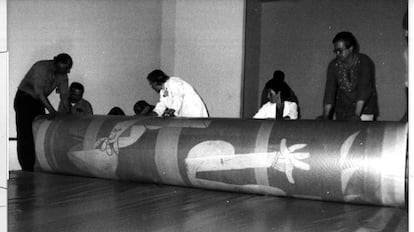
The transfer of works has become a matter of State in recent weeks following a new request from the Basque Government for the Guernica Picasso’s trip from Madrid to Bilbao. These days, black and white images of all the transits that this painting has made have been dusted off from the archives; and in many of them, a group of workers can be seen rolling up the fabric after it has been removed from the frame. The process to move a cultural asset is far from the summary offered by this snapshot that occupies a fixed space in the popular imagination. The passing of the years has sophisticated, thanks to technology, a procedure that Reyes Carrasco, general coordinator of Conservation at the Prado Museum, has been doing for more than 30 years in different institutions and that has a very specific name: “From nail to nail.” This metaphor not only encompasses the technicality by which a work is insured, but also all the operations that are carried out from the moment an operator touches a piece in its original location until he returns to that place.
“Nothing is left to chance: from the first call, which is usually a conversation between directors, until the moment the work returns to its origin, everything is regulated by very precise technical, administrative and scientific procedures,” explains Carrasco. In the case of public institutions, such as the Prado, this work is subject to state surveillance through, for example, public competitions to choose transport companies.
“First of all, a formal letter is sent to the other institution indicating what work is requested, for what dates and what exhibition project it will be integrated into,” continues Carrasco. From that moment on, the mechanism is activated by which almost an entire institution becomes involved because details as minute as whether the place reserved for a piece is near an entrance come into play. “There is a fundamental document,” points out the expert, “the so-called facility reporta report that describes in detail the building and the room where the work will be exhibited, from the accesses and routes to the security and conservation measures. Not all rooms or museums are the same, and before accepting a loan you must check that the environment is suitable.” This means, for example, that you must ensure that the constant temperature is around 22 degrees.
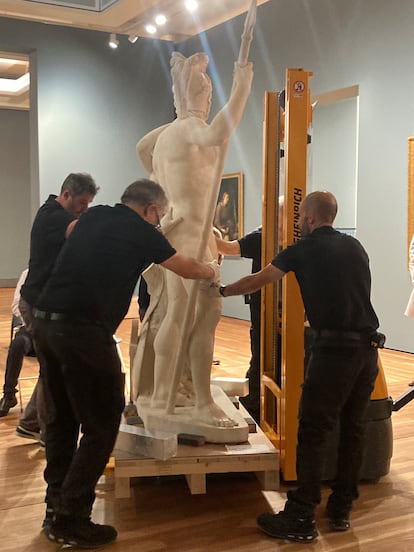
These reports are confidential because they also include the standards of each piece. “It is not the same to transfer a painting on canvas as a sculpture, an ancient coin or an object made of organic materials such as wood or feathers,” adds Carrasco. “The work is a living being, and just like us, it is affected by changes in pressure and hustle and bustle,” says De Diego. The passage of time and the materials with which the works were carried out are also included in these documents. A painting by Veronese that can be the same size as the Guernica It won’t travel the same way. The ancient masters worked with high-quality pigments, centuries later the lapis lazuli that came from the region of Afghanistan, whose value exceeded that of gold, or the natural earths, such as ochres, which are extraordinarily stable, remain. Meanwhile, the urgency with which Picasso painted forever determined the state of his canvas, which he created in just over a month, on which he made multiple changes and superimposed layers without respecting drying times on all occasions.
Throughout this process there is a constant negotiation between the institutions that can last until the moment a box is opened at the destination and the provider is not convinced of the chosen place. In between, in addition, the highest bodies of the museums, their boards of trustees, have to give approval. “The majority of our loans are usually international, so we also have to request export permits from the Qualification Board, an agency of the Ministry of Culture, which also has the power to access or deny a loan,” explain those responsible for the Thyssen Museum. “The objective of our collection is its dissemination, so that the entire world can enjoy it, but if, for example, we wanted to take half of the museum’s collection to another country, the Board could argue that it is an excessive number of pieces to be transferred because it is a massive temporary export or because of the importance and fragility of a piece.”
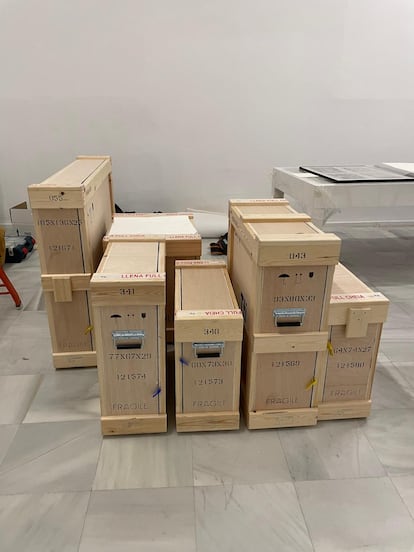
Once the loan is approved, comes one of the moments that all the experts consulted consider to be key: the packaging. The works travel in boxes designed specifically for them, generally made of wood, with cushioning systems that absorb shocks and vibrations. “In the case of especially delicate pieces, climate boxes are used, which keep the humidity and temperature stable thanks to technical materials such as absorbent gels. The packaging adapts not only to the work, but also to the duration and type of trip,” Carrasco details.
“I remember that on one occasion we exhibited a wonderful piece by Brancusi,” explains Lucia Agirre, curator of the Guggenheim Bilbao, “it was a marble that came from the Philadelphia Museum in a spectacular box because another box was floating inside.” That system, says the expert, was devised by a group of engineers. These types of advances have allowed, for example, that the Rothko piece that this museum has lent to Florence has not arrived rolled up as the artist himself did in a transfer that he organized on his own from his workshop to an institution in Chicago. “It wouldn’t cross our minds, over the years the progress has been impressive.”
The boxes usually travel in air-conditioned trucks, equipped with environmental control systems, with specific security. When they go by air, in the hold of commercial airplanes. The exception is always the boat. “During the entire journey the work is accompanied by a courier, a museum technician who does not separate from it,” says Carrasco. “His role is to supervise each step, control the conditions of the trip and react to any incident. On long journeys he can spend entire days following the load, crossing borders, sleeping near the truck or traveling in the same means of transport as the construction site.”
The person in charge of the Prado remembers the trip she made to London accompanying works by Raphael that were going to be exhibited in the National Gallery in the British capital. He sat in the cabin of the truck next to the driver and a team of specialists from the museum and began a journey in which he had to stop at the offices of the Spanish security forces, in charge of guarding the vehicles every night. In the case of airplanes, the couriers do all the paperwork with the work until their seat is occupied. From the cabin or in the boarding areas, it is likely that any passenger has been able to see the large metal boxes, usually no longer than 160 centimeters, circulating on the runways. In these pallets, along with other types of merchandise, with their own security measures, the great masterpieces also travel.
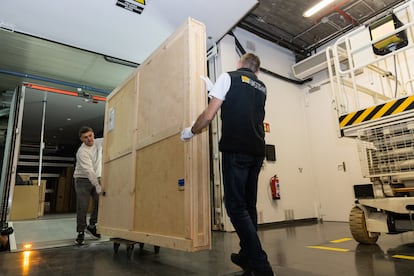
When the work reaches its destination, it is thoroughly reviewed again and compared with the initial report. “Only when it is confirmed that everything is correct is unpacking and assembly in the room authorized,” says Carrasco. Another delicate moment. “In the case of Thyssen, when monumental works arrive, transport companies have to ask the city council for permission to use the bus lanes,” they say from the Madrid museum. “This usually happens when there is almost no traffic, that is, these pieces enter through the main door at dawn, when the city stops, so as not to hinder traffic.”
Most of the museums consulted have unloading docks and their own teams, brigades, in charge of moving the pieces. Logistics have advanced in the same way that the boxes in which cultural property is kept change to ensure that the most ornate frame is not damaged or that the thousands of coins from the Mercedes treasure that Carrasco had to receive and classify arrived in the best possible condition after centuries at the bottom of the sea.
Museum experts, Agirre recalls, not only dedicate their conferences to discussing the future of these institutions, but also debate how to guarantee that art continues to spread throughout the world. “Moving a work is not just moving an object: it is guarding a part of the cultural heritage,” summarizes the Prado expert. “For this reason, even if a loan request is negative, the important thing in any process that involves movements of works of art is the maximum safety and comfort of the pieces. The rest is irrelevant. We will have to continue thinking about the direction to take in the project. These are the rules of heritage protection,” adds De Diego.