
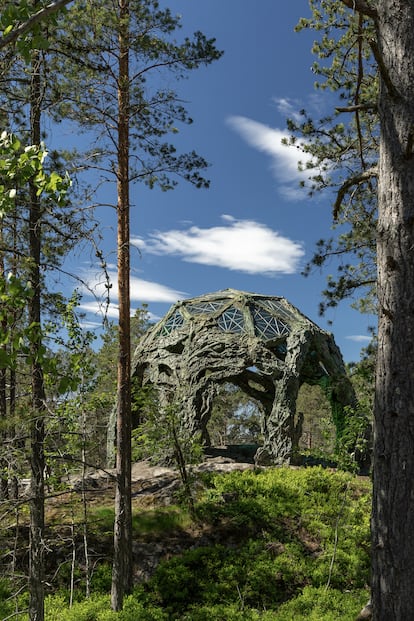
On June 6, a work by Cristina Iglesias was inaugurated in Stockholm, a European city among the most pioneering capitals of art, especially with regard to contemporary production, installed in the daily lives of its inhabitants. In fact, for Stockholm today’s art is a form of sustained accompaniment and a good proof is the subway: since the 1950s, each of the stations is an artistic installation that, while it snows outside, makes you dream of mysterious caves and indigo and starry interiors, a particularity that caught my attention in the mid-1980s on visits from Helsinki, after crossing the frozen sea by boat.
In this wonderful city, the waters move to the rhythm of the seasons conversing with the bridges; parks and avenues built by infinite greens; changing skies and northern lights; incredible classic buildings and colorful houses that speak of an extremely civilized and nature-friendly society before the world became environmentalist; of a slow order that is related to the rhythm that ice and thaw impose on the seasons. Not in vain, in front of the Kondo ordered, The Swedes have popularized another type of detachment that Margareta Magnusson talked about in The Swedish art of tidying up before you die. Still, the term, death row —cleaning of death—is not related to the end of life, but rather to putting one’s existence in order and getting rid of things that are not needed… or not loved enough to keep. And it’s about doing it without rushing. Start early, do not leave the cleaning task to those left behind, or improvise at the last minute. It is the philosophy of what is austere, what is important; aesthetics in Bergman’s cinema and Strindberg’s theater; certain spiritual nuances that are related to nature and its designs, a certain Swedish way of life, meditative and at the same time ready to live with what nature brings.
Whoever knows the work of Cristina Iglesias, author among other proposals of the vegetal doors for the expansion of the Prado Museum in Madrid – in addition to countless interventions from New York or London to the underwater work of the Pacific Ocean – will understand the special nature of the artist’s intervention in Stockholm. There he has been able to display that recurring desire in Iglesias: to inhabit urban or natural environments with his works; modify them and modify themselves in said coexistence. Because Iglesias is not only one of our most international sculptors and, without a doubt, the most reputable when it comes to something that could be called “public sculpture”, in which she is unbeatable. He likes to give places and buildings a new story through his imagination. She is, furthermore, an artist of enormous constructive complexity, although this is camouflaged behind the organic belonging to the place where she is located.
Cristina Iglesias’ forms grow into wonderfully insidious gestures, powerful and almost evil in their living beauty, and her proposal for the Princess Estelle Sculpture Park, a public park in the center of Stockholm, will not disappoint anyone who enters that hidden place that Iglesias has sought, chosen, and to which she has taken us, since true treasures require the effort of those who pursue them.
The committee of experts – it was explained – chose Cristina Iglesias for this permanent work in the park because of her ability to reconcile sculpture and architecture; to foster irresistible intersections with nature and the surrounding space. Thus, in the secret and magical place of this unexpected forest in the center of the city, it seduces the visitor. Aurora Borealis Star Dome, an immersive structure in the shape of a five and a half meter dome, composed of aluminum shapes with a branch texture and crowned by a type of stained glass window where the light is reflected and filtered. The plant structure seems to sprout from the ground. The artist has known how to think from the place where she places the piece – this happens with the works of Cristina Iglesias -; He wanted to explore the layers of history of that specific site only to turn the story around and create new traditions associated with the previous ones. Congregate. Cristina Iglesias brings us together with her works. He always does it. We immerse ourselves. We enter the sculpture. We inhabit it and it inhabits us, while Stockholm seems to have stopped. “A sanctuary, a place of contemplation and reflection, an invitation to connect with the cosmos,” says Iglesias regarding this work.

Later, when asked about the difference between intervening on a façade – like the doors of the Prado – or in the middle of nature, he answers: “Ultimately, there is not that much difference. In both cases it is about building habitable places; nooks and passages in which viewers can enter, create and imagine their own spaces. It is about establishing new relationships with the environment and the imagination.”
Along with two other artists, Cristina Iglesias is one of those selected to propose the design of the façade of the Glòria in the Sagrada Familia. It could be a new opportunity in his career to encounter the immensity of the cosmos and the spirituality that he has displayed so successfully in Stockholm; that discreet and delicate spirituality—just like the artist—that she revealed movingly in the Convent of Santa Clara in Toledo and that undoubtedly speaks of her longing for contemplation and reflection; of the immersive experiences to which Iglesias appeals in his work and to which a temple must appeal, even as grand and exuberant as the Sagrada Familia in Barcelona.