

Since reading broadens the soul, in addition to providing us with references and making us a little happier, here are fifteen LGTBIQ+ book recommendations, which arrive at the best time: in Pride month, in the middle of the Madrid Book Fair and with summer ahead.
(This text is an extract from the Queerletter, the weekly LGTBIQ+ newsletter from EL PAÍS. To receive it, you can sign up here).
How to survive a pandemic by David France (Captain Swing)
This colossal essay (800 pages) begins with the identification of the first cases of AIDS in New York in 1981 and culminates with the commercialization of antiretrovirals effective against the virus, in 1996. Along the way, it covers all the facets of a pandemic that shaped the 20th century and also marked LGTBIQ+ activism. France, who was covering the rise of the virus as a journalist, published this essay in 2016 – before, in 2012, he released a documentary with the same name that was nominated for the Oscars – but it has not been translated into Spanish until now, a job that Alberto Sesmero has done with great care.
Play the game by Fatima Daas (Cabaret Voltaire)
This French author, Muslim, lesbian, and feminist, has just published this novel, her second literary work after the already reference The little daughterwhich has been transferred to the cinema and competed at Cannes. Daas, 31 years old, crystallizes, with a powerful direct style, all the intersections that she herself represents in Kayden, a talented young woman, studying high school and with great writing skills. When one of her teachers discovers this talent, she encourages Kayden to explore that path and dedicates herself to enhancing the young woman’s gifts. At the same time, Kayden begins to experience complex feelings toward his newfound mentor. The translation is by Lydia Vázquez, who was also in charge of Dass’ previous work.
Another thing by Danele Sarriugarte (Consonni)
This volume, which could fit into that definition of a literary artifact that is so popular now, can be read as a particular personal diary to which a friend has invited us. Sarriugarte, who writes in Basque and with this work won the Navarra and Bizkaia Bookstores Award last year for the best book in that language, questions everything that surrounds us, talks about the housing crisis, about twerking, about how we feel and how we feel. Furthermore, he fills his annotations with quotes – from Virginie Despentes to Sara Torres, including Simone de Beauvoir or the queer utopia of José Esteban Muñoz – and does not use capital letters. Immersing yourself in this book is a personal, genuine and different experience for each person who does it. The careful translation is carried out by Lucía Baskarán. (On Wednesday, June 10, from 8:00 p.m. to 9:00 p.m., it will be at the publisher’s booth in El Retiro).
Exploded view by Vicente Ferrer (Two Bigotes)
In his literary debut, Ferrer addresses the story of a working family – the parents are butchers – whose reality is crossed by the abuse suffered by Vicentín, the youngest son. Although it is a novel, written in the first person, Ferrer’s experiences intersect with those of the protagonist: the author was abused by one of his teachers at school. The book goes far beyond that broken childhood, it travels between the child’s narrative and that of the same character as an adult. Furthermore, he makes a very interesting portrait of an era: Spain in the nineties.
Its glare can destroy your world by Ramón Martínez (Egales)
Literature is the absolute protagonist of this brutal essay by Ramón Martínez, whose subtitle is “an LGTBI+ look at the history of Spanish literature.” The author has sought the representation of queer characters in texts from Al-Andalus, from the Golden Age, in The Celestinehe Lazarillo de Tormes, Don Quixote until we reach Gil de Biedma and the present. Martínez not only analyzes this representativeness, ignored and silenced, but also carries out an excellent work of documentation that results in this necessary volume of more than a thousand pages, which can be read in one sitting or more at a slow pace. A must have in the library.
Gender Queer de Maia Kobabe (Spaceship)
In this graphic novel, Kobabe literally tells her life, that of a non-binary and asexual person. With a careful line, close to Hergé’s clear line and mixed with American narrative power, the author talks about adolescence, adulthood, anti-fascism or fairy tales. It is a volume of (self) discovery, accompaniment and perfect for understanding a reality that is too often invisible. The accurate translation is by Alba Pagán.
Novice instruction by Ana Garriga and Carmen Urbita (Blackie Books)
The wonderful Daughters of Felipe (Garriga and Urbita, recognized for their podcast homonymous) have published this incredible book in which they reveal to us a Baroque that remained hidden: that of the nuns of the 16th and 17th centuries who lived in convents. The researchers, both have doctors from Brown University, have crossed those walls to discover a space governed by and for women, where work, creativity, friendship, love and politics intersect. (Both authors will be at various booths signing on Saturday, June 13, as at Olavide Bar de Libros, from 7:00 p.m. to 9:00 p.m., and on Sunday, June 14, as at Mary Read’s, from 10:30 a.m. to 12:00 p.m.).
flammable material by Rosa Ramírez Mazaheri (Almadía)
In her first novel, the Mexican-Iranian writer Rosa Ramírez Mazaheri tells the story of a Mexican and lesbian student at a Massachusetts university who tries to get her life ahead between classes, institutional racism and lgtbiphobia. Another very interesting narrative at the intersections, with a fragmented structure that jumps from the dreamlike to the lacerating realism.
Phony. A queer history in the Falange by Andrea Momoitio (KO Books)
In this fascinating essay, Momoitio investigates the life of Margarita Beese Rodríguez and her prismatic – and complex – personality. Beese Rodríguez was born in Tenerife into a well-off family, with a German father and a Tenerife mother; She traveled to Madrid to train, passing through the Residencia de Señoritas under the direction of María de Maeztu; She tried to register in the Registry as a man (with the name Juan Carlos), for which she was imprisoned in 1940; and she was also a fervent Falangist. A person with a thousand faces and a great love for fabulation and lying. Momoitio navigates his curious life through the archives, tracing his writings and rereading the correspondence he maintained with his father and which he jealously guarded. (The author signs at the Retiro on Friday the 12th, from 5:00 p.m. to 7:00 p.m. in Berkana and from 7:00 p.m. to 8:00 p.m. at Traficantes de Sueños, and on Saturday the 13th at the Librería Mujeres, from 12:00 p.m. to 1:00 p.m.).
Are we ready? We are the seventh by Nando López (Molino)
Nando López is a prolific author who may write a novel with queer characters in the Civil War (The Chosen Ones), a zarzuela (The New Bohemians) or youth novels (We Were 15 Years Old, Something More Than Sex). Her commitment to sexual and gender diversity is unwavering. Now, in search of new audiences, he has just published Are we ready?the first installment of his We Are the Seventh saga, for kids ages 9 and up. In this series he tells the story of some high school kids who want to start a podcast and that they do it on Wednesdays at the seventh hour with their Language teacher.
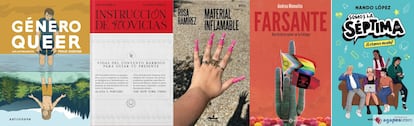
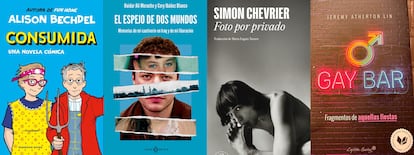
Photo by private by Simon Chevrier (Random House)
This novel begins as an autofiction story about the time in which Chevrier had to prostitute herself to survive. That narrative has become Chevrier’s literary debut and with which he has won the prestigious Goncourt Prize in that category. In the novel, the protagonist survives in precarious conditions, away from his family, alternating dates on Grindr and selling his body to improve his economic situation. Suddenly, he discovers an iconic portrait of Peter Hujar, in black and white (the image on the book’s cover), which provokes a cathartic reaction in the protagonist. “When I signed up for this website a year ago, the ad space had a limit of one hundred characters. About me: Language student, tailor-made lover for cultured men, rates and photos by private message,” introduces the protagonist of this book, translated by María Enguix Tercero, and highly, highly recommended.
Consumed by Alison Bechdel (Reservoir Books)
This graphic novel is based on Bechdel’s research into how capitalism impacts her own life. The author of the excellent Fun Homethe iconic strip Some careful lesbians (which was published between 1983 and 2008) or, more recently, The secret of superhuman strength She draws again on her own experiences, now as a lesbian woman in middle age at the height of the reactionary international. This is a very entertaining volume, translated by Rocío de la Maya Retamar, which hides deep and important reflections.
The mirror of two worlds by Haidar Ali Moracho and Cory Ibáñez Blanco (KO Books)
This book hides many stories. On the one hand, that of Ali Moracho’s transition. On the other hand, when he was eight years old he was kidnapped by his father and taken to Iraq. Divided into two parts, first the child abduction and then the experience as a trans boy, this essay covers Ali Moracho’s life path with very different tones: the initial part from the point of view of a minor while later it changes to the experience of a young adult. A very interesting work, full of edges, but also affection and acceptance. The illustrations that accompany each chapter are by Cory Ibáñez Blanco, the writer’s partner and also trans. (On June 16 at 7:00 p.m., the authors present the book at the Balqís bookstore in Madrid).
gay bar by Jeremy Atherton Lin (Captain Swing)
The rise of social (and sexual) networks has been accompanied by a certain decline in physical spaces and the possibility of real interaction, which has been subsumed by virtual encounters. Atherton Lin takes this premise to a specific space: gay bars, spaces that emerged as a refuge, a recreational, sexual, but also cultural meeting place. In this essay, translated by María Porras, the author takes you on a journey that takes you to the end of the 18th century, to San Francisco in the late eighties or to current queer spaces to analyze the impact of these establishments and what the siege they suffer implies.
The flame by Nino Bulling (Editorial Finestres)
This graphic novel tells the story of Ingken, who lives in Berlin and is in a polyamorous relationship with Lily, a trans woman. You can’t be more contemporary. Ingken uses drugs as an escape from a discomfort that afflicts him and he cannot identify its origin, which is why he decides to reduce his consumption to seek a little clarity. It is Bulling’s first work, published in 2024, and which has been translated into Catalan by Núria Molines Galarza.
In the Queerletter, Pablo León collects LGTBIQ+ stories like this every Tuesday. If you also want to be part of the community, sign up here.