
On April 15, 1915, hours before Pastora Imperio premiered witchy love at the Lara Theater, the diary The Homeland published a conversation between Rafael Benedito and Manuel de Falla. In a cafe, while the same page collected radiograms from the Verdun front, the composer reviewed his literary vocation, Pedrell’s teaching, Tragó’s classes and his gratitude towards “that magnanimous spirit called Albéniz.” He also left a credo: “I never thought of being a virtuoso. Virtuosity has always caused me true horror.” The talk ended suddenly: Falla I had to “finalize a number” of the score that was going up on stage that night.
In the year in which the Granada Festival commemorates the 150th anniversary of the birth of Falla, that creed resonated again last night in the Patio de los Arrayanes of the Alhambra. Javier Perianes He put his piano music in front of the two mirrors that the interview pointed out: Chopin, received almost directly through Tragó, a student in Paris of a disciple of the Polish composer, and the magnanimous Albéniz of Iberia. When everything seemed to have been said, the last of the three tips returned the echo of that Madrid afternoon in 1915: the piano arrangement of the Ritual fire danceof witchy loveperhaps the number that Falla rushed to finish when saying goodbye to Benedito. It was not virtuosity. It was almost an exorcism.
The metamorphosis began shortly before midnight, at thirteen minutes into the night. Baetic fantasy. At twelve, as in the stories, the poet of the nocturnes heard until then turned Falla’s most arduous and brilliant work into a ritual, which Arthur Rubinsteinits recipient, barely understood and soon removed it from its repertoire. Perianes mastered his dissonances and outbursts, that stylization of flamenco whose title, Falla specified, lacked “especially Sevillian” meaning, and he responded with irony: he linked as a second tip a brilliant Sevilla of Albeniz. The third encore arrived at dawn, when the tips took up a third of the recital and the clock seemed to follow the plot of the final version of witchy lovejust after At midnight: the spells.
The recital had begun with the first of those mirror games: Falla-Chopin. As Luis Gago remembers in his notes to the program, night of poetsthe man from Cádiz considered the Pole the purest representation of Romanticism. Perianes linked the Night and the Mazurka in minor of the twenty-something Falla with exquisite Chopinian models. The most revealing crossing joined the Andalusian serenadewhose singable passages marked “with abandon” he highlighted with special delicacy, and the melancholic Waltz in A minor, op. 34 no. 2converted into that dance for souls, more than for bodies, that Schumann imagined.
The first part flowed like the water of the pool surrounded by myrtles, on which some bats danced. It ended with the Song of Failure, whose start of gymnopedia Satie style soon acquires its own flight, and an exquisite Berceuse, op. 57 by Chopin. But the second set of mirrors, Falla-Albéniz, reached greater heights. In the Four Spanish piecesPerianes displayed a sense of color, danceable naturalness and a stolen subtle. The work contributed to opening the doors of Paris to Falla, where Albéniz gave the “thin young man” a dedicated copy of the third notebook of Iberia.
From that third notebook, Perianes touched The Poleto which he added Evocationof the first, and Almeria y Trianaof the second. The selection revealed an unequivocally personal reading of Iberiacloser to the subjective colorism of Esteban Sánchez than to the rhythmic grip and canonical pulse of Alicia de Larrocha. Almeria It was one of the highlights of the night, due to its precise balance between expressive voluptuousness and dreamlike grace. In that second set of mirrors, Albéniz ended up also reflecting Perianes.
But the Granada Festival had brought other spells. On Sunday the 5th, the National Youth Orchestra of Spain faced a marathon concert with an attractive program on paper: the Fausto by Goethe converted into a symphony by Liszt and a soundtrack by Mascagni, each work with a different director. The Faust Symphonyin its version with tenor and chorus, did not find in Donato Renzetti the right baton. The veteran specialist in Italian opera performed successfully, but did not breathe life into the network of thematic transformations with which Liszt portrays Faust, Margaret and Mephistopheles. The young Spanish formation exhibited, however, outstanding quality in all its sections, especially in the rope, led by the concertmaster Almudena Quintanilla. Not even the Chorus mystic final, with the tenor Alejandro del Ángel and the male choir of the City of Granada Orchestra, he managed to overcome the work.
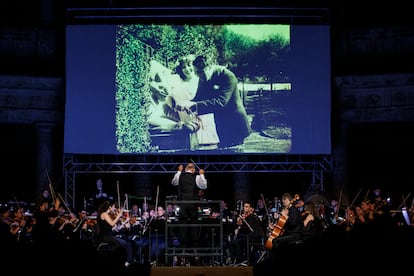
The second part completely changed the tone of the evening. Timothy Brock directed the screening of satanic rhapsody (1915, released 1917), silent film by Nino Oxilia with music by Pietro Mascagni and starring Lyda Borelli, great diva of the moment. The author of Rustic cavalry He allowed himself to be attracted by a cinema that was beginning to displace opera as a mass spectacle. In 1918 he lamented in a letter about “how low I have fallen” by directing two daily passes for a considerable sum. But Brock’s reconstruction showed that nothing that happens on the screen escapes Mascagni’s ear. La JONDE admirably translated its exact fit between music, image and dramatic tempo.
The film turns the myth of Faust into a feminine parable. An elderly countess makes a pact with Mephistopheles to regain her youth in exchange for renouncing love, but she causes a tragedy between two brothers in love with her and ends up breaking the promise. Mascagni follows every fold of the action with writing of surprising refinement: he assigns the same theme to both suitors, straight for one and inverted for the other, and turns the mirror games in the bedroom into sound.
Nods to Wagner and Chopin also abound. One of the brothers is called Tristano, in reference to Tristan and Isoldeand the countess plays the piano Ballad no. 1 by the Polish composer, in one of the first examples of diegetic film music. Where Liszt had remained inert, Mascagni found life in every frame.
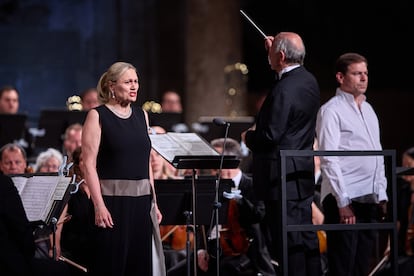
On Saturday the 4th, the spell took place around midnight in the Palace of Charles V, with the final scene of La Valquiria. The visit of the Budapest Festival Orchestra con Ivan Fischer It has been one of the great symphonic successes of this 75th edition, although the evening began below expectations. The Symphony no. 3, Rhinelandby Schumann, started without the necessary metric liveliness, but grew on the solidity of a very compact orchestra, with the double basses aligned in the background as in the composer’s time. The turn came in the solemn fourth movement, inspired by the Cologne Cathedral: the trombone chorale acquired an almost liturgical rotundity and Fischer recreated himself in archaizing polyphony. From that gravity he lifted a finale optimistic, bustling and flexible, with the return of the cathedral theme in major mode.
The great success came in the second part, with the diaphanous and almost chamber-like Wagner that Fischer imposed in the final scene of La Valquiriafirst day of The Ring of the Nibelungwhose full premiere in Bayreuth turns 150 this summer. The Budapest Festival Orchestra wove with exquisite timbre Wotan’s farewell to Brünnhilde, stripped of her divinity with a kiss and then plunged into a dream surrounded by fire. That refinement covered the soprano Anja Kampethe great winner of the night, which confirmed its status as a current reference in the role: homogeneous line and phrasing that turned filial supplication into dignity, not submission. The bass-baritone Hanno Müller-Brachmann He was, on the other hand, a solvent but vocally inadequate Wotan, forced to widen and force his voice in volume and range during the famous goodbye monologue.
Thus, on three consecutive nights and always at ten, the spells of the big week of the festival were chained: the fire that guards the dream of a Valkyrie, the pact that buys youth at the price of love and the spell that frees a gypsy from her specter. In the central evening, the choir had sung the verse that closes the Fausto from Goethe: Everything that is transitory is just a parable (everything ephemeral is nothing more than a symbol). It is difficult to find a better motto for festival music, an art that dissolves in a summer night and endures as an emblem. Falla, who never wanted to be virtuous, would have subscribed to it: music, before a prowess, is a spell.